All species › Caryophyllales › Sundew family › Drosera bulbigena
Drosera bulbigena
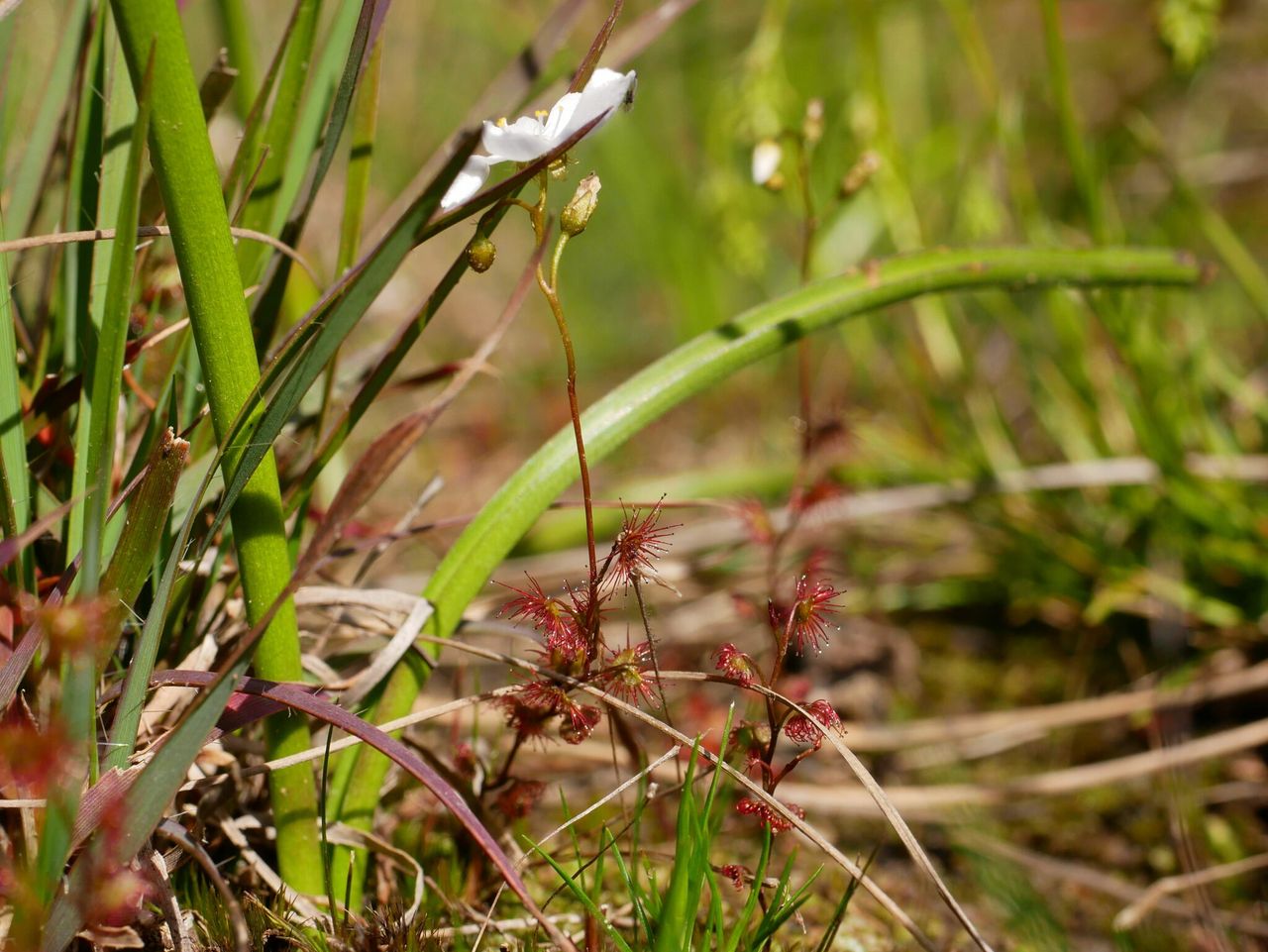
In English it is called the midget sundew, and at 3 to 6 cm tall Drosera bulbigena is indeed one of the smallest erect tuberous sundews. Alexander Morrison described it in 1903. The name means 'producing tubers': the plant forms new small tubers on runners and so grows into small colonies at the edges of the swamps of the coastal plain near Perth.
Identification
A perennial tuberous plant with an erect, glabrous stem 3 to 6 cm tall that changes direction at every leaf node and so gently zigzags. The most striking feature is the leaf posture: the petioles bend downwards where the blade attaches, so the crescent-shaped blades, notched in their upper edge, point towards the ground. That is unique among its close relatives. The flowers are white; the sepals are glabrous with fringed margins. Flowering runs from August to October.
Similar species
The closest relative is Drosera radicans, which occurs north of Geraldton, grows about twice as large and lacks downward-pointing leaves. From the many other small tuberous sundews of the coastal plain, such as forms related to Drosera stolonifera or Drosera pallida, it is told by the combination of its low height, zigzag stem and downturned blades.
The trap and how it works
An active flypaper trap. The crescent-shaped blades bear stalked glands with sticky droplets along the margin. Because they point downwards, they catch mainly small animals moving through the moss and over the ground. After capture the tentacles bend around the prey and digestive enzymes are secreted.
Habitat and ecology
Sandy and clayey soils in low-lying, winter-wet ground and swamps (FloraBase), often in seasonally wet moss at swamp margins (W4, W7). The plant shoots with the first winter rains; at the end of spring the above-ground part dies back and the plant rests as a tuber in the dried-out soil.
Distribution and elevation
Endemic to the south-west of Western Australia, on the Swan Coastal Plain: around Perth and south along the coast, roughly to the Busselton district. The coastal plain around Perth is one of the most heavily urbanised parts of the south-west.
- Recorded (one-degree cells)
Forms and variation
No subspecies or varieties have been described. Besides seed, the species reproduces vegetatively through small tubers on underground runners, so plants at a single site are often genetically identical and stand in dense clusters.
Where and when to see it
September is a good month: the plants are in flower and the swamp margins still wet. Search the transition from wet to drier ground, in moss among rushes and low shrubs. The plants are so small that they are easily trampled; look before each step and keep to paths in reserves.
Conservation status
The IUCN code in this guide is Vulnerable (VU); in Western Australia the species is listed as Priority Two, for species known from few sites. Not in CITES. The main threats are urbanisation of the coastal plain, drainage and falling groundwater, weeds and too-frequent fires in the small remaining bushland areas.
Scientific name
Drosera bulbigena | Morren, 1903
Described by Alexander Morrison in 1903, in Transactions and Proceedings of the Botanical Society of Edinburgh, volume 22, no. 4, p. 417-418. The precise type locality could not be established. The species occurs near Perth and south along the coast, Western Australia. From the Latin bulbus ("bulb, tuber") and -gena ("born/produced from") — "bulb-producing", consistent with the plant's tuberous growth habit.
World Checklist of Vascular Plants (WCVP), via Plants of the World Online (POWO), Royal Botanic Gardens, Kew.