All species › Caryophyllales › Sundew family › Drosera broomensis
Drosera broomensis
A 'woolly sundew' of the tropical coast. Drosera broomensis belongs to the petiolaris group, the sundews of the monsoon belt of northern Australia, and is named after the region around Broome on the north-west coast. The species was described only in 1996 by Allen Lowrie, although herbarium specimens had existed since 1891. It has nothing to do with the south-west: the label in the base list is incorrect.
Identification
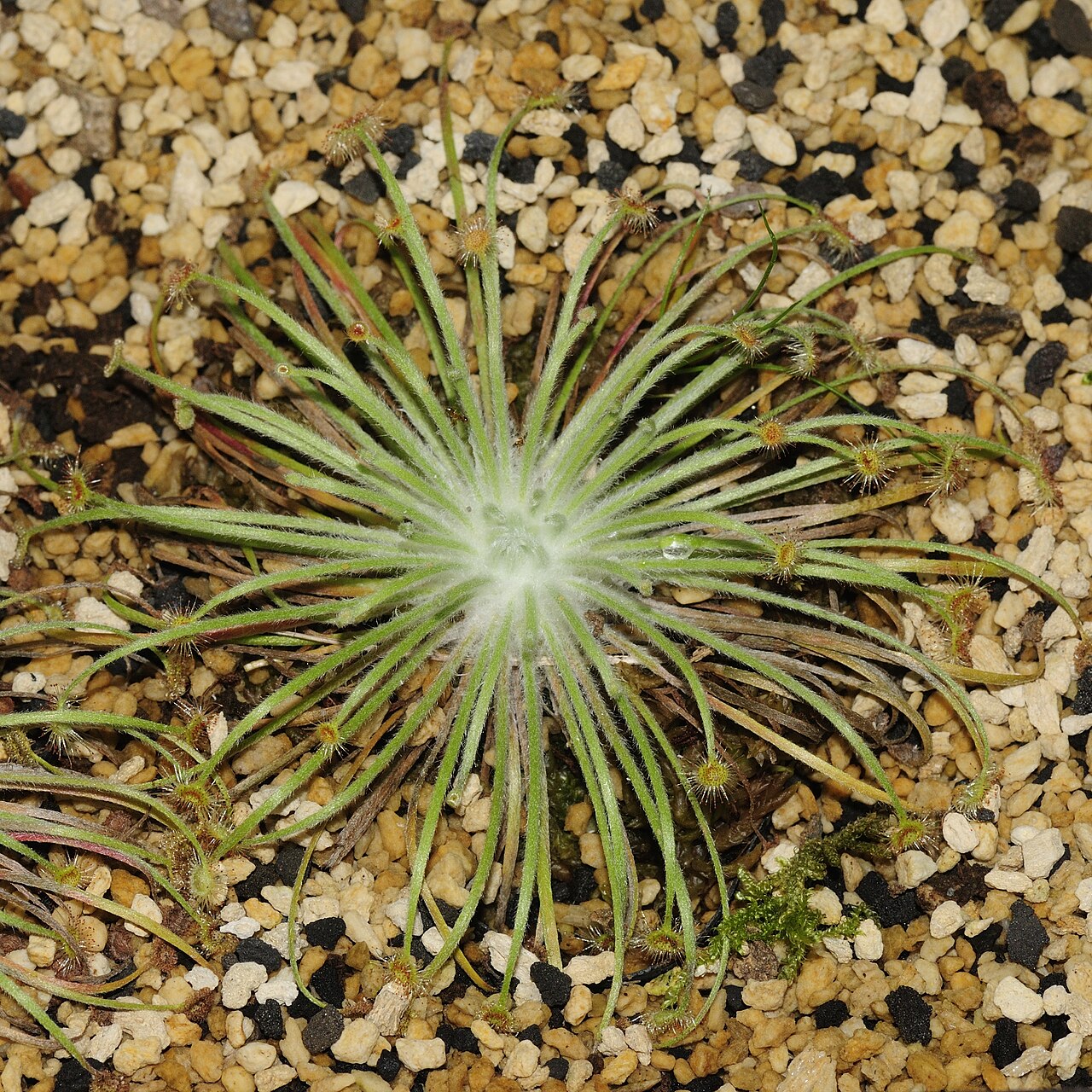
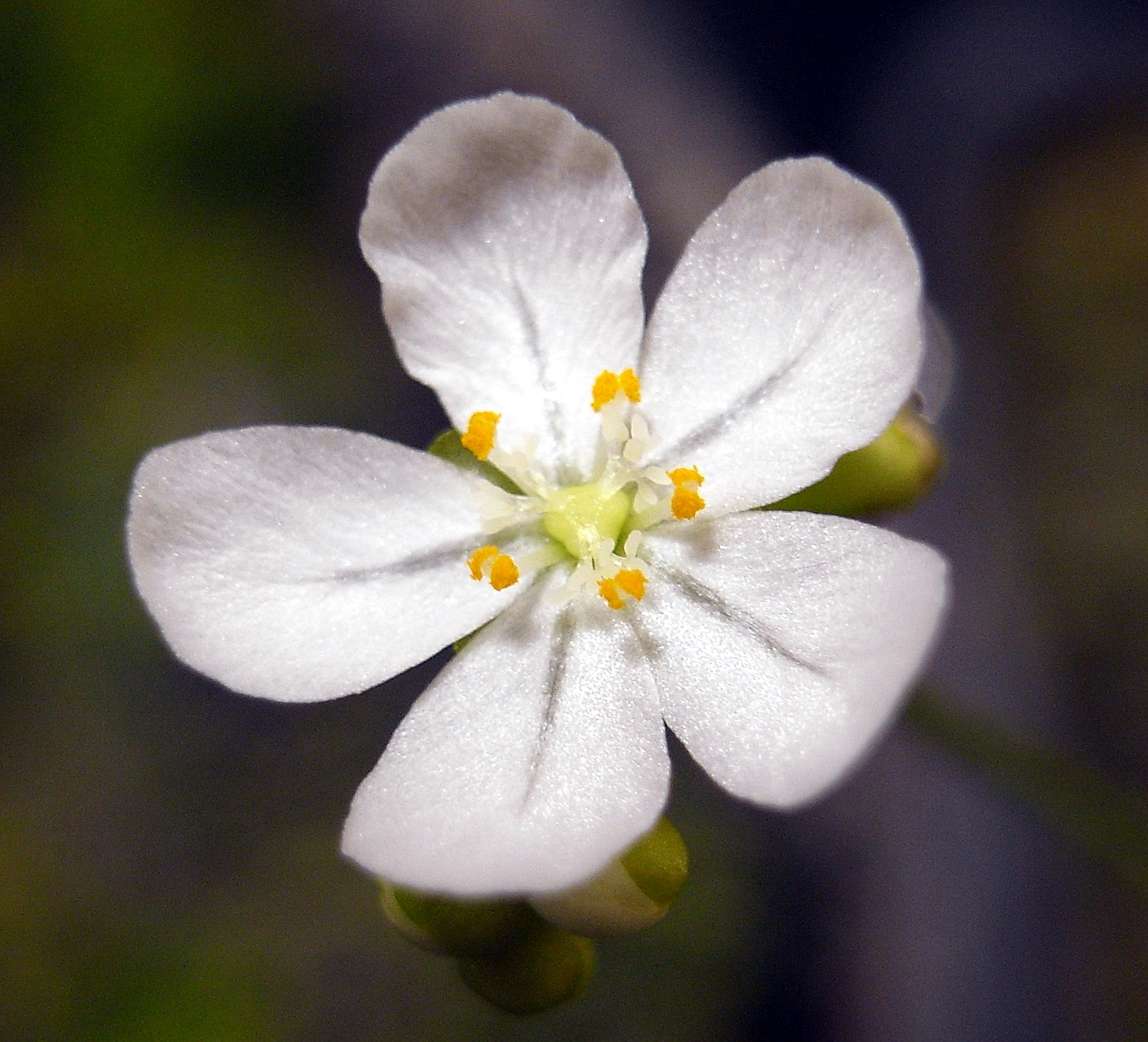
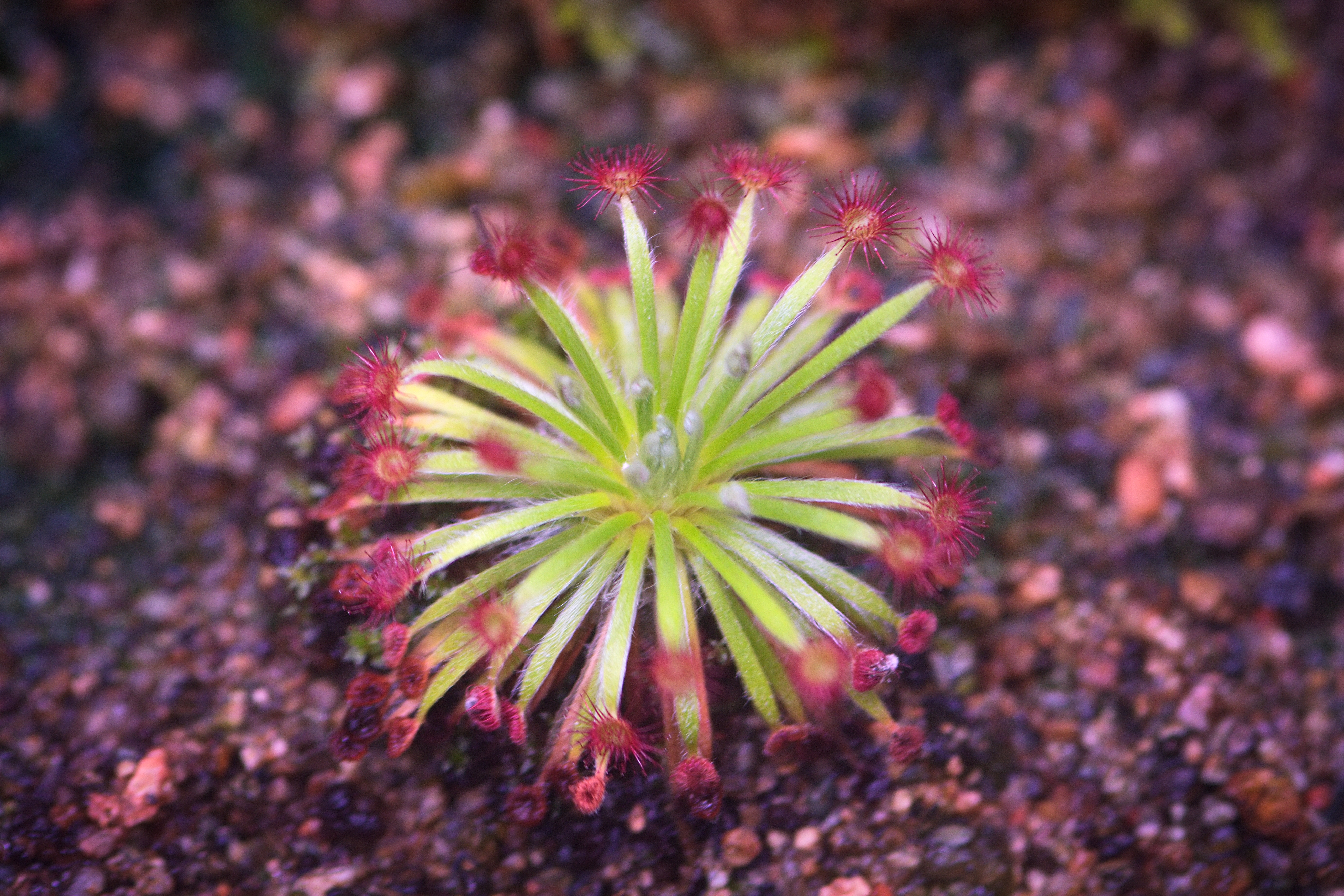
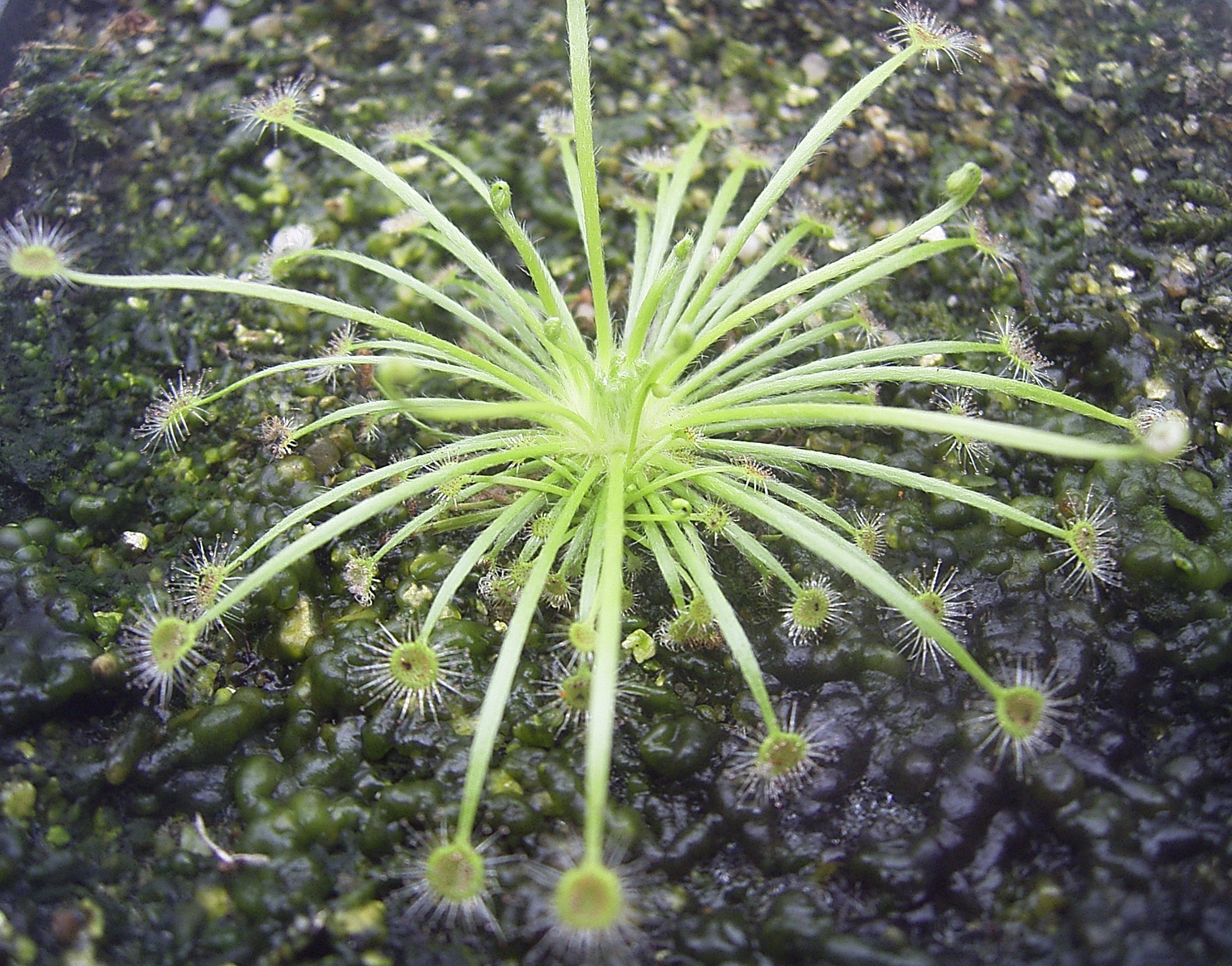
A small perennial sundew with a low, leafy rosette from which one to four flowering stems arise. The whole plant can reach 30 cm. The key feature is the completely glabrous inflorescence, scape included; in most relatives of the petiolaris group stem and calyx are hairy. The flowers are white and appear in February and March, late in the wet season. As throughout the group, the leaf consists of a narrow petiole ending in a small, round blade bearing tentacles.
Similar species
The closest relative is Drosera petiolaris, the most widespread species of the group, ranging from northern Australia to New Guinea. Other species of the same subgenus in the Kimberley include D. derbyensis, D. caduca and D. brevicornis, which Lowrie described in the same paper. The glabrous flowering stem is the most practical distinction; in the other species stem or sepals are covered in white hairs.
The trap and how it works
An active flypaper trap. The round blades at the ends of the petioles bear stalked glands with sticky droplets. An insect settling on one sticks, the tentacles bend towards the prey and the glands secrete digestive enzymes. In the petiolaris group the blades are small relative to the long petioles, so the traps project like little spoons around the heart of the rosette.
Habitat and ecology
Sandy soils (FloraBase), north and north-east of Broome, in the open savanna landscape of the Dampierland coast (D1, B6). The climate is monsoonal: a hot, very wet season from December to March and a long dry season. Species of this group usually survive the drought with thickened roots and a resting rosette, or protected by white hairs on the petioles that keep the plant cool and limit water loss.
Distribution and elevation
Endemic to the north of Western Australia. FloraBase lists the Dampierland and Great Sandy Desert bioregions; the species grows in the coastal area north and north-east of Broome.
- Recorded (one-degree cells)
Forms and variation
No subspecies or varieties have been described. The species belongs to subgenus Lasiocephala, which numbers some fourteen species, mostly in northern Australia. Natural hybrids occur within the group, but none involving D. broomensis is mentioned in the sources consulted.
Where and when to see it
Flowering falls in February and March, in the middle of the rainy season, when roads around Broome are sometimes flooded. Afterwards, at the start of the dry season, the rosettes can still be found. Search open, sandy patches among the grass. The glabrous flowering stem is visible to the naked eye when compared with a hairy relative; bring a hand lens for the leaf hairs.
Conservation status
Assessed as Least Concern (LC) on the IUCN Red List and listed as not threatened in Western Australia. Not in CITES. The coastal zone around Broome is under pressure from urban expansion and infrastructure, but most of the habitat lies in little-developed country.
Scientific name
Drosera broomensis | Lowrie, 1996
Described by Allen Lowrie in 1996, in Nuytsia, volume 11, no. 1, p. 55-69 — the same publication as D. brevicornis. Earlier specimens had already been collected from 1891 onward, but the species was only formally described in 1996. Sandy soils north and north-east of Broome, Kimberley region, Western Australia. Named after the town of Broome, Western Australia, where the species grows.
World Checklist of Vascular Plants (WCVP), via Plants of the World Online (POWO), Royal Botanic Gardens, Kew.