All species › Even-toed ungulates › Bovids › Slender-horned gazelle
Slender-horned gazelle | Gazella leptoceros
Duingazelle | Gacela de Astas Delgadas
The slender-horned gazelle (Gazella leptoceros) is the palest gazelle and lives in the sand seas of the central and northern Sahara. The species is confirmed in Algeria, Tunisia, Libya and Egypt, and thus within the guide area, but lives there in scattered areas that are difficult to reach. The IUCN estimates the number of mature animals at 300 to 600.
No photograph of a living wild animal of this species with a suitable Creative Commons licence exists. Do you have one that meets the rules? Send it in.
Tracks
The slot is broader than that of the Dorcas gazelle because of the broadened hooves, and easy to recognise in sand. In the morning the tracks of the night can be seen in the dunes, because the animals move mainly at night and at dusk. Males hold loose territories, which they defend actively.
Identification
A medium-sized gazelle of 100 to 110 cm head-body length, 65 to 72 cm shoulder height and 20 to 30 kg, with a tail of 15 to 20 cm. The coat is cream to yellowish white, the underparts pure white, with a faint flank stripe. The face carries a reddish stripe on the nose and stripes from the eyes to the nose. The ears are narrow. The hooves are broadened, which makes walking on sand easier. The male carries long, thin, slightly S-shaped horns of 30 to 41 cm; those of the female are thinner and straighter, 20 to 38 cm.
Similar species
The Dorcas gazelle is sandy to reddish beige with a clear reddish-brown flank stripe, has larger ears and shorter, lyre-shaped horns curving upwards at the tip, and lives mainly on gravel and rocky plains and in wadis rather than in dune areas. Cuvier's gazelle is much darker and lives in the mountains. In the field the very pale colour, the long straight horns and the dune habitat are the characters.
Habitat
Sand dunes and the hollows between them in the great ergs, such as the Grand Erg Oriental and the Grand Erg Occidental, and other sandy areas, sometimes also rocky terrain. The animals are nomadic and follow no fixed migration routes.
Where the animal is most at home, classified with EUNIS — the European standard for habitats.
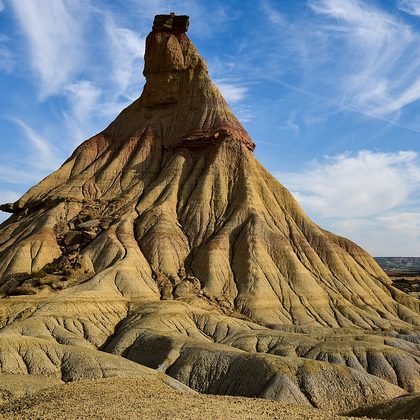
Distribution
Scattered areas in the central and northern Sahara. Confirmed in Algeria, Tunisia, Libya and Egypt; records from Chad, Mali, Niger and Sudan are uncertain. Most recent records in the guide area come from Algeria.
Way of life
The slender-horned gazelle is active mainly at night and at dusk; because of the heat it forages only in the early morning and evening. It obtains water from dew and plant sap and hardly drinks. The reflective white coat, cooling of the blood in the nasal passages and a body temperature that can vary with the seasons help it tolerate the heat. Groups number 2 to 20 animals; food consists of grasses and leaves. After a gestation of 156 to 169 days a single young is born, which is weaned after about three months. Females are sexually mature at 6 to 9 months, males at 18 months.
Where and when to look
The slender-horned gazelle is rarely seen in the wild. A visit to the ergs of Algeria and Tunisia requires an organised trip with a guide and an off-road vehicle. At sunrise search for fresh tracks in the dunes and for animals in the hollows between the dunes. The species is strictly protected; approaching in vehicles disturbs the animals.
Conservation status
Endangered (EN, 2016), with 300 to 600 mature animals in the wild. The slender-horned gazelle was hunted for sport, meat and horns; current threats are poaching, disturbance and habitat loss.
Scientific name
Gazella leptoceros | (F. Cuvier in É. Geoffroy Saint-Hilaire & F. Cuvier, 1842)
F. Cuvier in É. Geoffroy Saint-Hilaire & F. Cuvier described the species in 1842 as Antilope leptoceros; because it was later moved to another genus, the author and year stand in brackets. Gazella goes back through French and Spanish to Arabic ghazāl, 'gazelle'. leptoceros is Greek for 'slender-horned', from leptos, 'thin, slender', and keras, 'horn', after the long, nearly straight and strikingly narrow horns. The specimen the first description was based on came from Sudan, Sennar.