All species › Rodents › Voles and hamsters › Savi's Pine Vole
Savi's Pine Vole | Microtus savii
Savi's woelmuis | Topillo De Savi
Savi's Pine Vole is an underground-living vole of the Italian peninsula and one of the commonest mammals of Italian farmland. In fruit growing the species is regarded as a significant pest. It is named after Paolo Savi, the naturalist from Pisa from whose neighbourhood the type came. Because the animal lives almost entirely underground, it is rarely seen.
Tracks
Tunnels and spoil heaps are easier to find than the animal itself. The species digs straight tunnels 10 to 50 cm deep with several exits and pushes the soil to the surface, where it lies in small, loose heaps of fine earth: much smaller and flatter than a molehill, which is tall, conical and made of clods, and without the lateral tunnel opening of a water vole's heap. The holes are round, two to three centimetres across, worn smooth, set in small groups and often plugged with soil. Nearly all feeding takes place within ten centimetres of an exit: around the holes stems are bitten off to an even length, and small piles of cut greenery lie in the grass. In orchards and vineyards damage is the clearest sign: peeled and bitten-through roots of young fruit trees, causing a tree to lean or die in spring, and in kitchen gardens hollowed tubers, bulbs and beets. The droppings are four to six millimetres long, cylindrical with blunt ends, greenish black when fresh, and lie in small latrines in the tunnel or close to an exit. Barn and Tawny Owl pellets from the Po plain contain many remains of this species; the flat cheek teeth folded into zigzag prisms are vole teeth, and which pine vole is involved can only be established from the shape of the first lower molar under a lens.
Identification
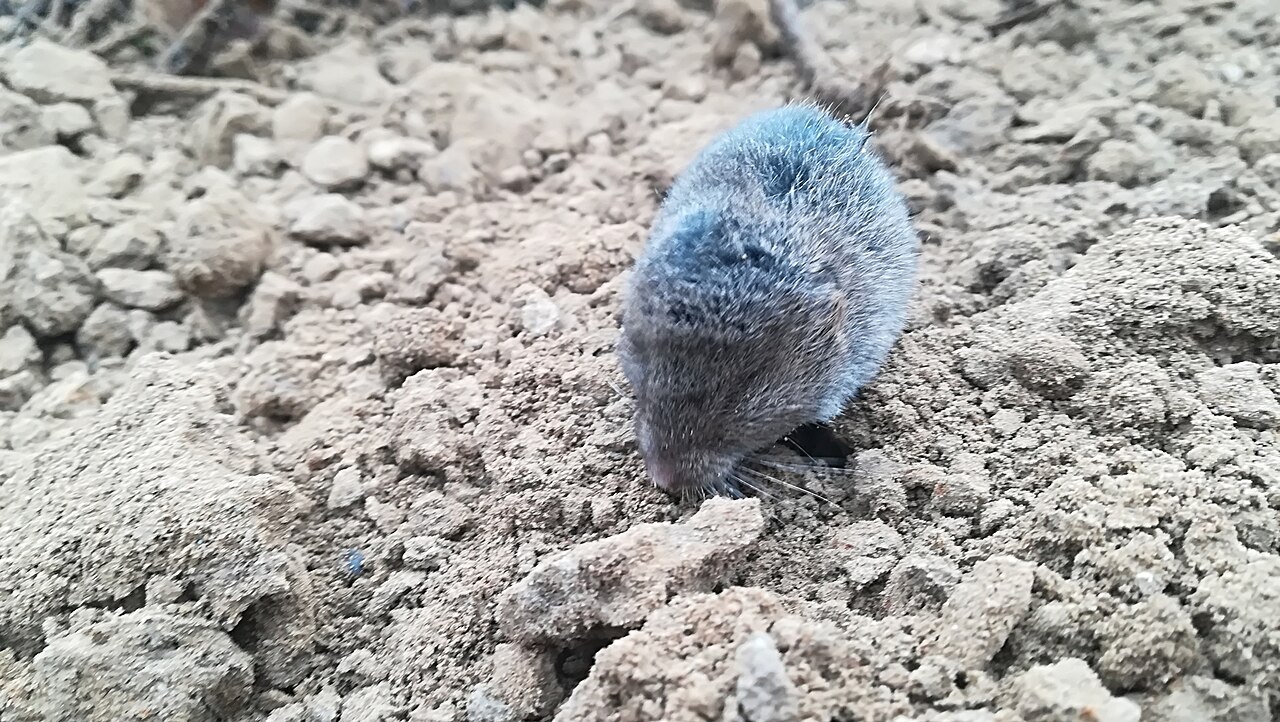
A small, thickset vole with the build of a burrower: rounded head, short muzzle, short rounded ears largely hidden in the fur and a short tail of 2.4 to 3 cm, roughly a quarter of head-body length. The eyes are small, but less reduced than in the other pine voles. The fur is short, dense and soft, grey-brown to ochre above and ash-grey below, with no sharp division on the flank; summer fur is thinner and yellower than winter fur. Females have four nipples in two inguinal pairs. Males and females are the same size. Adaptations to digging are the broad forefeet, the strong claws and a coat that lies in any direction, as in the mole.
Similar species
Externally the species cannot be distinguished from the other pine voles; locality is decisive. In the far south of the peninsula, roughly from Campania and Basilicata onward, the Calabria Pine Vole (Microtus brachycercus) occurs, and on Sicily the Sicilian Pine Vole (M. nebrodensis); both were split from Savi's Pine Vole on dental and chromosomal characters and cannot be recognised in the field. In the western Alps and their foothills lives the Alpine Pine Vole (M. multiplex), with a distinctly longer tail, and in the south-eastern Alps the Common Pine Vole and Liechtenstein's Pine Vole. On the Iberian Peninsula the Mediterranean Pine Vole and the Lusitanian Pine Vole are the underground voles, with the same identification problems. What can be determined in the field is the difference from the surface-living voles: Common Vole and Field Vole have larger eyes, plainly visible ears and a longer tail and use runways in the grass rather than tunnels, while the Bank Vole has a chestnut back, bulging eyes and a tail half the body length. A vole with very small eyes disappearing into a hole in a field in central or northern Italy can be assigned to this species on locality.
Habitat
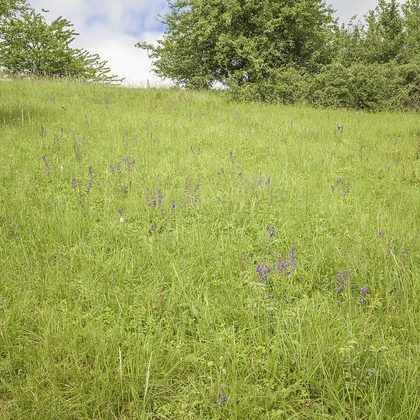
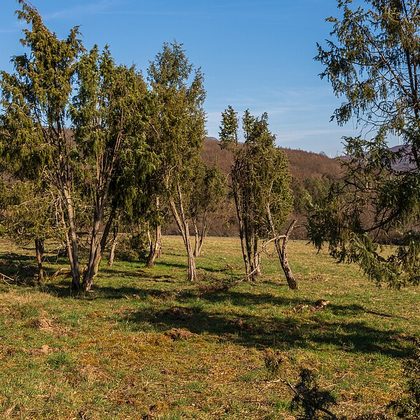
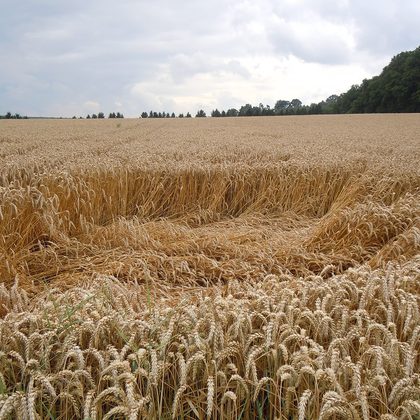
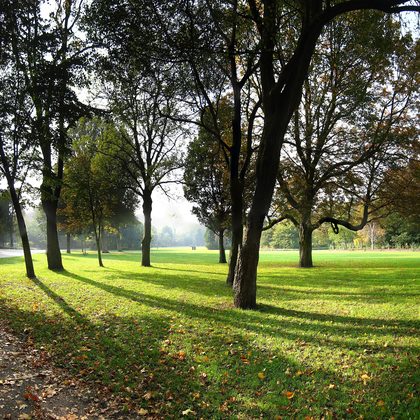
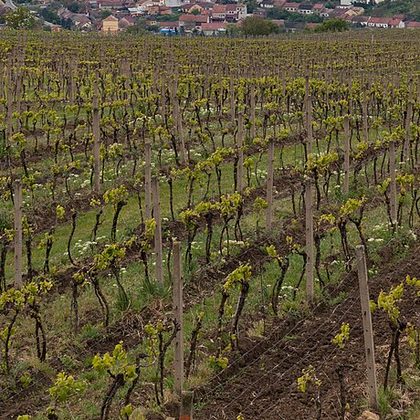
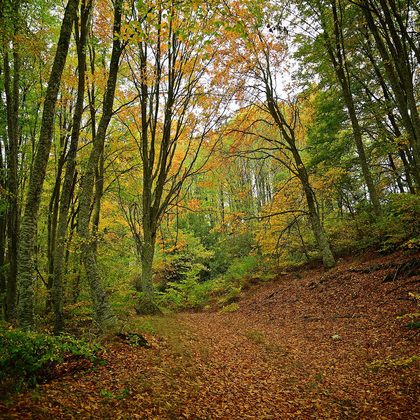
Farmland with diggable soil: pastures, hay meadows, arable fields, kitchen gardens, orchards, vineyards, verges, banks and gardens, and also woodland of various types with a closed herb layer. The species requires deep, moist, free-draining soil under dense cover; stony and markedly dry ground is avoided. It occurs from sea level to about 2,800 m and lives almost entirely below the turf.
Where the animal is most at home, classified with EUNIS — the European standard for habitats.
Distribution
The Italian peninsula from the Po plain southward, with an outlier in Switzerland in Ticino and the eastern part of Valais, and a narrow strip on the French Mediterranean coast. In the far south and on Sicily the species is replaced by the Calabria and Sicilian Pine Voles; it is absent from Sardinia and Corsica. It is also absent from the Iberian Peninsula, where the Mediterranean and Lusitanian Pine Voles occur without contact with its range, from the Low Countries, where only the Common Pine Vole occurs in South Limburg, and from the British Isles, where no pine vole occurs.
- Native
- dark = core range, pale = thinly spread
Way of life
The activity rhythm is polyphasic: short bouts of feeding and digging alternating with short rests, round the clock, and it barely changes with the seasons; in total the animal is active about a third of the time. In winter it has been established in Italian arable land that the species comes above ground mainly by day, and that the few nocturnal excursions fall on dark nights; in bright moonlight it stays underground, when owls and foxes hunt most successfully. It is strictly herbivorous, eating mainly grasses, legumes, composites and goosefoots, supplemented with roots and, in winter, bark. Breeding runs from March to November, peaking in spring and summer; after 22 to 24 days' gestation an average of 2.5 young are born, and a female is fertile herself at about fifty days. The home range measures about 445 square metres for a male and 298 for a female. A burrow system is shared by a group of one to three females with several males and their young, and that area is defended against neighbours. The species does not hibernate and remains active under snow and in frost.
Where and when to look
Look for the tunnel system, not the animal. In February and March, when the fields of the Po plain and Tuscany are bare, the heaps of fresh soil and the plugged holes are clearly visible on the smooth ground; lift a tussock and follow the worn runway to the opening. In an old orchard a young tree that leans or wilts without visible cause usually indicates gnawed roots. Because the species comes above ground by day, you can sit still for half an hour by a group of holes on a winter morning: the animal emerges briefly, cuts some greenery within a hand's breadth of the opening and disappears again.
Conservation status
Least Concern (2016). Across much of Italy the species is common in the farmed landscape, with densities ranging from fewer than fifty animals per hectare in summer to more than a hundred in spring. Attention therefore focuses on damage: in orchards, vineyards and arable fields it is controlled, formerly with poison and now increasingly by arranging the landscape so that owls, weasels and foxes limit the numbers, with perches along the plots, wide margins and less clearance. The species contributes to soil aeration and is a main prey of nearly all predators in the Italian countryside.
Scientific name
Microtus savii | (de Sélys-Longchamps, 1838)
De Sélys-Longchamps described the species in 1838 as Arvicola Savii; because it was later moved to another genus, the author and year stand in brackets. Microtus is Greek, from mikros, 'small', and ous, genitive ōtos, 'ear', after the small ears hidden in the fur. savii honours the Italian naturalist Paolo Savi (1798–1871), professor at Pisa, who had himself already noticed the species. The specimen the first description was based on came from Italy, Pisa.