All species › Even-toed ungulates › Deer › Persian fallow deer
Persian fallow deer | Dama mesopotamica
Dama mesopotamica | Dama mesopotamica
The Persian fallow deer (Dama mesopotamica) is the larger of the two fallow deer species and lives in south-western Iran and, after reintroduction since 1996, in northern Israel. In 2015 there were more than 1100 animals, about 300 of them free-living in Israel. In the guide area the species occurs in the wild only in Israel.
No photograph of a living wild animal of this species with a suitable Creative Commons licence exists. Do you have one that meets the rules? Send it in.
Tracks
The slot is cloven and larger than that of the fallow deer. As in other deer, there are fraying stocks on young trees and shrubs where the buck cleans the velvet from its antlers, and browsing signs on twigs with a ragged end. The animals avoid roads, even with little traffic.
Identification
A large fallow deer with a shoulder height of 80 to 110 cm and a weight of 70 to 140 kg, clearly heavier than the fallow deer (Dama dama). Head-body length and tail length have not been found in a reliable source. The coat is reddish brown with white spots. Only the buck carries palmate antlers, with a narrower palm than in the fallow deer. The tail is darker than in the fallow deer, and the upper end of the nasal bones is wider.
Similar species
The fallow deer (Dama dama) is smaller, the buck has broader palmate antlers, and the tail is paler; in the wild the two species do not occur together, and in Israel only the Persian fallow deer lives free. The mountain gazelle lives in the same hill country in Galilee, but is much smaller, unspotted and has horns in both sexes.
Habitat
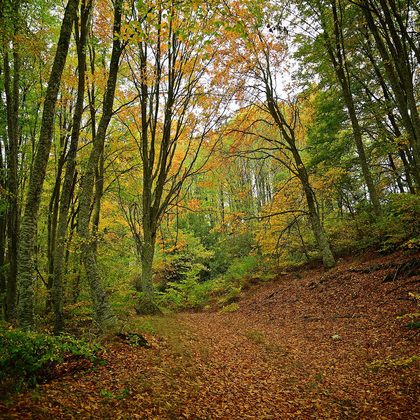
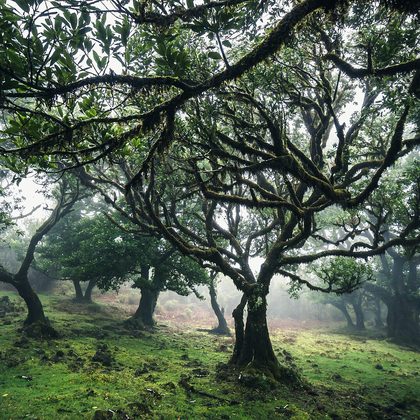
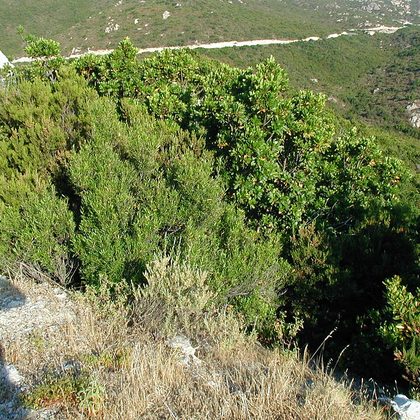
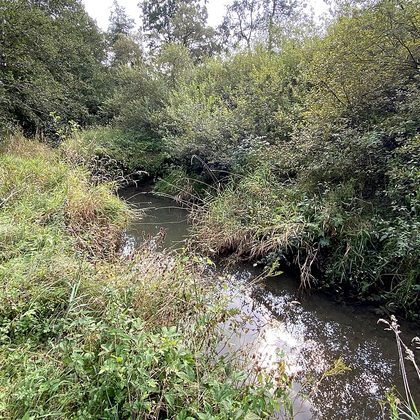
Woodland and open woodland of tamarisk, oak and pistachio, in Iran mainly the riverine forests along the Dez and Karkheh rivers; in Israel oak woodland and Mediterranean scrub in the hills of Galilee and Mount Carmel. Grass makes up about 60 per cent of the diet; clearings and grassland within woodland are therefore important.
Where the animal is most at home, classified with EUNIS — the European standard for habitats.
Distribution
Originally a large area from Mesopotamia and western Iran to the Levant and possibly Anatolia; about 10 per cent of the former range remains. In Iran 371 animals lived at 14 sites in 2013, including Dasht-e Naz, along the Karkheh and the Dez, and on Ashk Island in Lake Urmia. In Israel animals have been released since 1996, first in the valley of Nahal Kziv in western Galilee and later on Mount Carmel, near Mount Sasa and in the Judean Hills; in 2015 about 300 lived free and about 270 in captivity.
- Native
- dark = core range, pale = thinly spread
Way of life
The Persian fallow deer is mainly crepuscular. About 60 per cent of its food is grass, supplemented with leaves and nuts. After release older hinds stay close to the release site, 0.9 km on average, whereas young hinds move 2.3 km away on average. Gestation lasts about 230 days. Hinds breed until about 15 years of age; the maximum lifespan is about 20 years.
Where and when to look
In Israel the species can be seen at the Hai-Bar Carmel breeding reserve and in the wild in western Galilee, around Nahal Kziv, early in the morning and in the evening at the edges of clearings in oak woodland. The animals are shy and keep away from roads; binoculars are needed.
Conservation status
Endangered (EN, 2015). The species had been almost exterminated, mainly by hunting. Its recovery rests on breeding programmes in Iran, Israel and European zoos. Threats are habitat loss, collisions with cars and trains, and competition with livestock. In Israel wolves have killed an increasing number of animals since the late 2010s.
Scientific name
Dama mesopotamica | (Brooke, 1875) (GBIF: Dama dama)
Brooke described the species in 1875 as Cervus (Dama) mesopotamicus; because it was later moved to another genus, the author and year stand in brackets. Dama is a Latin animal name, also written damma, used of a deer or an antelope; which animal the Romans meant, and where the word came from, is not settled. mesopotamica means 'of Mesopotamia', Greek Mesopotamia, 'land between the rivers', from mesos, 'middle', and potamos, 'river', after the Euphrates and the Tigris. The specimen the first description was based on came from Iran.