All species › Sengis › Sengis › North African Sengi
North African Sengi | Petrosaltator rozeti
Noord-Afrikaanse olifantspitsmuis | Asarfif
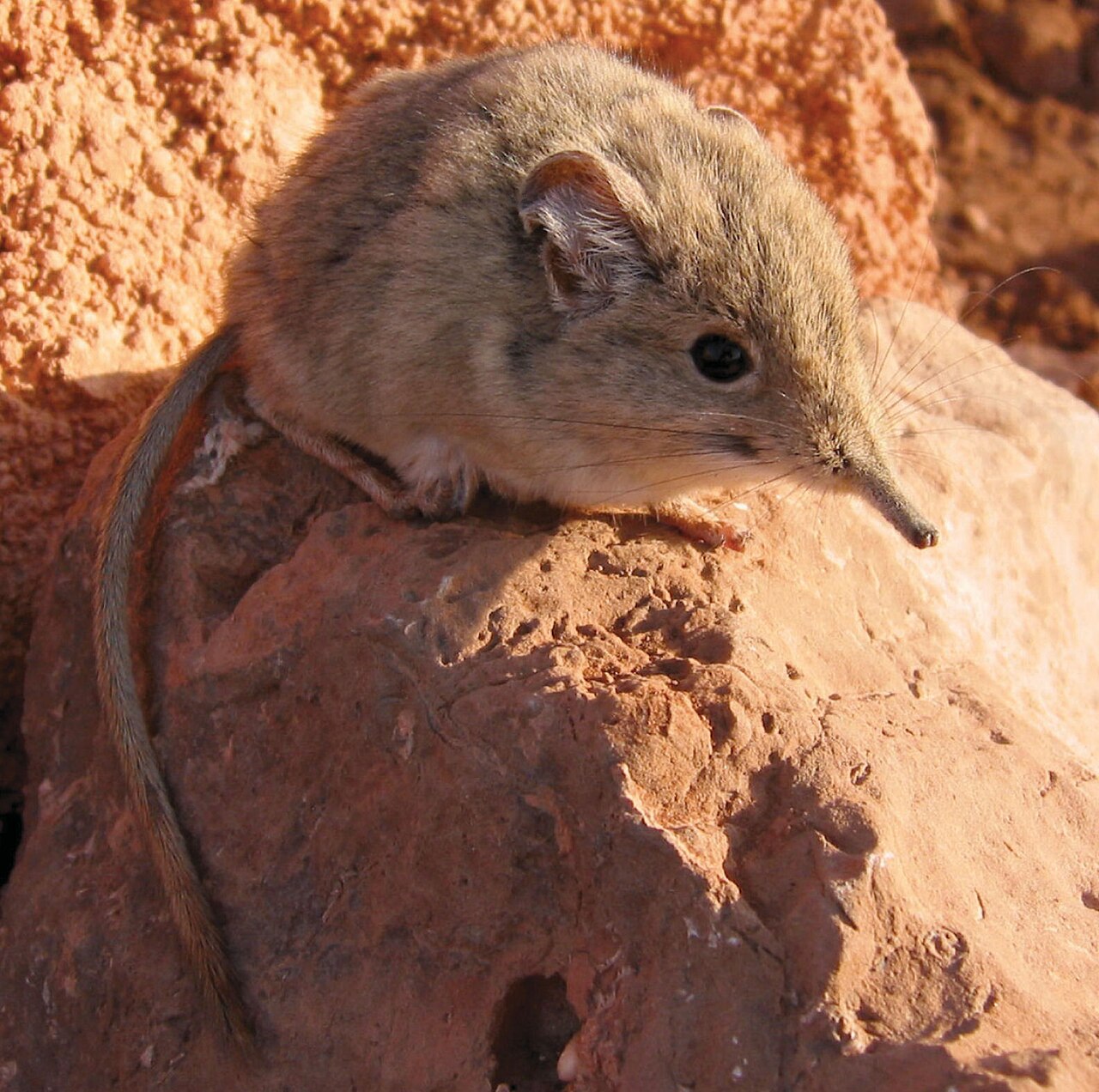
The North African Sengi is a mouse-sized animal with a long, mobile snout, large eyes and long hind legs with which it bounds over rocks. It is not a mouse, not a shrew and not a rodent, but the only representative outside sub-Saharan Africa of an order of its own, the elephant shrews or sengis (Macroscelidea). Its nearest relatives are the hyraxes, the aardvark and the elephants. The species lives on rocky slopes in the Maghreb and is not closely related to any European mammal.
Tracks
Hardly any signs of this species have been documented, and knowledge of sengis in general is not sufficiently established for this species to give a full account of signs. The print is very small and not visible on rock; in fine dust or sand between boulders a small, elongated hind foot with four long toes can be seen, with the small forefoot in front of or beside it, and in a fleeing animal bounds of up to several decimetres. The droppings are small, dark, hard pellets a few millimetres across, often at fixed spots at the edge of a crevice, and in the field hardly distinguishable from those of a gerbil. Most sengis are known to maintain a network of cleared trails, kept free of leaves and pebbles, along which they run to cover when alarmed; for this species this has not been well described. Because the species is diurnal, the animal itself is relatively easy to observe.
Identification
Small and light: head-body 11 to 12.5 cm and 25 to 70 grams, with a tail longer than the body (13 to 16 cm), thin, lightly haired and often darker at the tip. The coat is yellowish brown to pale sandy pink above and white below, with a sharp boundary; animals from the desert edge are palest. The main character is the head: a long, mobile, downcurved snout that probes continuously, with long whiskers; above it large, black, protruding eyes with a pale eye-ring, and behind them large, thin, rounded ears. The hind legs are long, the forelegs short; at rest the animal sits high on its hind legs, and when disturbed it moves over the stones in short, rapid bounds. A gland beneath the base of the tail is used to mark the territory. The dentition has 42 teeth, more than in any rodent.
Similar species
No other animal in the region has a comparable snout; this character is sufficient for identification. Animals of similar size in the Maghreb: gerbils and jirds (Gerbillus, Meriones) also have long hind legs and a long tail, but an ordinary rodent muzzle on a tapering head and a tail ending in a tuft, and they are nocturnal rather than diurnal; the North African Gundi (Ctenodactylus) lives on the same rocks, but is thickset and short-tailed, about the size of a guinea pig; shrews also have a pointed snout, but are smaller, short-legged and short-tailed and forage in the litter rather than bounding. The name 'elephant shrew' suggests a relationship with shrews, but there is none. South of the Maghreb other sengis occur; in north-western Africa this is the only species.
Habitat
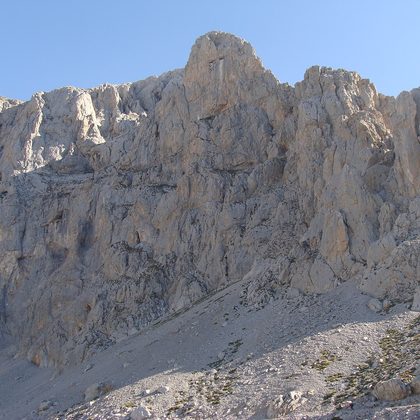
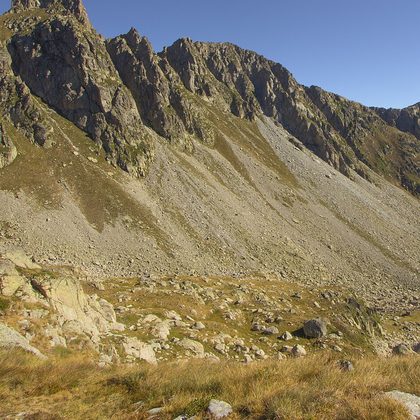
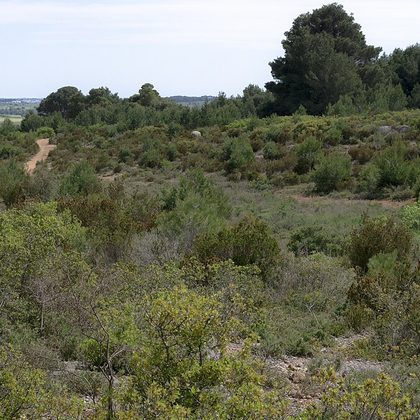
Stone and rock in dry areas: rocky slopes and boulder fields, scree and wadi walls, limestone and sandstone plateaus, and the surrounding garrigue, phrygana and low maquis; also semi-desert with scattered shrubs and the stony margins of fields and olive groves. Required are crevices and cavities as refuges close to open, stony ground for running and foraging. The habitat extends from the coastal strip into the High Atlas and to the northern edge of the Sahara.
Where the animal is most at home, classified with EUNIS — the European standard for habitats.
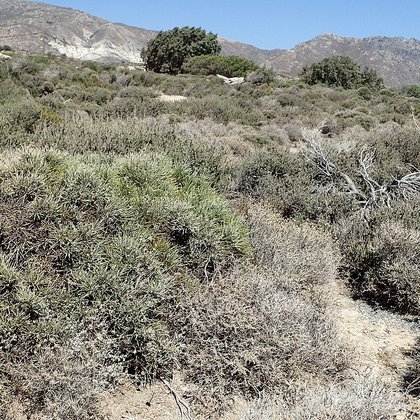
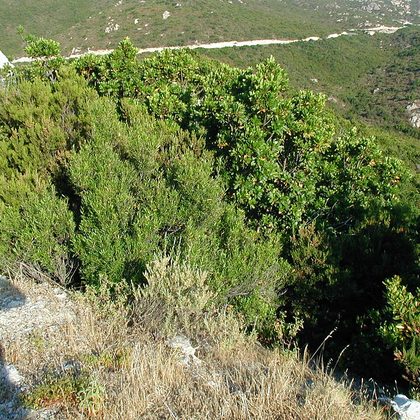
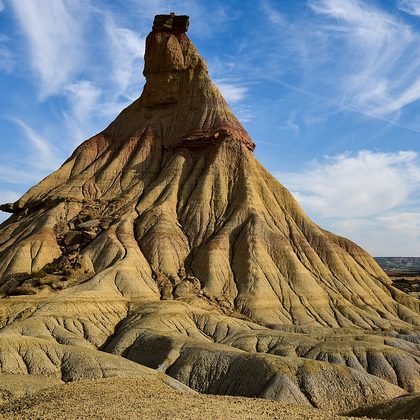
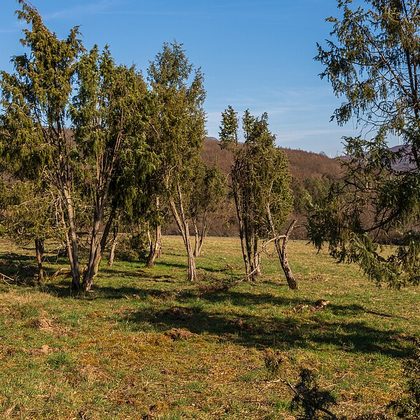
Distribution
North-western Africa: Morocco, Algeria, Tunisia and western Libya, with an extension south to the north of Western Sahara; the core lies in the Atlas countries and their foothills. The species does not occur in Europe and never has. Even in North Africa it is unknown to most travellers.
- Native
- dark = core range, pale = thinly spread
Way of life
Diurnal and crepuscular, which is unusual for a small mammal in a hot climate; in the hottest months activity shifts to early morning and late afternoon. The diet consists mainly of insects, with ants and termites as the main prey, and also beetles, spiders and some seeds, buds and small fruits; the snout continuously probes crevices and litter. The territory is marked with the gland beneath the base of the tail. Sengis in general are known to live in monogamous pairs that jointly defend a territory but otherwise largely forage separately; for this species this is probable but not described in detail. Litters fall between about January and August, two a year, with one to four, usually two young, after a gestation of about seventy-five days. The young are born well developed, furred and with open eyes, and are adult within six weeks. In the wild the species rarely lives longer than a year and a half. There is no hibernation, but in cold weather or food shortage the species can enter short bouts of torpor.
Where and when to look
Search early in the morning on sunny rocky slopes or boulder fields in the foothills of Morocco and Algeria, such as the Jbilet near Marrakesh, the slopes of the High Atlas and Anti-Atlas, and on the limestone plateaus of northern Tunisia. Wait on a stone overlooking a slope with crevices: the animal moves in short dashes from cover to cover and is detected by movement, not by sound. The long tail remains visible longest on a darting animal. When travelling in the Maghreb it is worth scanning rocky slopes at short stops. Do not pursue the animal: when disturbed it dives into a crevice and stays there for about half an hour.
Conservation status
Least Concern (2015). The range is large, the species is numerous in suitable rocky areas, and its habitat, stony slopes and semi-desert, is little altered by agriculture and building. No serious threats have been identified; locally overgrazing, stone extraction and the loss of scrub play a role, and in the long term warming and drying of the Maghreb may shift the southern limit of the range northwards. Little fieldwork has been done on this species: data on social organisation and signs are limited, and most existing photographs derive from a small number of excursions.
Scientific name
Petrosaltator rozeti | (Duvernoy, 1833) (GBIF: Elephantulus rozeti)
Duvernoy described the species in 1833 as Macrocelides Rozeti; because it was later moved to another genus, the author and year stand in brackets. Petrosaltator couples Greek petra, 'rock', to Latin saltator, 'dancer, leaper'; Rathbun and Dumbacher themselves glossed their 2016 name as 'rockdancer', after the boulder-strewn habitat. rozeti honours the French engineer officer and geologist Claude-Antoine Rozet (1798–1858), who had just published his description of the newly conquered regency of Algiers. The specimen the first description was based on came from Algeria, Oran.