All species › Hyraxes › Hyraxes › Rock hyrax
Rock hyrax | Procavia capensis
Kaapse klipdas | Procavia capensis
The Rock Hyrax is a stocky, almost tailless rock-dwelling mammal of 1.5 to 5.4 kg. It belongs to an order of its own, the hyraxes (Hyracoidea), whose closest living relatives are the elephants and the sea cows. The range covers large parts of Africa and the Arabian Peninsula; in the north it reaches the rocky areas of the Levant, from the Golan to the Dead Sea. On rocky slopes in Israel groups of basking animals can be seen in the early morning.
Tracks
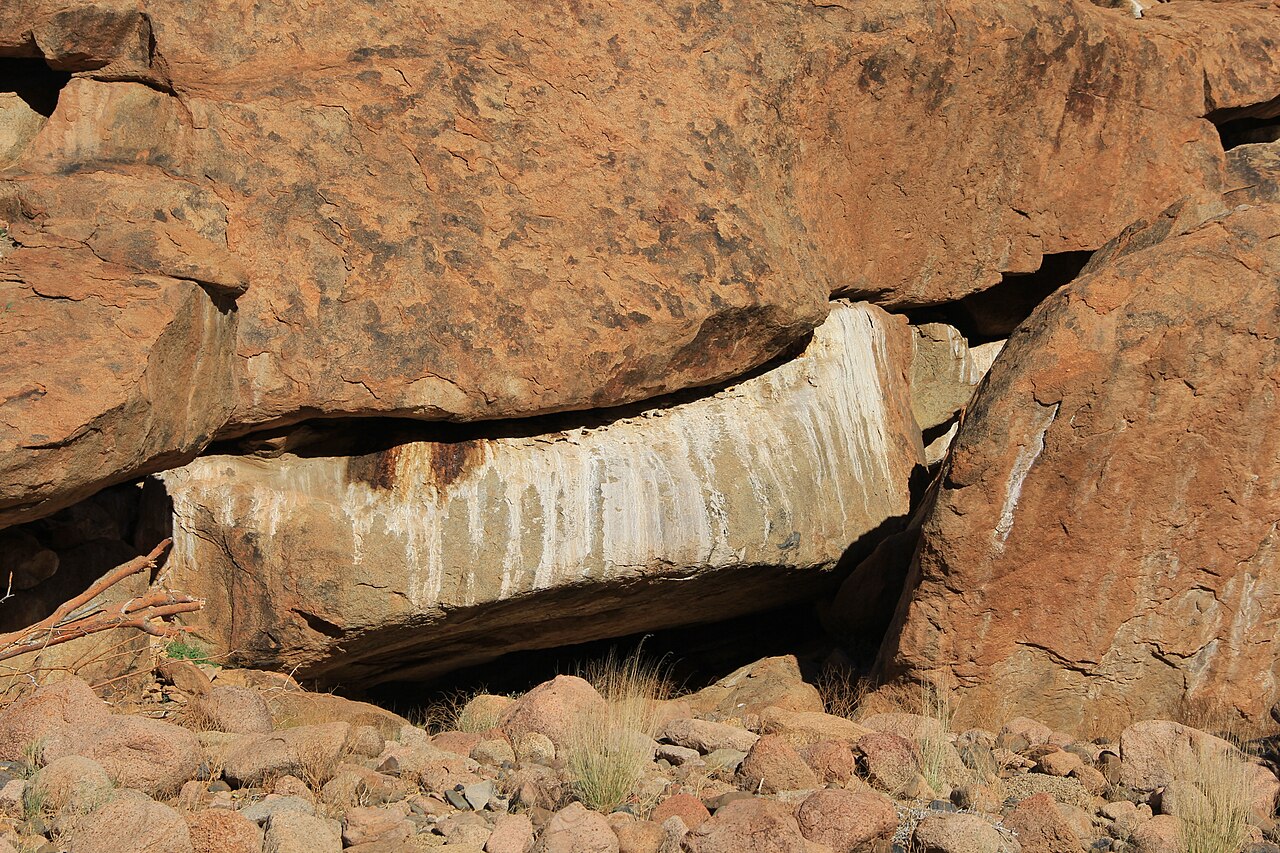
The most conspicuous sign of this species is visible from hundreds of metres away and persists for centuries. Hyraxes use fixed latrines under overhangs and in crevices. Because they defecate and urinate in the same place, a mixture of pellets and dried urine accumulates there and hardens into a tough, glossy, black-brown mass: hyraceum. Fresh urine runs down the rock face and dries into long, cream to chalk-white streaks of calcium salts from the urine; on a dark rock face these are visible from afar and are the most reliable sign of an occupied colony. Below the streaks lies the latrine with the conical or oval pellets of about a centimetre; the air there smells sharply of ammonia. Hyraceum is so durable that in the Levant and southern Africa it is cored as a climate archive: the layers contain pollen thousands of years old. On the routes to the latrine trails across the rock wear smooth and dark, and the edges of the crevices where the animals go in and out are polished. Prints are rare because the animal walks almost only on bare rock; in dust or sand the short, broad foot leaves a pad print without claw marks.
In its habitat
Head close-up
Identification
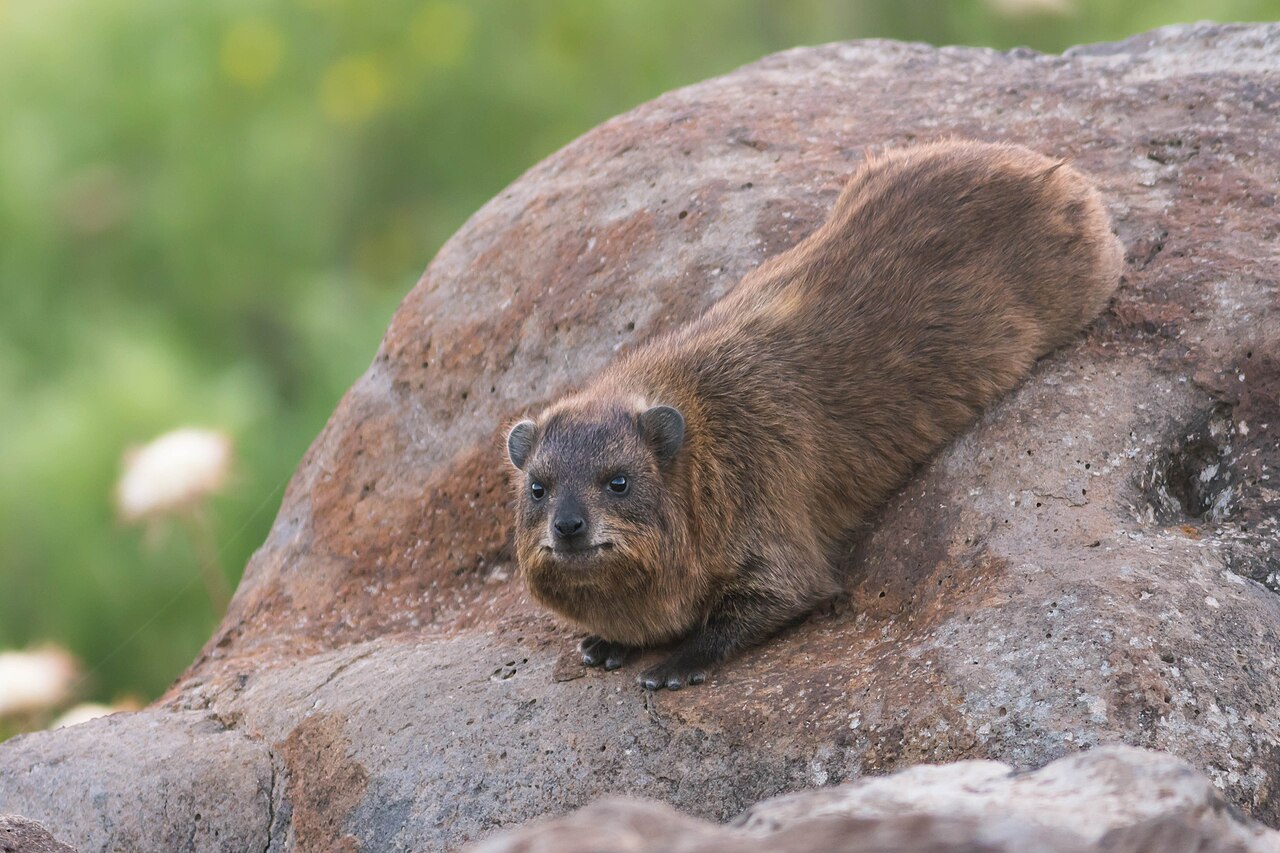
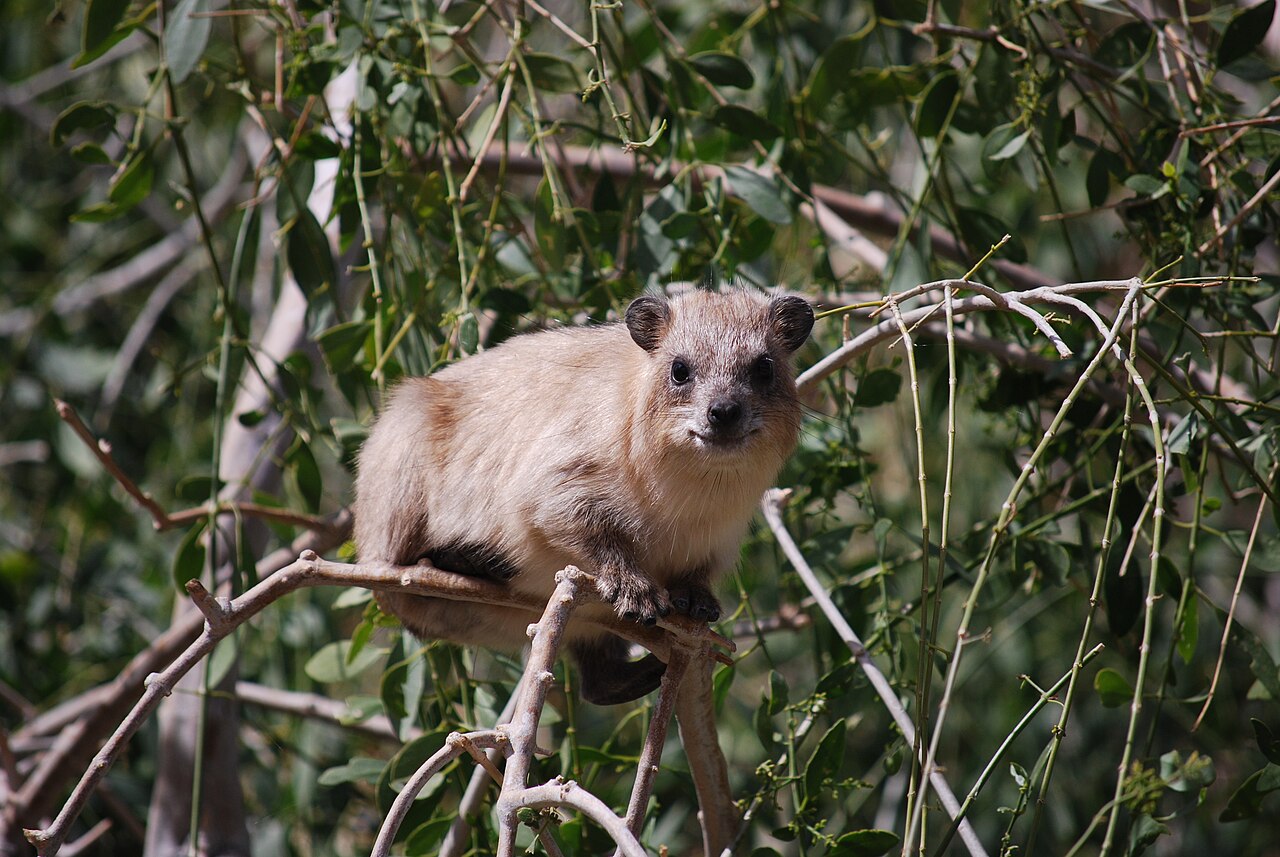
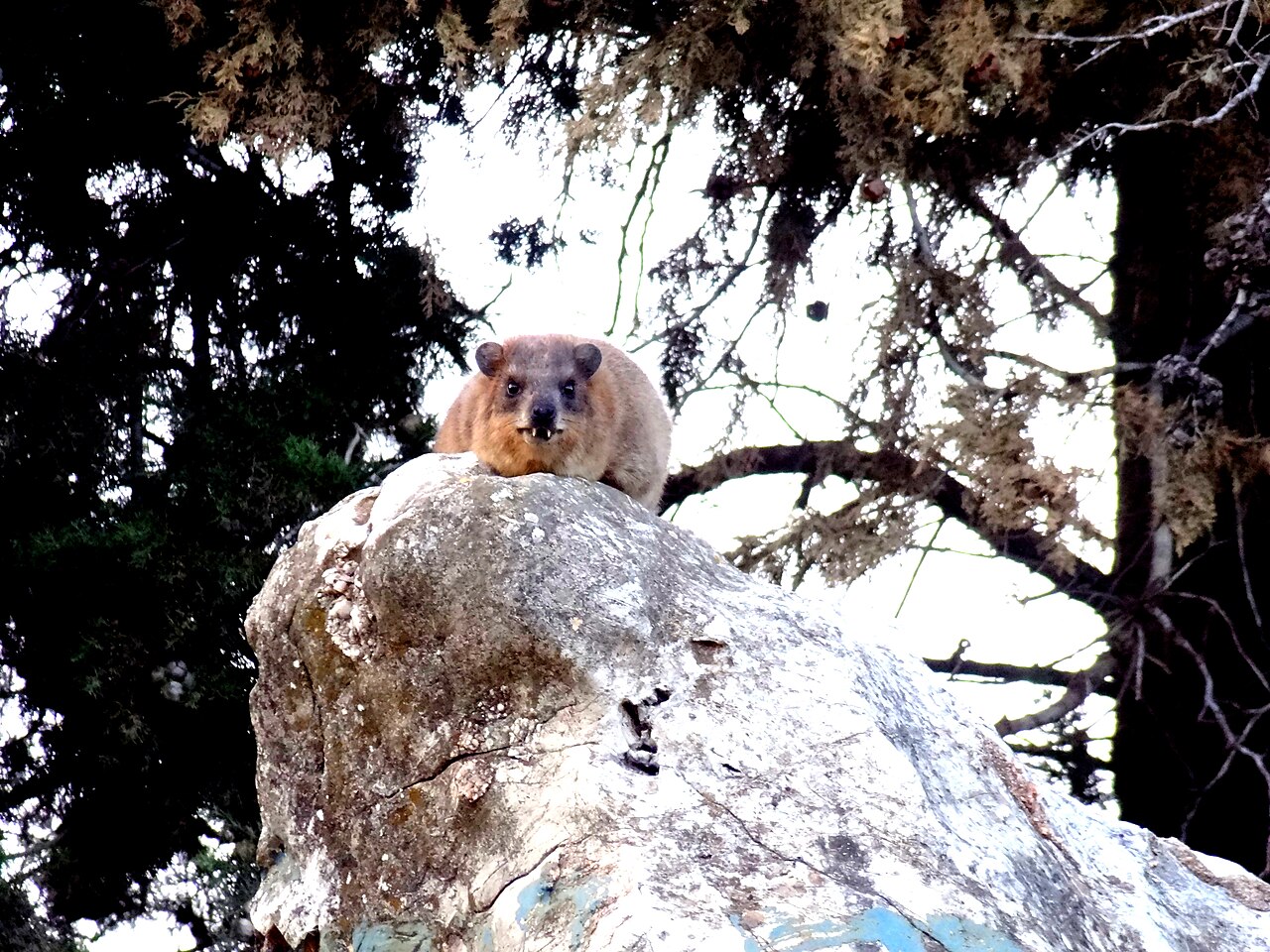
A stocky, apparently tailless animal with a head-body length of about 38 to 63 cm and a weight of 1.5 to 5.4 kg. The coat is greyish to yellowish brown, in the Levantine form often cream to rufous on the back, with a paler belly. In the middle of the back is a gland patch of differently coloured hair (black, yellow or white, depending on the animal), which is erected when the animal is excited. The tail is a stub of at most two centimetres and is hidden in the fur. The head is short with a blunt muzzle, small round ears and small black eyes; the upper lip is cleft, and when the animal yawns two short, triangular, tusk-shaped incisors become visible. The legs are short, with rubbery, permanently moist sole pads with which the animal climbs almost vertical rock faces; the toes bear flat nails instead of claws, apart from a single curved grooming claw on the hind foot. Young are smaller and darker but otherwise like the adults.
Similar species
In the Levant there are no confusion species: it is the only hyrax, and no other stocky, tailless mammal of this size occurs on rocks. At a distance and against the light a hyrax can resemble a large rat or a small marmot; marmots, however, do not occur in the Levant, and a rat has a long tail and a pointed muzzle. The spiny mice and gerbils living on the same rocks are much smaller. The Bush Hyrax (Heterohyrax), which occurs alongside the Rock Hyrax in East Africa, is absent from the Levant. A resting hyrax on weathered limestone is difficult to spot until it moves.
Habitat
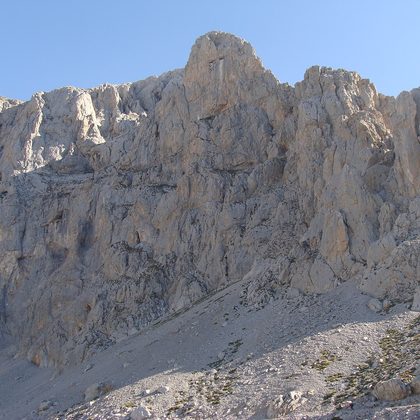
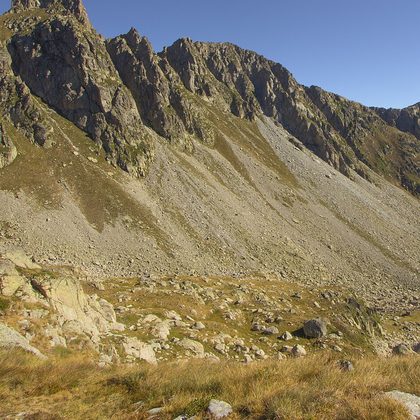
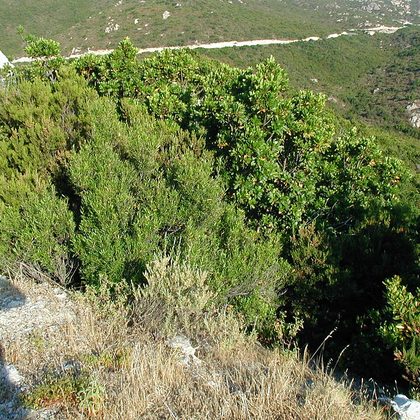
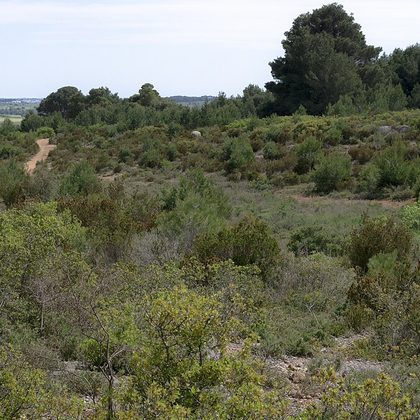
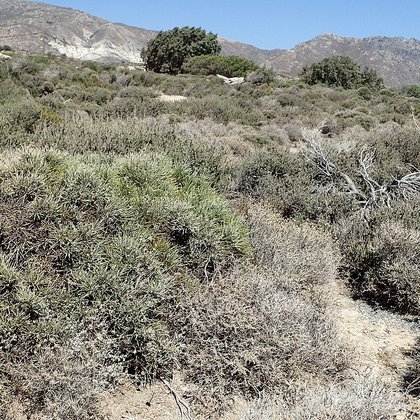
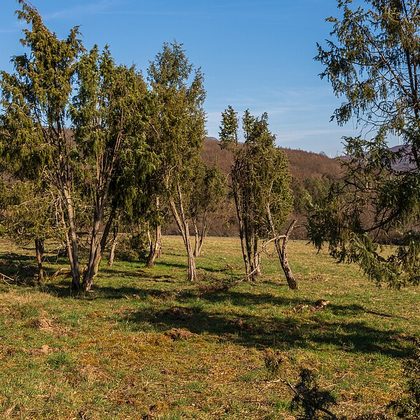
The species is tied to rock: steep rock faces, cliffs, boulder fields, scree slopes, limestone gorges and basalt outcrops, with crevices and cavities in which the animal shelters at night and from danger, and with herb-rich vegetation, scrub or trees nearby. In the Levant the habitat extends from the wadis by the Dead Sea, more than four hundred metres below sea level, to the basalt slopes of the Golan and the flanks of Mount Hermon. It includes maquis, garrigue and phrygana on rocky ground, oases such as Ein Gedi, and nowadays also quarries, embankments, ruins and rubble along mountain roads. Where people create rocky ground, the species settles.
Where the animal is most at home, classified with EUNIS — the European standard for habitats.
Distribution
Large parts of Africa and the Arabian Peninsula, with a strongly fragmented northern edge. From the north-eastern part of the range GBIF holds over seven thousand records, almost all from Israel; the remainder come from the Palestinian territories, Lebanon, Syria, Jordan and Egypt. The Mammal Diversity Database also lists Algeria and Libya; these are isolated mountain populations in the Sahara. The species does not occur in Europe.
- Native
- dark = core range, pale = thinly spread
Way of life
Diurnal. The species regulates its body temperature poorly and compensates through behaviour: in the morning the colony emerges from the crevices and basks for an hour or more, closely packed on the same rock, and only then feeds. About ninety to ninety-five per cent of the time is spent resting. Colonies number ten to eighty animals and consist of harem groups of one territorial male with three to seven females and their young; young males wander outside these groups. While the group forages, one animal keeps watch from a high point; at an eagle or jackal a shrill alarm call sounds, after which all animals leave the slope within seconds. The vocal repertoire is large: more than twenty different sounds have been described, and the territorial song of the males can be heard hundreds of metres away. The diet consists of grass, herbs, leaves, twigs and bark; to reach these the animal also climbs into shrubs and trees. The gestation of six to eight months is long for an animal of this size; the one to six young are born furred and with open eyes and can climb within an hour. There is no winter rest.
Where and when to look
Search in the first two hours after sunrise at a rock face facing south or east; the colony is then basking and the animals are not very active. First scan the rock face with binoculars for the white urine streaks, which reveal a colony before an animal is visible, then check the edges of the crevices below them. In Israel, Ein Gedi by the Dead Sea, Nachal David, Masada, the area around Tabgha on the Sea of Galilee, the basalt outcrops near Katzrin on the Golan and the gorges of Upper Galilee are places where the species can almost always be seen; at much-visited sites the animals are not very shy. Sit still and wait: if the sentinel does not give the alarm, the other animals come out. Listen for the calls: the shrill alarm and the long, creaking song of the males.
Conservation status
Least Concern (LC, 2015). The world range is large and the species is adaptable. In the Levant it has benefited from people rather than suffered: road cuttings, quarries and ruins create new rocky ground, and gardens and orchards provide food. In Israel the species is locally so numerous that it is regarded as a pest of crops and gardens. There is also a public health issue: the hyrax is a reservoir of the parasite that causes cutaneous leishmaniasis, and the sandflies that transmit it live in the same rock crevices. In the Saharan part of the range the situation differs: there the species survives in small, isolated mountain populations that can disappear unnoticed through hunting and the drying up of springs. The global Red List category does not reflect this difference.
Scientific name
Procavia capensis | (Pallas, 1766)
Pallas described the species in 1766 as Cavia capensis; because it was later moved to another genus, the author and year stand in brackets. Procavia joins Greek pro, 'before, near', to Cavia, the genus of the guinea pig: the animal set alongside the cavy. capensis is Latin for 'of the Cape'; Pallas described the animal from the Cape of Good Hope. The specimen the first description was based on came from South Africa, Cape of Good Hope.