All species › Bats › Horseshoe bats › Mehely’s horseshoe bat
Mehely’s horseshoe bat | Rhinolophus mehelyi
Mehely's hoefijzerneus | Murciélago mediano de herradura.
Mehely's Horseshoe Bat (Rhinolophus mehelyi) is a medium-sized horseshoe bat, described in 1901 by Paul Matschie from an animal taken in Bucharest and named after the Hungarian zoologist Lajos Méhely. The species lives around the Mediterranean and in south-west Asia, roosts almost exclusively in caves and is assessed globally as Vulnerable. It can be separated from the Mediterranean Horseshoe Bat only on a combination of facial and nose-leaf characters.
No photograph of a living wild animal of this species with a suitable Creative Commons licence exists. Do you have one that meets the rules? Send it in.
Tracks
The most visible sign is the animals themselves: dense clusters of grey-brown, white-bellied horseshoe bats on the ceiling of a warm cave in summer, or of a cooler, deeper cave in winter. Droppings lie beneath the clusters. At night the bats use temporary roosts between foraging bouts, among them groves of trees. On a bat detector the call is a long constant-frequency tone around 109 kHz with short frequency-modulated start and end sweeps and a mean interpulse interval of 62.5 milliseconds (Greece).
Identification
Medium-sized, with a forearm of 48 to 56 mm and a weight of 10 to 23 g. The back is grey-brown (hairs pale grey-beige with grey-brown tips), the face paler, usually with a dark brown patch around or below each eye, much darker than in the Mediterranean Horseshoe Bat. The belly is pure white or nearly white, with a fairly sharp boundary against the back. No orange morph is known. The ears are short (about 42 per cent of the forearm) and lack a tragus. The nose-leaf: a hastate lancet whose upper half is narrow with almost parallel sides and a blunt tip; a subtriangular connecting process; a rounded, forward-tilted sella with fully parallel sides; a narrow horseshoe of 4.9 to 7.5 mm without lateral leaflets. Wings and tail membrane are grey-brown. Echolocation is FM/CF/FM with a constant frequency averaging 109 kHz (104–112 kHz); calls in Europe last 20 to 36 milliseconds. Juveniles call lower than adults, and animals in better condition call higher.
Similar species
The Mediterranean Horseshoe Bat (Rhinolophus euryale) is the species most often confused with Mehely's. It is on average slightly smaller (forearm 43–51 mm), has a belly paler than the back but never nearly white, at most a faint eye marking, a straight-sided lancet and a narrow, pointed, forward-curving connecting process. Call frequencies overlap (Mediterranean 100–109 kHz). Blasius's Horseshoe Bat (R. blasii) has a forearm of 41 to 51 mm, a yellowish-white face with a dark patch under each eye, a connecting process shaped as a high, narrow, pointed horn and a wedge-shaped sella; it calls around 94 kHz. The Greater Horseshoe Bat (R. ferrumequinum) is larger (forearm 51–61 mm) and calls around 82 kHz; the Lesser Horseshoe Bat (R. hipposideros) is smaller (35–42.5 mm) and calls around 110 kHz, within the range of Mehely's. In a colony, active Mehely's and Mediterranean Horseshoe Bats hang in dense clusters in body contact; the other European horseshoe bats do not.
Habitat
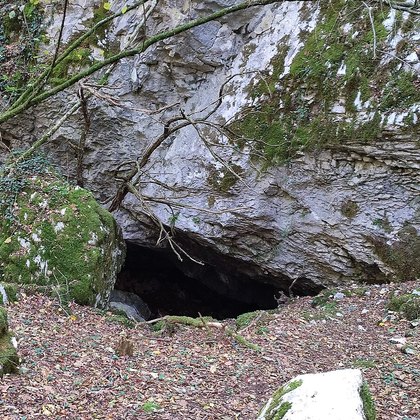
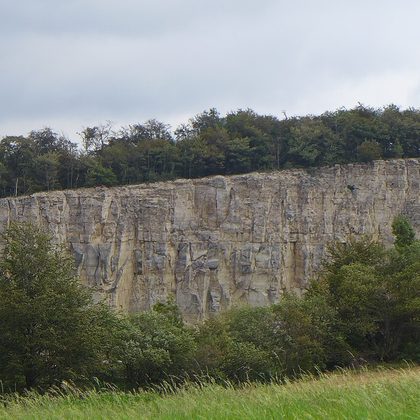
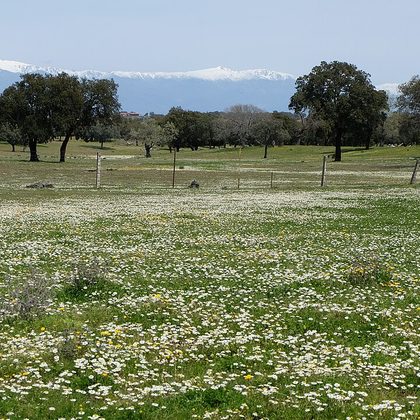
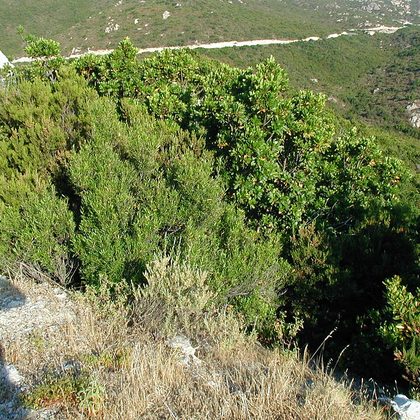
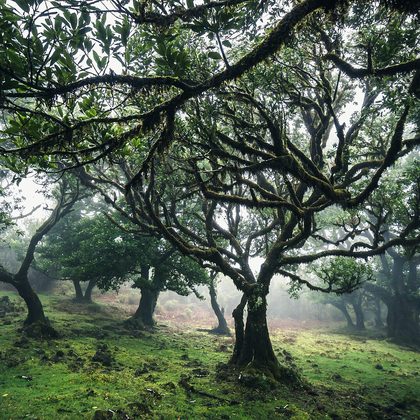
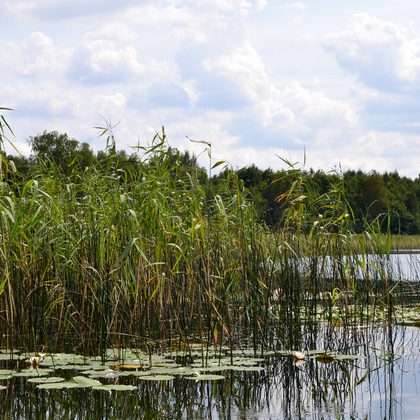
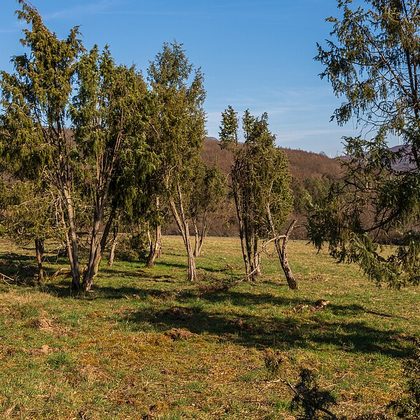
Mediterranean scrub and woodland and dry steppe, closely tied to water and caves, from sea level to about 2000 m. In south-western Iberia the species was often found in semi-natural oak wood-pasture (dehesa) and avoided open ground; there males foraged mainly in riparian and broadleaved woodland, females in dehesa, scrub and eucalyptus plantations. In North Africa it lives in Mediterranean woodland, montane forest and semi-desert grassland and scrub, and avoids the coast. By day it roosts almost exclusively in caves, sometimes in abandoned mines: in summer in warm caves in karst, in winter in cooler, deeper caves with a stable climate.
Where the animal is most at home, classified with EUNIS — the European standard for habitats.
Distribution
Southern Europe: southern Iberian Peninsula, Sardinia, eastern Sicily, south-eastern Italy, southern Albania, eastern Serbia, southern Romania, eastern North Macedonia, Bulgaria and Greece. Further, northern Morocco, northern Algeria and northern Tunisia, and in south-west Asia the Caucasus, Anatolia, northern Iraq and the Zagros Mountains. The subspecies judaicus lives on Cyprus, in northern Syria, western Jordan, Israel, north-eastern Egypt and north-eastern Libya. The species has disappeared from Catalonia, Mallorca, most of Italy and Croatia; most French records date from 1908 to 1965. In south-eastern Italy a male was found again after no records since 1960.
- Native
- dark = core range, pale = thinly spread
Way of life
Nocturnal. The bats hunt in slow flight and from a perch, close to the ground or dense vegetation, and probably also glean prey from foliage and the ground. In most regions the diet consists mainly of moths: 80 to 90 per cent by volume in Spain, 57 to 88 per cent in spring in Iran; further flies, beetles, hoppers, lacewings and cockroaches, which made up 99 per cent of dropping volume in Libya. Mating probably takes place before hibernation, with delayed fertilisation. Females prefer males with higher-frequency calls. In Algeria young are born in May and early June, one per litter. Females mature only in their third year, males at two years. Outside the breeding season males and females roost together, in groups of up to 5000 in winter; maternity colonies hold up to 3000. The species is largely sedentary, but movements of more than 90 km have been recorded. In hibernation torpor is deeper than in daily rest, and both active and torpid animals have been found in winter roosts.
Where and when to look
The chance is greatest at a known colony in karst country in the south of the Iberian Peninsula, Bulgaria or Greece, at emergence around dusk. A call around 109 kHz does not rule out the Mediterranean Horseshoe Bat; a photograph of the face and belly decides: a white belly, a dark patch around the eyes and a subtriangular connecting process point to Mehely's. Entering caves with colonies during the maternity or winter period disturbs the bats; the species is strictly protected.
Conservation status
Vulnerable globally (VU, 2016). The range is large but fragmented, and populations are declining across much of it, for reasons not fully understood. Some colonies have been reduced to a fraction of their former size; the handbook assumes a decline of 30 per cent over three generations (27 years). Causes cited are habitat loss and disturbance and roost disturbance; in Iran mining has destroyed large multi-species maternity colonies, in Portugal road traffic is a cause of death, and climate change is named as a possible threat. The species is listed in Annexes II and IV of the Habitats Directive.
Scientific name
Rhinolophus mehelyi | Matschie, 1901
Matschie described the species in 1901 and placed it straight away in the genus where it still stands. Rhinolophus is Greek, from rhis, genitive rhinos, 'nose', and lophos, 'crest', after the nose-leaf. mehelyi honours the Hungarian zoologist Lajos Méhely (1862–1953), who had shortly before published a monograph on the horseshoe bats. The specimen the first description was based on came from Romania, Bucharest.