All species › Bats › Horseshoe bats › Lesser horseshoe bat
Lesser horseshoe bat | Rhinolophus hipposideros
Kleine hoefijzerneus | Murciélago Pequeño de Herradura
The Lesser Horseshoe Bat (Rhinolophus hipposideros) is the smallest European horseshoe bat, with a forearm of 35 to 42.5 millimetres and a weight of 4.7 to 9 grams. The Handbook of the Mammals of the World calls it the most northerly distributed horseshoe bat, with records up to 52° N. In the north of the range females spend the summer in lofts and buildings and the animals hibernate in caves, mines and cellars; in the south the species uses underground sites all year.
Tracks
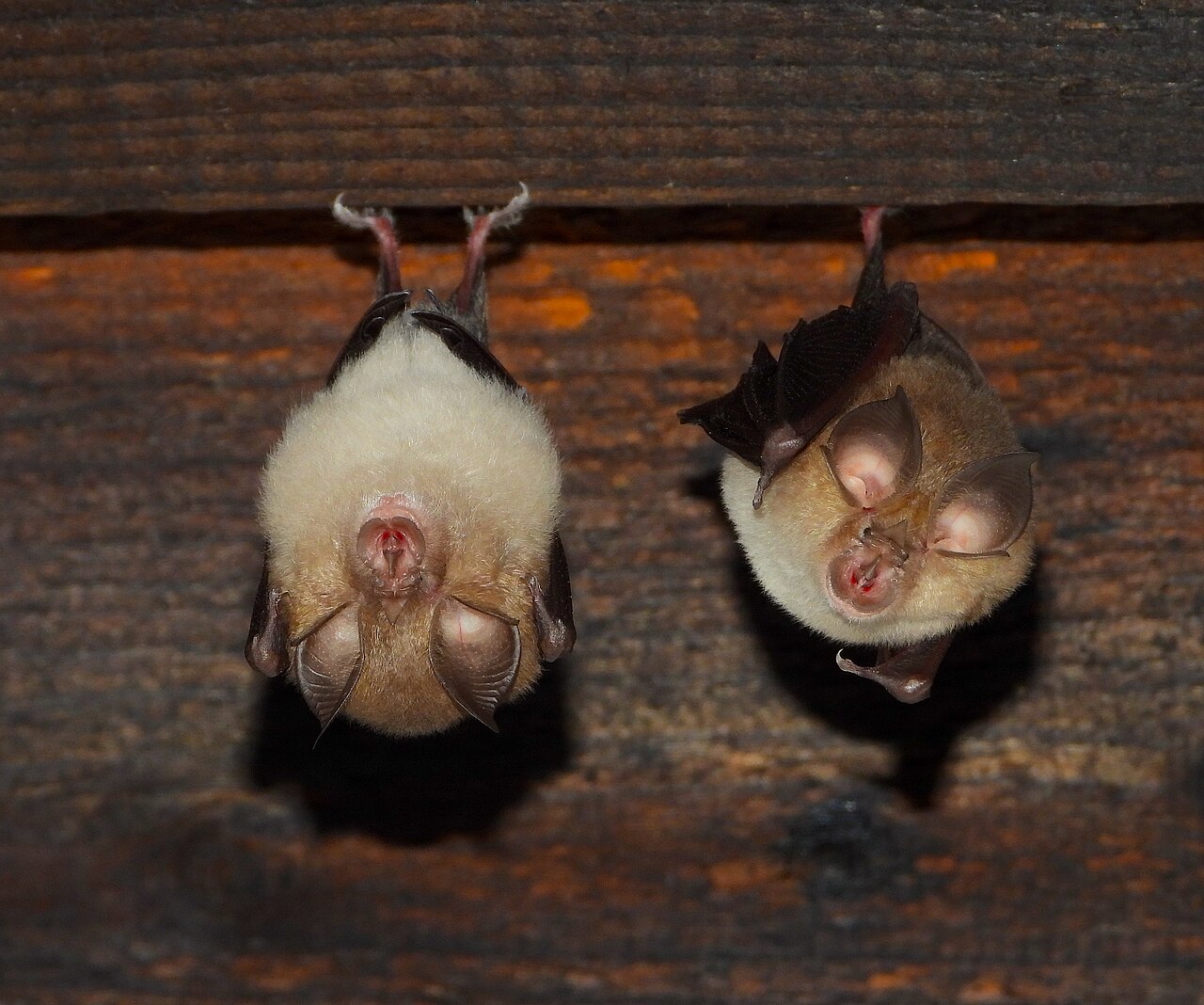
In a summer roost in a loft or barn, droppings of a small bat lie beneath the hanging spots, scattered over several places because the animals hang apart. The bats themselves are often visible in daylight: small, dark animals wrapped in their wings, on beams or along the ridge. In the winter roost – a cellar, a small cave, a mine adit, a tunnel – they hang singly from ceiling or wall, fully wrapped in their wings with the legs drawn in close to the surface. Hibernacula in Europe have been recorded at 6 to 9 °C with high humidity. On a detector the species gives a long constant-frequency tone around 110 kHz with short frequency-modulated start and end sweeps; calls last 42 to 45 milliseconds on average.
Identification
A small bat with a forearm of 35 to 42.5 mm. Upperparts are light to dark buff or grey-brown, underparts drab grey; the hair bases are drab. The ears are small, pointed and without a tragus, as in all horseshoe bats. The nose-leaf: a long, narrow, wedge-shaped lancet with a blunt tip, a low, rounded connecting process and a narrow sella whose tip points forward and down; the horseshoe is 5.7 to 7.3 mm wide and covers nearly the whole muzzle. Flight is low, fluttering and agile, close to vegetation, walls or water, with short spells of hovering. At rest it hangs free by the feet, fully wrapped in its wings. Echolocation calls are FM/CF/FM with a constant frequency averaging around 110 kHz: 110.6 kHz in Greece, 109.6 kHz in France, Switzerland and the UK, 111.5 to 117.5 kHz in Morocco and 103.5 to 109.3 kHz in Israel. Females call higher than males (by 4 kHz on average in Ireland) and juveniles lower than adults.
Similar species
Within the family, size is the first character. The Greater Horseshoe Bat (Rhinolophus ferrumequinum) has a forearm of 51 to 61 mm and calls around 82 kHz. The three medium-sized species – Mediterranean Horseshoe Bat (R. euryale, forearm 43–51 mm), Mehely's Horseshoe Bat (R. mehelyi, 48–56 mm) and Blasius's Horseshoe Bat (R. blasii, 41–51 mm) – barely overlap with the Lesser Horseshoe Bat at the lower end. On a bat detector the Lesser Horseshoe Bat is the highest at around 110 kHz, but the Mediterranean (100–109 kHz) and Mehely's (104–112 kHz) reach into that band; in southern Europe a call between 104 and 112 kHz therefore cannot be assigned to one species without another character. In the hand the connecting process of the nose-leaf decides: low and rounded in the Lesser, pointed and curved forward in the Mediterranean, subtriangular in Mehely's, and a high, narrow, pointed horn in Blasius's. Roosting posture helps too: Lesser Horseshoe Bats in a colony usually hang apart, 25 to 50 cm from each other, whereas active Mediterranean and Mehely's Horseshoe Bats hang in clusters in body contact. All other European bats have a tragus and no nose-leaf.
Habitat
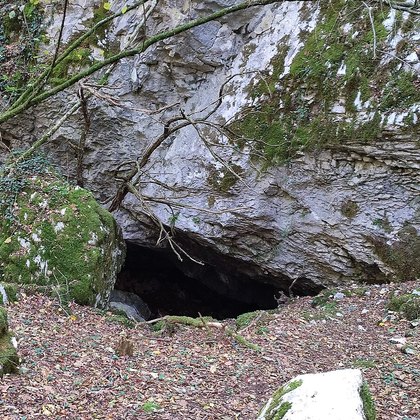
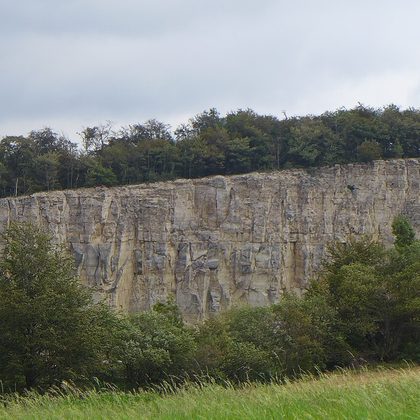
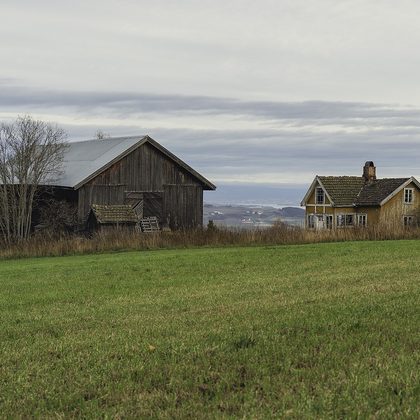
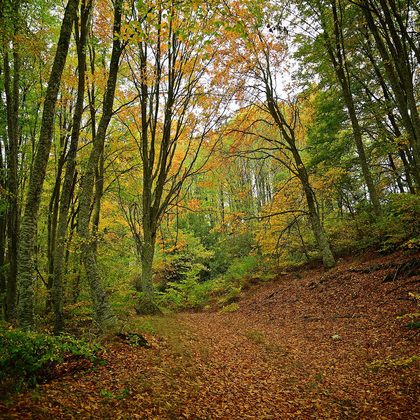
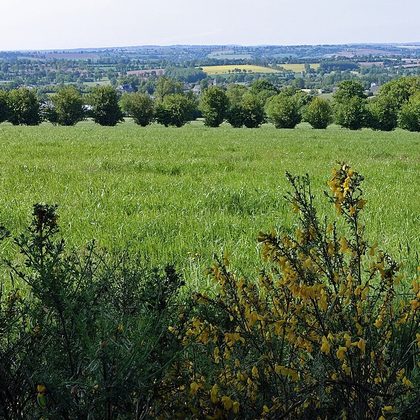
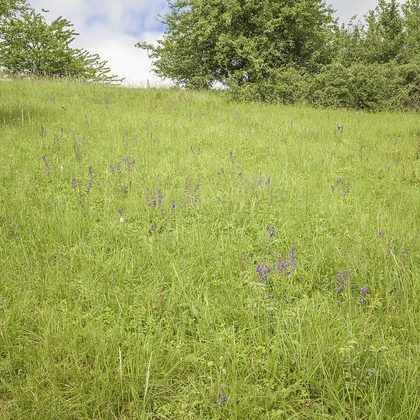
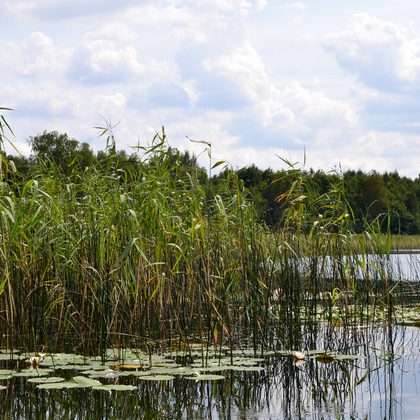
In the north of the range mainly broadleaved woodland and half-open country with copses, parkland, farmland, pasture and scrub; in the south riparian vegetation, Mediterranean and sub-Mediterranean scrub, grassland, thorn scrub and bushy woodland along streams. It occurs from sea level to over 2100 m and, according to the handbook, is found more often at higher elevations. Foraging areas lie close to the roosts: summer and winter roosts are usually within 5 to 10 km of each other. In summer the species uses lofts and buildings with a free flight entrance in the north, and caves, tunnels and mines as well in the south; in winter it needs cool, humid underground sites.
Where the animal is most at home, classified with EUNIS — the European standard for habitats.
Distribution
From Ireland and south-west Britain across continental Europe east to southern Ukraine and Romania, the whole Mediterranean with many islands (Balearics, Corsica, Sardinia, Sicily, Malta, Crete, Cyprus, the Ionian and Aegean islands), North Africa from Morocco to Tunisia and Sinai, and on through the Caucasus, Turkey and the Middle East to Central Asia and Kashmir. Isolated records are known from East Africa. The handbook tentatively recognises six subspecies, but the chromosomal forms (2n = 54, 56 and 58) and the genetic lineages do not match that arrangement. Since the 1950s the northern limit has moved south: the species has disappeared from the Netherlands, most of Belgium and western Germany. In Switzerland and Austria the distribution is fragmented, with colonies left only above 400 m.
- Native
- dark = core range, pale = thinly spread
Way of life
The bats leave the roost around dusk and hunt low and slowly, mostly in flight, but also pick prey off stones and leaves, including non-flying larvae. In Europe the diet consists mainly of small moths and midges, supplemented with lacewings, caddisflies, beetles and spiders; in Slovakia small moths made up 87 per cent of dropping volume. Six radio-tracked females on an island in the Chiemsee foraged for 229 minutes a night on average, mostly in woodland, over 6.8 to 62.7 ha. Mating takes place in autumn or in the hibernaculum; sperm is stored until March-April. Between mid-June and early July usually a single young is born (in Iran 35 per cent of females had twins); it flies at 18 to 20 days and is weaned at 4 to 5 weeks. Maternity colonies hold 10 to 1500 females; males live apart. Winter is spent in hibernation, singly or in groups of up to 500. The longest recorded movement is 152 km, the greatest recorded age 21 years and three months.
Where and when to look
Emergence time around sunset at a known maternity loft or cave entrance gives the best chance: the bats leave low, along a hedge or wall. A detector that reaches above 110 kHz makes the identification conclusive where no medium-sized horseshoe bats occur; in southern Europe a photograph of the nose-leaf is needed as well. Entering a hibernation site between October and April is not permitted in most countries, and every disturbance wakes a hibernating bat and uses up fat reserve. Winter surveys are carried out by licensed counters.
Conservation status
Least Concern globally (LC, 2016); listed regionally as Near Threatened in Europe and the Mediterranean. In northern Europe the species has declined strongly over the past fifty years and its northern limit has shifted; according to the handbook the decline continues, but more slowly. In Switzerland the number of adults counted in maternity colonies rose from 2200 to 2500 in ten years. Causes cited are disturbance and destruction of underground roosts and lofts, for example during restoration of old buildings, agricultural change and intensification, habitat fragmentation and pesticides. The species is listed in Annexes II and IV of the Habitats Directive and is covered by the Bern Convention and the EUROBATS Agreement.
Scientific name
Rhinolophus hipposideros | (André, 1797)
André described the species in 1797 as Noctilio Hipposideros; because it was later moved to another genus, the author and year stand in brackets. Rhinolophus is Greek, from rhis, genitive rhinos, 'nose', and lophos, 'crest', after the nose-leaf. hipposideros is Greek for 'horse-iron', that is horseshoe, from hippos, 'horse', and sidēros, 'iron', after the nose-leaf — the same image as Latin ferrumequinum. The specimen the first description was based on came from Germany.