All species › Rodents › Voles and hamsters › Mediterranean Pine Vole
Mediterranean Pine Vole | Microtus duodecimcostatus
Provençaalse woelmuis | Topillo Mediterráneo
The Mediterranean Pine Vole is a subterranean vole of southern France and the Iberian Peninsula. Its tunnel systems lie beneath road verges, olive groves and vineyards, and the small heaps of fresh soil every few metres among the grass are often the only sign of its presence. The animal itself seldom comes above ground.
No photograph of a living wild animal of this species with a suitable Creative Commons licence exists. Do you have one that meets the rules? Send it in.
Tracks
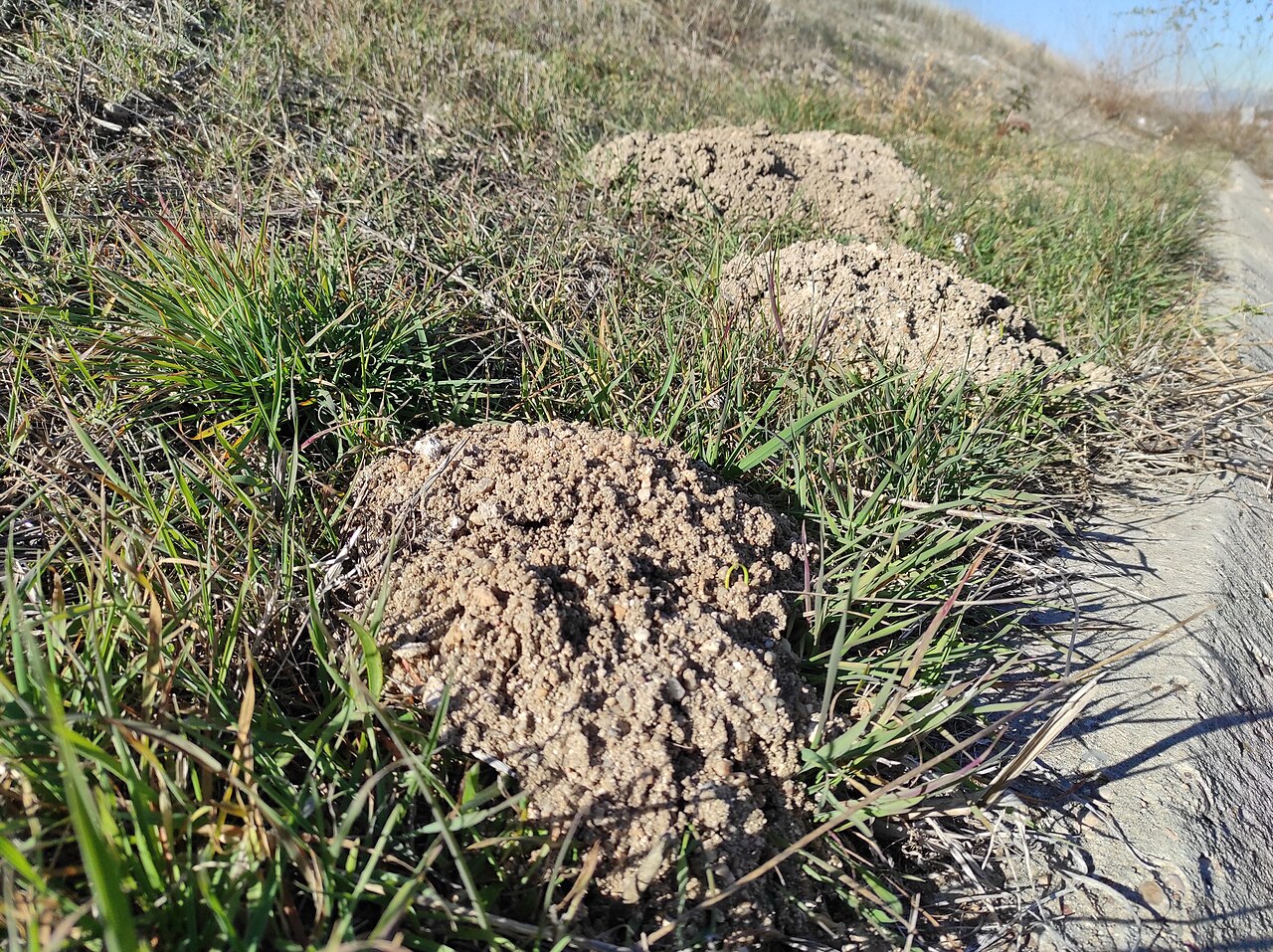
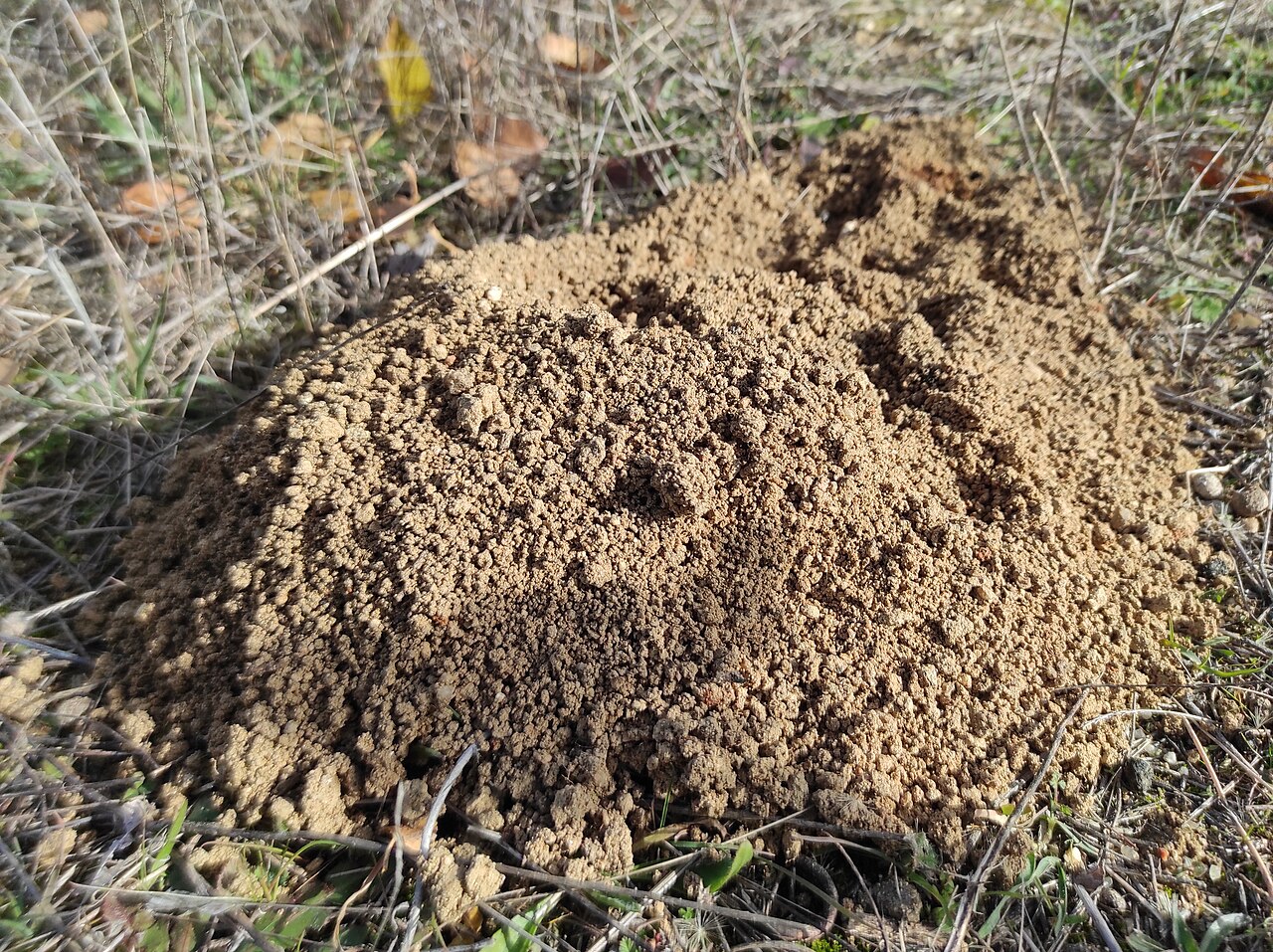
The species is recorded mainly from its signs. It lives in an underground tunnel system 10 to 50 cm deep, which in summer may descend to a metre to reach damp soil, and pushes the excavated soil out with its head. Under experimental conditions one animal moved over two kilograms of soil a day. The result is small heaps of fine, loose soil, which can be distinguished from those of the two other species that make soil heaps in south-western Europe:
— Mole. The opening is in the centre of the heap, the tunnel runs vertically upwards, the heap is large and conical and the soil is coarse, with clods and small stones, because the mole digs with its feet. Molehills lie in a line at fairly regular intervals.
— Pine vole. The opening is at the side of the heap, the tunnel enters at about 45 degrees, the soil is even-grained and free of coarse stones, because the animal digs with its teeth, and the heaps lie irregularly, often touching or in a winding row along the tunnel. Heaps of the Mediterranean Pine Vole are clearly smaller and flatter than a molehill, and the entrance beneath is plugged again, so that an open hole is seldom seen.
— Water vole (Arvicola scherman in the mountains, A. sapidus along water). The same pattern as the pine vole, but larger: bulkier heaps and tunnels of 5 to 6 cm against 3 to 4 cm in the pine vole.
There are also feeding signs underground: gnawed bulbs, tubers and roots, and young trees and citrus stems ringed just above or just below ground level; at high densities, up to nine hundred animals per hectare, this is clearly visible in orchards. Beneath a carefully brushed-away heap lies the sloping tunnel, and sometimes a store chamber with collected root fragments.
Identification
Small, thickset and built for digging. Head-body 8 to 11.1 cm, tail only 1.9 to 3.5 cm — a fifth to a quarter of head-body length — and a weight of 19 to 32 g. The head is massive and broad with a blunt muzzle, the neck heavy, the eyes small and the ears short and sunk in the fur. The coat is long and soft, brown with a buff or greyish wash above and pale grey below; juveniles are greyer. The skull is heavy and deep with strongly expanded zygomatic arches, and the upper incisors project clearly forwards; the animal digs with teeth and forefeet together. The second upper molar is short and has only three salient angles on the inner side.
Similar species
Identification here rests not on the animal but on locality, soil and altitude. The most difficult relative is the Lusitanian Pine Vole (Microtus lusitanicus), its sister species, whose range overlaps with it in central and northern Spain and in Portugal; the two are not fully reproductively isolated, hybrids have been found and mitochondrial DNA has passed from one species to the other. In the field they are practically inseparable: the Lusitanian is slightly smaller and darker and prefers damper, cooler, higher and more acid ground, the Mediterranean deeper, looser, more calcareous and drier soils. In Galicia and Cantabria it is the Lusitanian, in the Languedoc, the Levant, Andalusia and the Ebro valley the Mediterranean, and in much of Castile it may be either. The Common Pine Vole (M. subterraneus) and, in the Pyrenees, Gerbe's Vole (M. gerbei) are small burrowing voles of the same type. It can be separated from the Common Vole and Microtus lavernedii: these have larger eyes, more free-standing ears and a longer tail, hardly dig and throw up no soil, and live in the grass rather than beneath it. Cabrera's Vole is much heavier, long-haired and has a hind foot over 20 mm. The water voles (Arvicola) are two to four times the size and also throw up soil, but in much larger heaps. A live animal can therefore seldom be identified to species, but the heaps often can.
Habitat
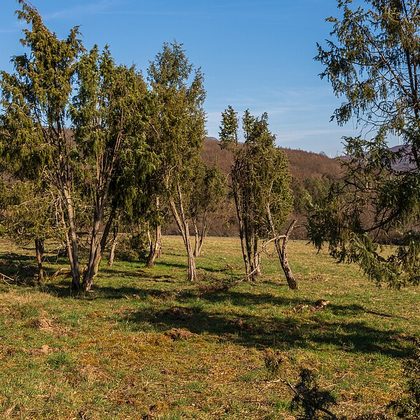
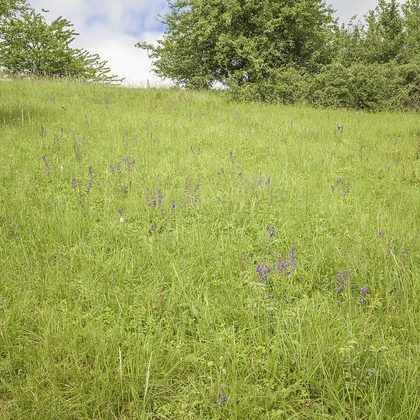
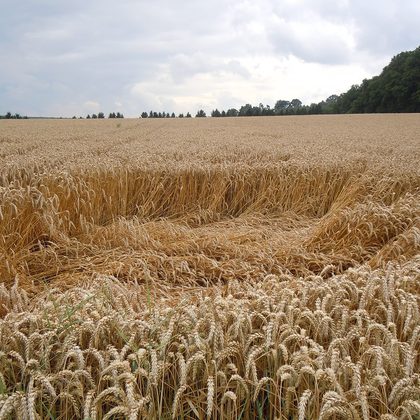
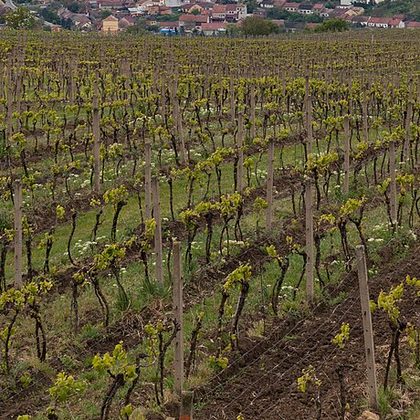
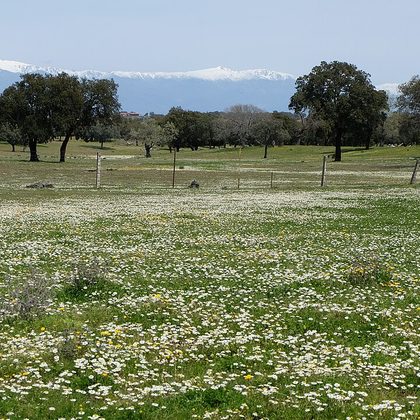
Open grassy ground and arable land in a Mediterranean climate, from sea level to about 3,000 m. The soil is decisive: a soil layer of intermediate depth, not stony, on a moderate slope, with a dense herb layer and preferably the shade of a tree canopy, but without shrubs. This includes verges and embankments, clover-rich pasture, hay meadow, fallow, lucerne, olive groves, vineyards, almond and citrus plantations, vegetable gardens, parks and the herb layer of dehesa and holm-oak pasture. It is absent on hard, shallow or rocky soils.
Where the animal is most at home, classified with EUNIS — the European standard for habitats.

Distribution
Southern and south-eastern France and the Iberian Peninsula: from the Languedoc, Provence, the Rhône valley and the foothills of the French Pyrenees through Andorra across the whole of Spain and Portugal, except the north-western corner of Spain, where the Lusitanian Pine Vole occurs. The total range is estimated at about 532,000 square kilometres. In Spain it is, together with the Wood Mouse, the most widespread small mammal: it occurs on the Meseta, in the Ebro valley, the Levant, Andalusia and Catalonia, from the coast to high mountains, and is absent only from Galicia, western Asturias and León and very shallow soils. The northern limit runs roughly along the Rhône at the latitude of the Drôme and Ardèche and from there follows the limit of the Mediterranean climate. It is absent from the rest of France and from northern and central Europe.
- Native
- dark = core range, pale = thinly spread
Way of life
Almost entirely subterranean, and therefore difficult to observe: it spends most of its time in the tunnel system and comes above ground mainly after dark. It climbs well and swims very well. It eats mainly underground plant parts — bulbs, tubers and roots, with a marked preference for Bermuda buttercup and autumn crocus — and much less green leaves and fruit. It lives in small colonies averaging three animals, with a home range of about 50 square metres; the mating system is monogamous and the degree of inbreeding is high. In northern Spain and France it breeds all year, with a peak from November to May and the maximum in February and March; in southern Spain breeding is restricted to winter, outside the summer drought. After a gestation of 24 days one to five naked, blind young are born — on average two in the south, almost three in the north — which are sexually mature at 60 to 70 days. Males live up to 33 months, females up to 27; in the wild it normally survives two winters. It does not enter winter torpor.
Where and when to look
Look for the heaps, not the animal. They can be found all year and are most visible after rain, when the ground is soft; walk a verge, orchard edge or olive grove in Provence, the Languedoc, Catalonia, the Levant, the Ebro valley or on the Meseta. Make the comparison with the mole: brush a heap aside and see where the tunnel is, at what angle it enters the heap and whether there are stones in the soil. The animal itself can only be seen at dusk or at night, close to a fresh opening, especially after heavy rain or when a vegetable plot is dug over. Many animals are found because cats bring them in.
Conservation status
Least Concern (LC, 2024), with a large, continuous range and locally high densities. In citrus, almond and stone-fruit plantations in Spain and southern France it can damage the roots and collars of young trees at high densities, and it is controlled with poisoned bait. As with the Common Vole, this leads to secondary poisoning of owls, raptors, foxes and mustelids that eat the poisoned animals. Alternatives cited are management of ground cover and soil, keeping the tree base clear and providing perches and nest boxes for raptors. Outside cultivation it aerates and mixes the soil, and it is an important prey of Barn Owl, Little Owl, Grey Heron, Red Fox and Common Genet.
Scientific name
Microtus duodecimcostatus | (de Sélys-Longchamps, 1839)
De Sélys-Longchamps described the species in 1839 as Arvicola duodecimcostatus; because it was later moved to another genus, the author and year stand in brackets. Microtus is Greek, from mikros, 'small', and ous, genitive ōtos, 'ear', after the small ears hidden in the fur. duodecimcostatus is Latin for 'twelve-ribbed', from duodecim, 'twelve', and costa, 'rib', after the twelve pairs of ribs de Sélys-Longchamps counted in the animal. The specimen the first description was based on came from France, Hérault.