All species › Carnivores › True seals › Harbour seal
Harbour seal | Phoca vitulina
Gewone zeehond | Foca común
The Harbour Seal lives in shallow, sheltered coastal seas of the northern hemisphere; in Europe from the Wadden Sea and the British and Irish coasts to Norway, the Barents Sea and Iceland. At low water it rests on drying banks and rocks with head and hind flippers raised, and it enters the water on the rising tide. In the Wadden Sea the species declined strongly through hunting, then recovered, and was decimated by a virus epidemic in 1988 and 2002; each time the population recovered.
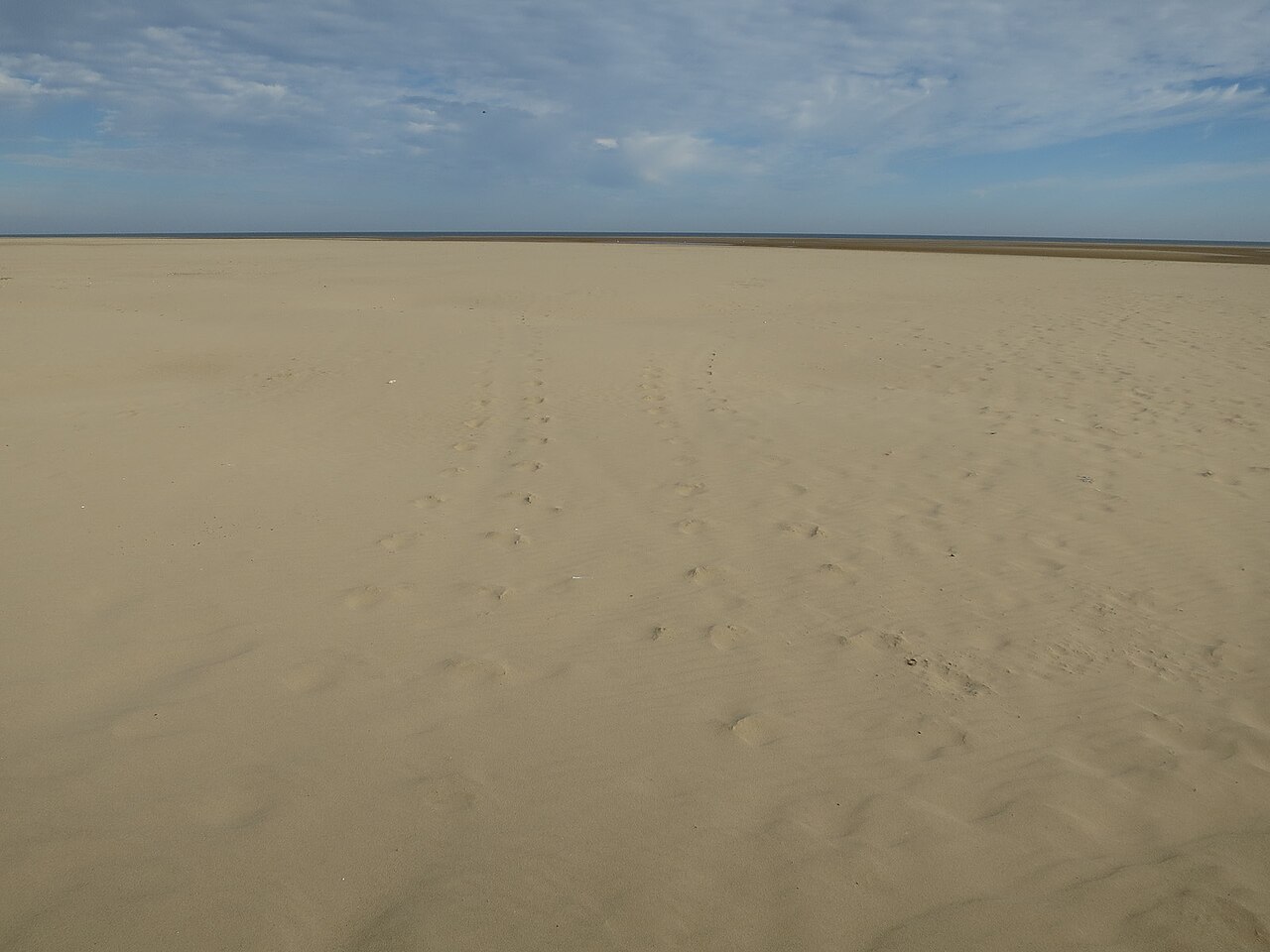
Tracks
The drag trail resembles that of the Grey Seal but is narrower: a smooth groove 25 to 40 cm wide from the water to dry ground, with the slanting scrape marks of the fore flippers on either side and sometimes a slight weave where the animal pushed off. On a soft wet flat the groove is sharply defined and disappears at the next high water; a trail found is therefore from the same tide. It runs almost always at right angles to the water's edge. At the end lies the haul-out, a shallow scoured hollow on the highest part of the bank, and around it in summer moulted hair: tufts of short grey hair in the strandline, in July and August sometimes covering whole stretches of beach. Fresh droppings are a shapeless oily mass that washes away quickly; what remains are the otoliths, the calcareous ear stones of the prey fish, glossy white grains in the sand from which researchers determine a colony's diet. Sound: a disturbed Harbour Seal gives a short coughing bark; a pup without its mother calls with a thin, persistent wail that carries far across the flats.
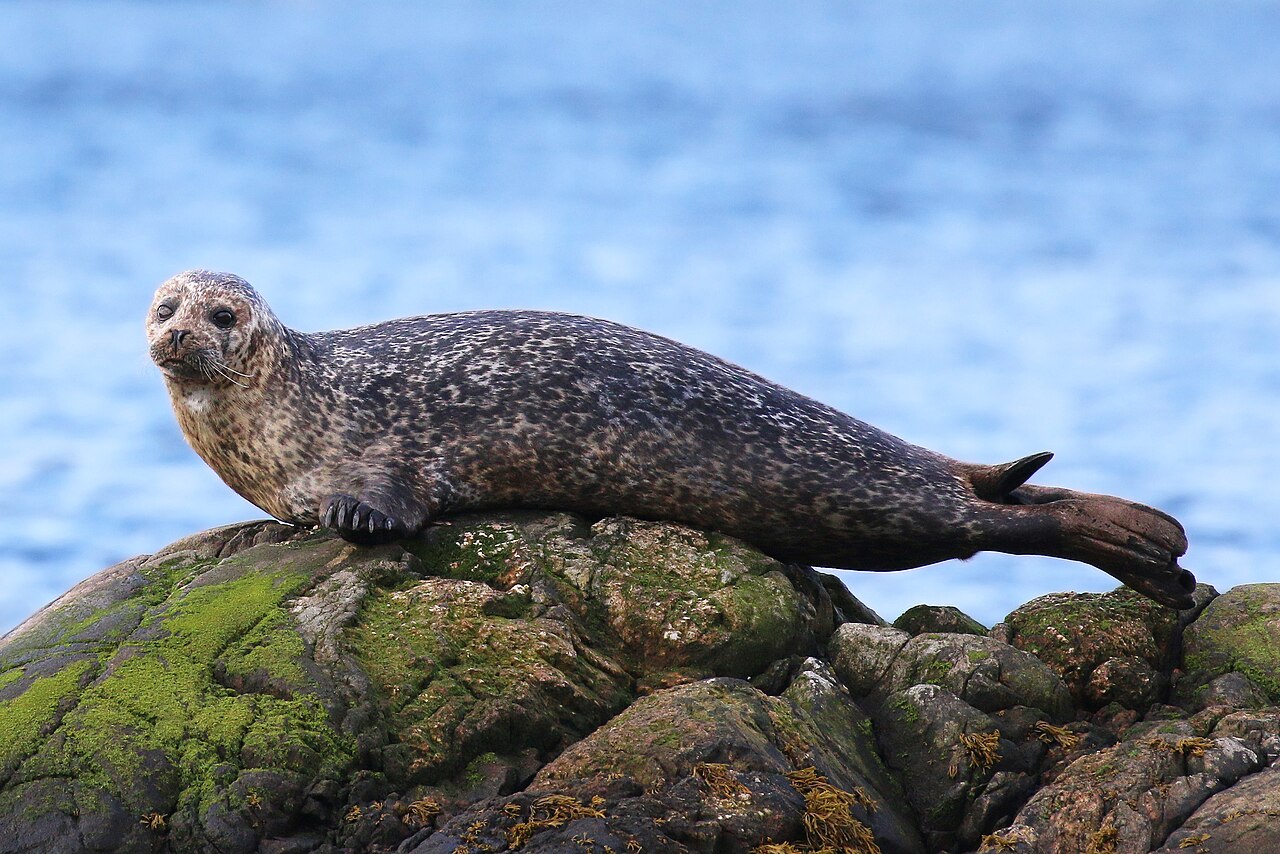
In its habitat
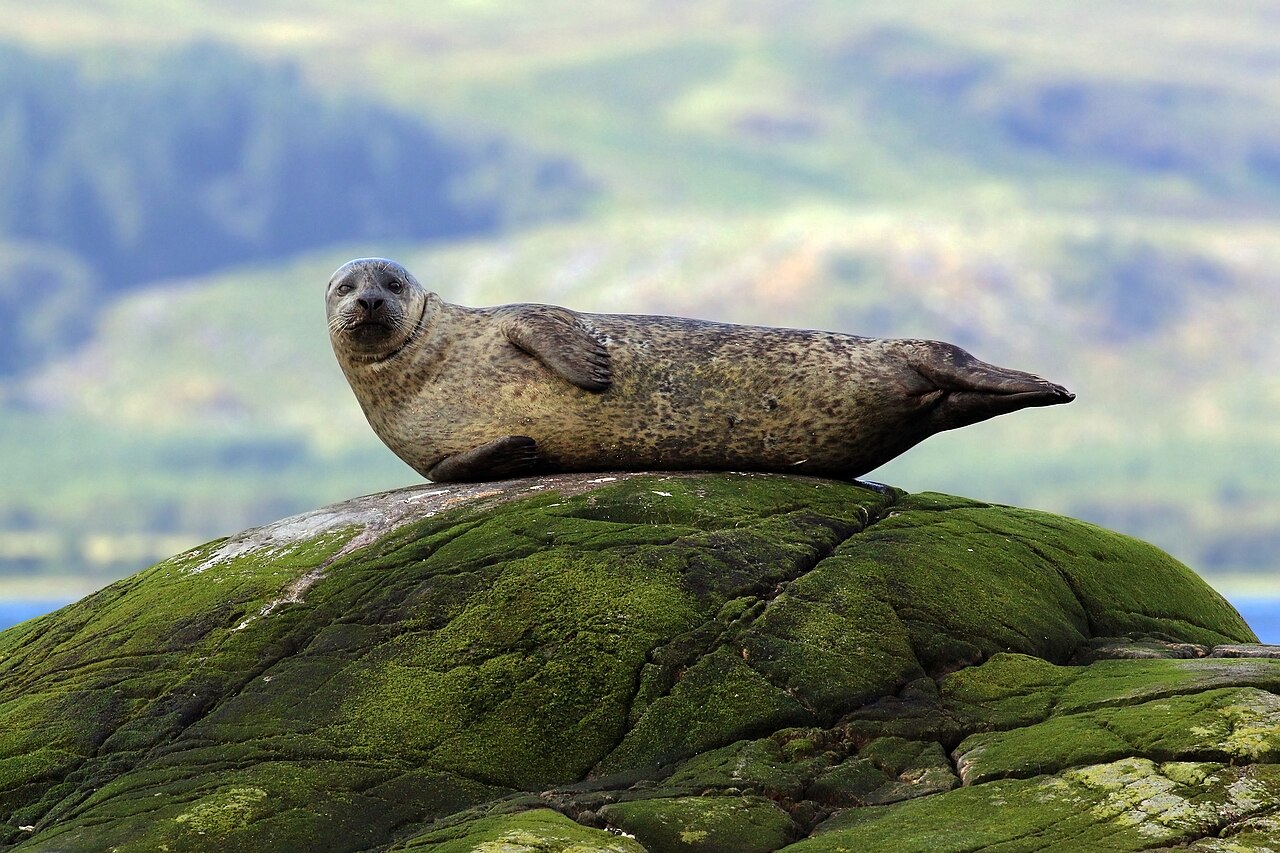
Head close-up
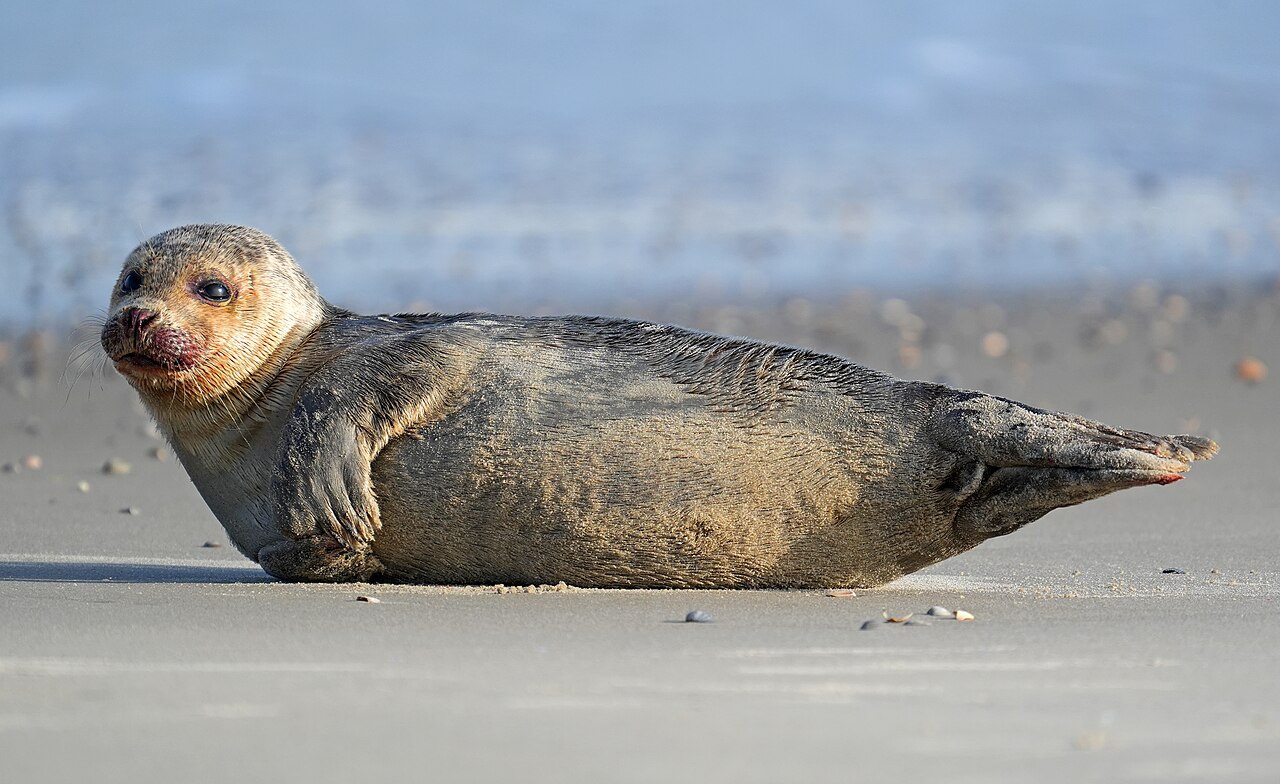
The young
Identification
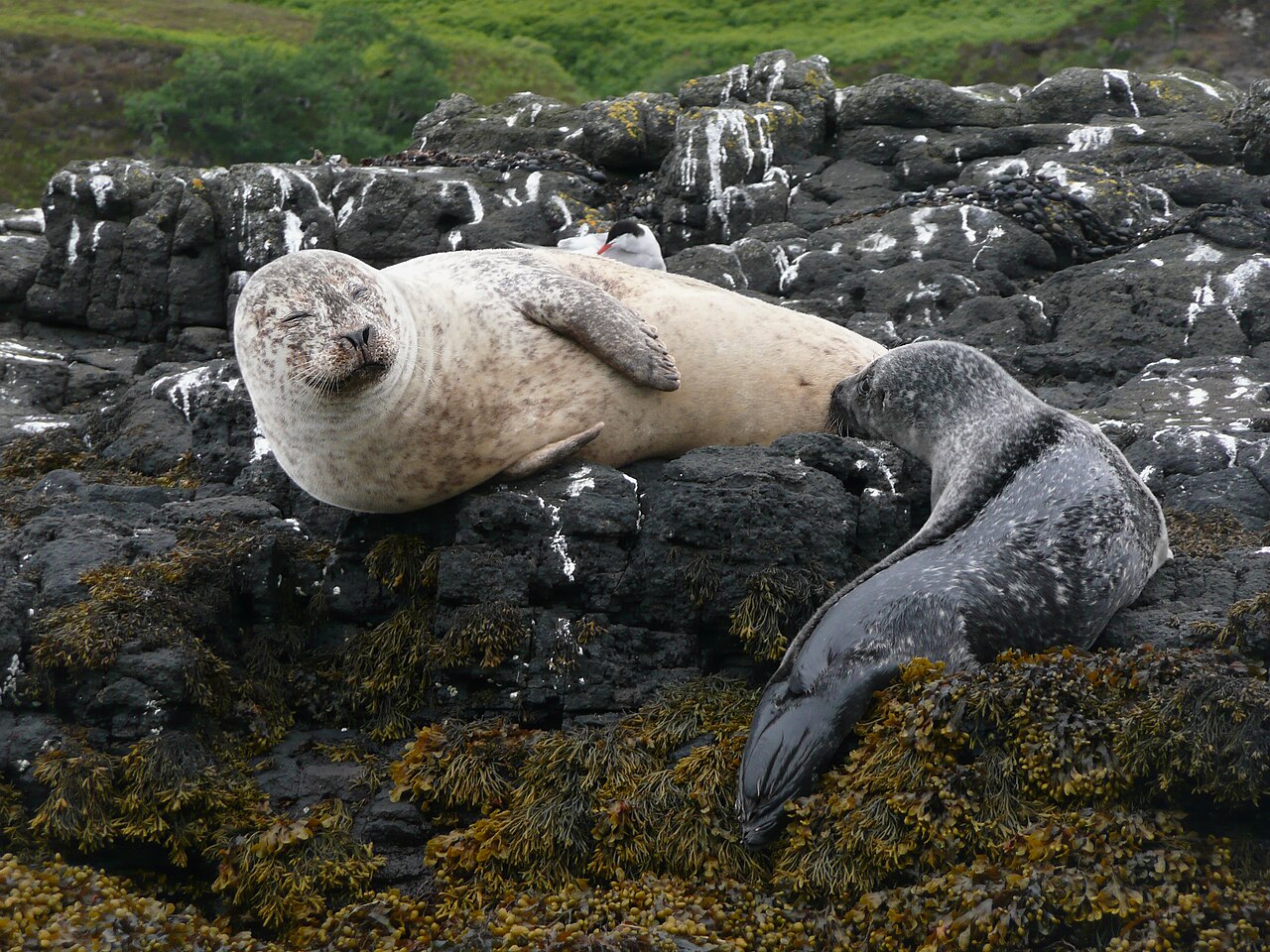
Smaller and rounder than the Grey Seal, with a short, dished muzzle and a clear step in front of the eyes; the head profile is not conical. The nostrils form a V: they almost meet below and diverge upwards. The coat is grey, sandy or dark brown, always with fine, round, sharply edged spots and rings, denser on the back than on the belly; a wet animal looks plain dark, and the pattern is visible on a dry animal. The eyes are large, close-set and forward-facing. The sexes barely differ in size. The posture ashore is characteristic: head raised and hind flippers lifted, so that the body is arched and only the belly touches the ground.
Similar species
The Grey Seal is the main confusion species; on mixed haul-outs the two lie together. The most reliable feature is the head: the Harbour Seal has a short dished muzzle and V-shaped nostrils, the Grey Seal a long, straight, conical muzzle without a step and parallel nostrils with a gap between them. The Grey Seal is also larger and heavier, has irregular blotches rather than spots, and lies flat rather than arched. A full-grown Grey Seal bull can be recognised at a distance by its heavy neck; a young Grey Seal and an adult Harbour Seal can be separated only by the head. In the Baltic the Ringed Seal occurs: smaller, with a shorter muzzle and a dark back with pale rings rather than spots. Rare visitors from the north, Harp Seal and Hooded Seal, are almost always found as young animals on a beach and can be recognised by the pattern: the Harp Seal silver-grey with sharp black spots, the Hooded Seal blue-grey above with a sharp division from the cream belly.
Habitat
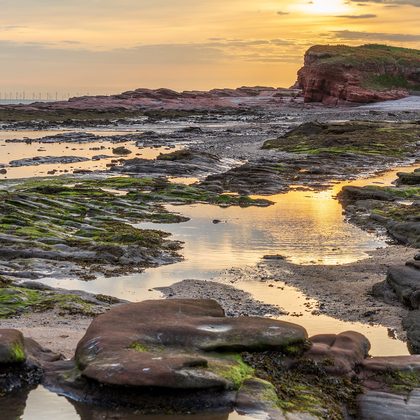
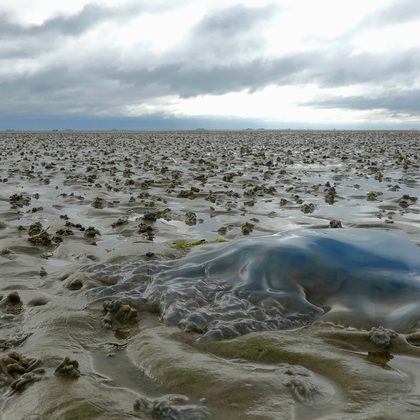
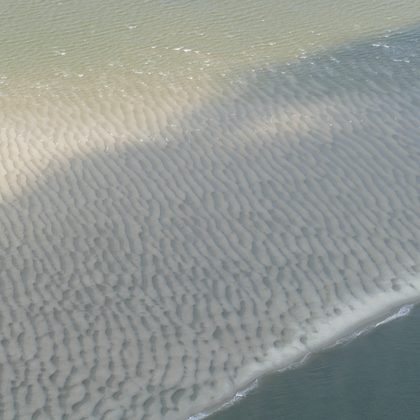
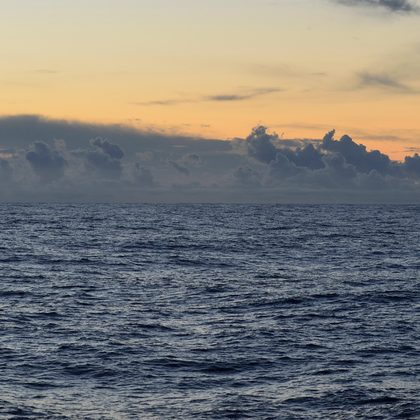
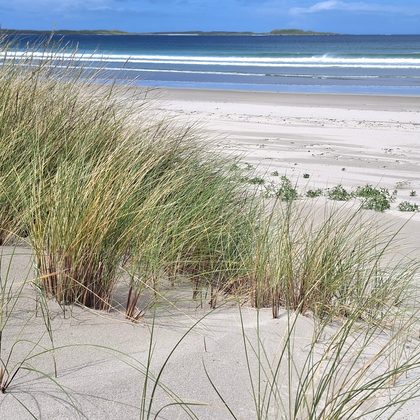
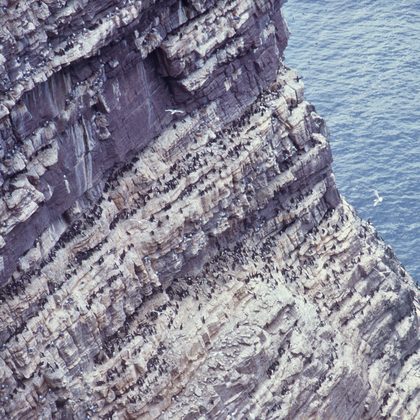
Shallow, sheltered coastal seas with drying sandbanks, tidal flats, estuaries and inlets, and in the north and west also rocky shores, boulder beaches, fjords and sea lochs. The species stays close inshore and hunts flatfish, herring, whiting, gobies and shrimp, usually within fifty kilometres of the haul-out and to depths of a few tens of metres. It regularly enters river mouths and tidal inlets and is seen tens of kilometres inland in the Ems, the Elbe, the Thames and the Scottish sea lochs. The haul-out dries at low water and borders deep water, into which the animal can slide at once when disturbed.
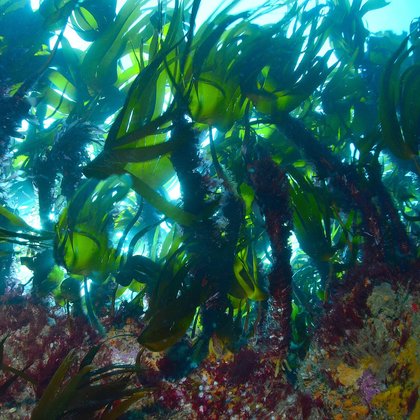
Where the animal is most at home, classified with EUNIS — the European standard for habitats.
Distribution
Around the northern hemisphere in the Atlantic and Pacific; the European subspecies vitulina from Portugal to the Barents Sea and around Iceland. Within the guide area it is most numerous in the Wadden Sea, along the British and Irish coasts and in Norway and Iceland. Britain holds a large share of the European population, concentrated in western and northern Scotland (Hebrides, Orkney, Shetland), with important groups in the Wash, Strangford Lough and the Thames estuary; the populations on the Scottish east coast have declined sharply since 2000, for reasons still under discussion. In the Wadden Sea numbers trebled between 1990 and 2013; growth then levelled off, and since 2022 a slight decline has been measured. In the Dutch Delta a resident population lives in the Oosterschelde, the Westerschelde and Lake Grevelingen; animals appear every year along the Belgian coast and also swim into the Zwin and the Scheldt. In the Baltic only in the south-west, with small isolated groups in the Kattegat and near Kalmar. The southern limit of the breeding range lies in Brittany. The species does not breed in the Iberian Peninsula; there are scarce but regular records of vagrants on the Cantabrian coast, in Galicia and on the Portuguese coast, mostly young of the year, and a few animals have swum up the Guadalquivir and other rivers.
- Native
- dark = core range, pale = thinly spread
Way of life
Ashore by day, following the tide: the animal is left dry on the ebb and leaves on the flood; most animals are hauled out in the two hours either side of low water. Dives for three to five minutes, exceptionally half an hour, and hunts by sight and with the whiskers, which can follow the water turbulence behind a swimming fish. Pups are born from June to July, in the Wadden Sea between mid-June and late July, one per female, on a drying bank or a rock ledge. Unlike the Grey Seal the pup is already moulted at birth: the white lanugo is shed in the womb. The pup can swim within hours and follow its mother into the water. It is suckled for four weeks and doubles its weight in that time. Mating takes place in the water shortly after weaning; the males then make a mournful knocking call under water. In August the adults moult and spend long periods ashore. Lifespan up to twenty-five to thirty years.
Where and when to look
Watch in the two hours around low water, from a sea wall, a ferry or on a tidal-flat or boat trip. Known sites are, in the Wadden Sea, the Boschplaat on Terschelling, the Engelsmanplaat and the Richel near Vlieland; in the Dutch Delta the banks near the Brouwersdam and in the Oosterschelde; in Britain the Wash and Blakeney Point in Norfolk, Donna Nook, the Farne Islands, the Moray Firth and the skerries of the Hebrides and Orkney; the Thames estuary holds several thousand animals. With a telescope the species of every animal can be determined from the head. Keep at least three hundred metres away: a seal that raises its head and looks at you is already disturbed, and animals that leave the bank lose the rest they need for digestion and moult. In July pups are present; leave a lone pup alone, as the mother is almost always in the water nearby. A young animal on a bathing beach is not necessarily in distress.
Conservation status
Least Concern (LC, 2016). The Wadden Sea population numbers some tens of thousands of animals. In 1988 and again in 2002 phocine distemper virus killed more than half of all animals in the North Sea; both times the population had recovered within ten years. Recently numbers in the Wadden Sea have stopped rising and pups grow more slowly; possible explanations are competition for food and disturbance. Further threats are bycatch in fixed nets, disturbance by pleasure craft and drones, the unexplained decline on the Scottish east coast, and a slowly falling but still measurable PCB burden.
Scientific name
Phoca vitulina | Linnaeus, 1758
Linnaeus described the species in 1758 and placed it straight away in the genus where it still stands. Phoca is Latin phoca, 'seal', borrowed from Greek phōkē. vitulina is Latin for 'of a calf', from vitulus, 'calf'; sea-calf was the animal's old name. The specimen the first description was based on came from Baltic Sea, Gulf of Bothnia.