All species › Bats › Mouse-tailed bats › Greater mouse-tailed bat
Greater mouse-tailed bat | Rhinopoma microphyllum
Egyptische klapneusvleermuis | Rhinopoma microphyllum
The largest species of mouse-tailed bat (Rhinopomatidae), a family of dry regions from North Africa to India with a long, thin tail that projects largely free beyond the tail membrane. The species was described in 1782 by Morten Thrane Brünnich; the type locality was later fixed at Giza in Egypt. Within the guide area it lives in the Maghreb, the Nile Valley and the Levant, where it spends the winter in a shallow torpor lasting months.
No photograph of a living wild animal of this species with a suitable Creative Commons licence exists. Do you have one that meets the rules? Send it in.
Tracks
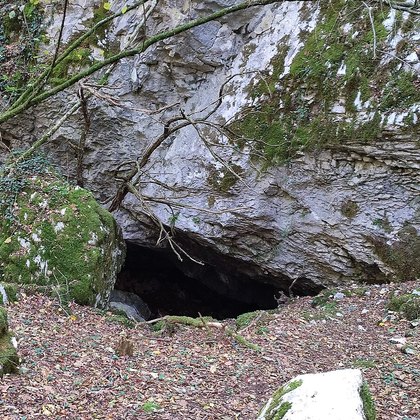
The species roosts in rock crevices, small and large caves, mines, underground tunnels, wells, old monuments and buildings, tolerating low humidity and daylight. In large roosts the bats hang in compact clusters in body contact; colonies usually number tens to a few hundred, but can reach tens of thousands. Activity in the colony rises for about an hour before emergence. Emergence begins about ten minutes after sunset, in groups of tens to hundreds. On a detector the calls are long, flat pulses around 28 kHz.
Identification
A fairly large bat with a forearm of 57 to 74 mm and a weight of 14 to 40 g, heaviest in late summer. The family character is the long, thin tail, which projects mostly free beyond the narrow tail membrane; in this species the tail is usually shorter than the forearm (92 per cent of it on average) and sometimes looks thicker. The large ears are joined at the base by a fold of skin across the forehead. The muzzle carries a broad, trapezoid nasal pad with slit-like nostrils that can close; a true nose-leaf is barely developed. The fur is fine and silky, each hair uniformly coloured, dull grey to tawny or reddish brown, paler below, sometimes whitish. Echolocation consists of long, near-constant-frequency pulses with several harmonics, most energy in the second harmonic at 27 to 31 kHz: mean 28 kHz in Jordan and Israel, 27.1 kHz in Iran and 28.2 to 31.2 kHz in Algeria. Pulses last 9 to 15 milliseconds.
Similar species
Rhinopoma cystops, the Arabian Mouse-tailed Bat, is the only other mouse-tailed bat in the guide area and shares winter colonies with this species in Israel. It is smaller (forearm 50–67 mm, weight 6.5–17 g) and has a tail clearly longer than the forearm (116 to 137 per cent) and longer shins; the second harmonic of its call lies higher, around 32 to 37 kHz. The Lesser Mouse-tailed Bat (R. hardwickii) resembles R. cystops but, as currently defined, lives only from south-eastern Iraq eastwards. The European Free-tailed Bat (Tadarida teniotis) and the Naked-rumped Tomb Bat (Taphozous nudiventris) also have a partly free tail, but in them only the last section projects beyond the membrane, not a long, thin mouse-like tail.
Habitat
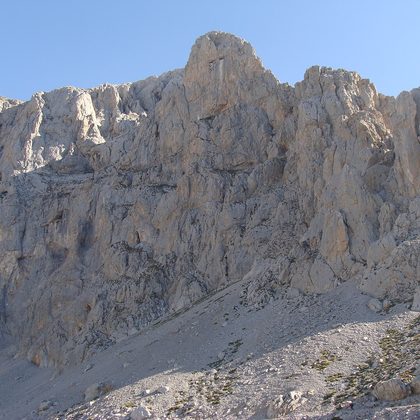
Arid regions with sparse vegetation, usually with less than 300 mm of rain a year: rocky desert and, in the south of the range, semi-desert. It occurs from sea level in Egypt to 1200 m in Morocco. The bats forage in open space. In Israel male summer roosts lie higher in the landscape than female ones, and the sexes forage in different places. In winter they prefer geothermally heated caves there, with a fairly constant temperature of about 20 °C and almost 100 per cent humidity.
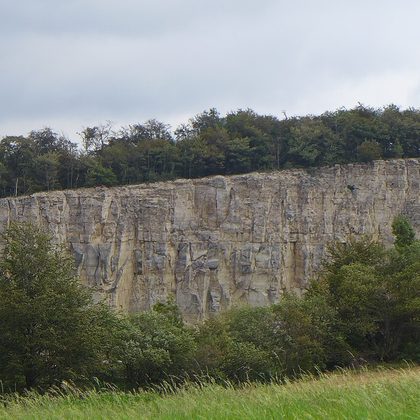
Where the animal is most at home, classified with EUNIS — the European standard for habitats.



Distribution
Confirmed from north-west Africa, the Sahel and the Nile Valley east through the Middle East and western Arabia to north-western and central India; a few mostly historical records suggest occurrence in eastern and south-eastern India. Listings for Bangladesh, Myanmar, Thailand and Sumatra are not supported by recent records; a report from Lombok rests on misidentification. Within the guide area it occurs in Morocco and Algeria, in the Nile Valley in Egypt and in the Levant (Israel, Jordan, Lebanon). The handbook treats the species as monotypic; six formerly described subspecies differ mainly in mean size, and their status needs revision.
- Native
- dark = core range, pale = thinly spread
Way of life
In the north of the range the species spends winter in torpor: in Israel for five months, November to March, in large winter colonies. The bats remain torpid without periodic arousals, do not leave the roost to feed and live on fat reserves; skin temperature is 1 to 3 °C above cave temperature, and a breathing cycle can last up to 16 minutes. Below 16 °C they switch to normal body temperature. In May, on arrival at the summer roosts, they take a broad range of prey, mainly beetles and moths; from July to September more than 90 per cent of the diet is large winged ants (Camponotus), and in that period males gain weight rapidly (25 to 39 g on average). Groups forage together; one female flew up to 90 km in a single night. Mating takes place in March-April, before the sexes separate for summer. In Israel a single young is usually born in early July; gestation has been estimated at about 123 days in India. Females probably mature only in their second year. In Israel the largest summer colonies hold 3000 to 6000 males or 5000 to 10,000 females.
Where and when to look
A known colony in northern Israel, where the species occurs at high densities, gives, at emergence shortly after sunset, groups of large bats with a visible thin tail. A detector listening around 28 kHz picks up the long, flat pulses; if there are also calls around 34 kHz, R. cystops is present as well. According to studies in Israel, hibernating mouse-tailed bats do not arouse periodically, respond instantly to stimuli and fly off quickly when disturbed; every disturbance costs fat reserve that has to last until spring.
Conservation status
Least Concern globally (LC, 2016). The species is widespread and common with no major threats; in some regions, particularly the Sahel and West Africa, it is known from only a few scattered records.
Scientific name
Rhinopoma microphyllum | (Brünnich, 1782)
Brünnich described the species in 1782 as Vespertilio Microphyllus; because it was later moved to another genus, the author and year stand in brackets. Rhinopoma is Greek, from rhis, genitive rhinos, 'nose', and pōma, 'lid', after the flaps with which the animal can close its nostrils. microphyllum is Greek for 'small-leaved', from mikros, 'small', and phyllon, 'leaf', after the small nose-leaf. The specimen the first description was based on came from Egypt, Giza.