All species › Rodents › Mice and rats › Fat-tailed gerbil
Fat-tailed gerbil | Pachyuromys duprasi
Dikstaartmuis | Pachyuromys duprasi
The Fat-tailed Gerbil is a gerbil that stores fat reserves in its tail, which is short, thick, pink and almost naked. It is the only species of the genus Pachyuromys. The species lives on the bare high plateaus of the northern Sahara and differs markedly in build from other North African rodents.
Tracks
The track lies in sand and fine grit and is that of a walker, not a jumper. The print is small, fore and hind foot both less than two centimetres, and the prints alternate left and right in a narrow line, without the paired impressions of a jerboa. The hind foot is short and broad and leaves a complete, broad impression rather than the long, narrow impression of a Gerbillus. On soft ground a shallow, continuous drag mark of the heavy tail often runs alongside the line of prints; this is the most reliable distinction from other gerbils on the same terrain. The burrow is the most conspicuous sign: a system in a sandy slope or in hard sandy loam with three to twelve entrances, with tunnels only five to thirty centimetres below the surface and a nest chamber down to about a metre, a fan of sand at each entrance and often a plugged entrance by day. Droppings are small, dark and dry, up to four millimetres, and lie scattered around the burrow rather than in a latrine. The feeding signs are those of a seed-eater that also eats insects: gnawed colocynth pips, empty seed coats and hard parts of beetles and grasshoppers at the burrow entrance.
In its habitat
Head close-up
Identification
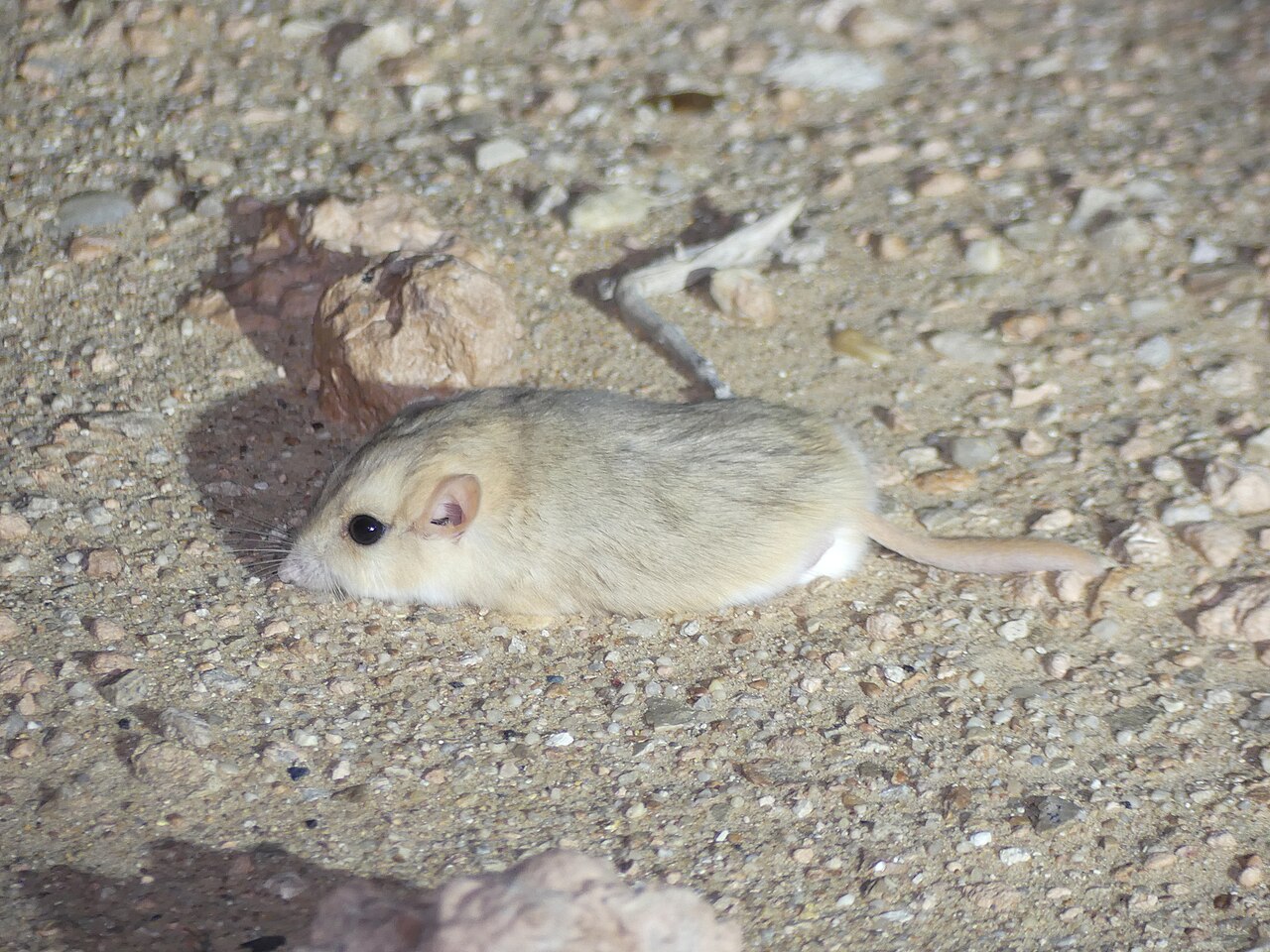
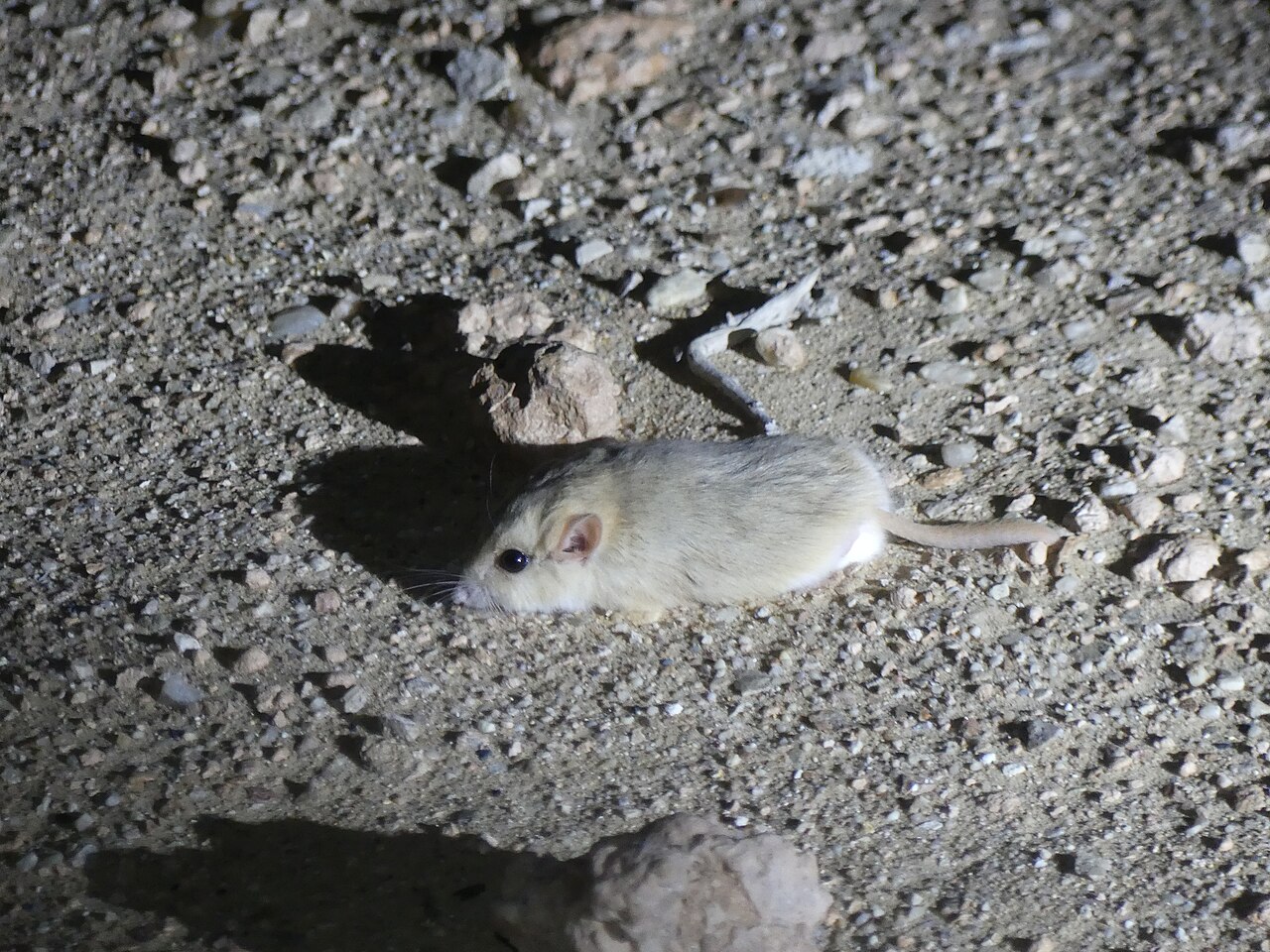
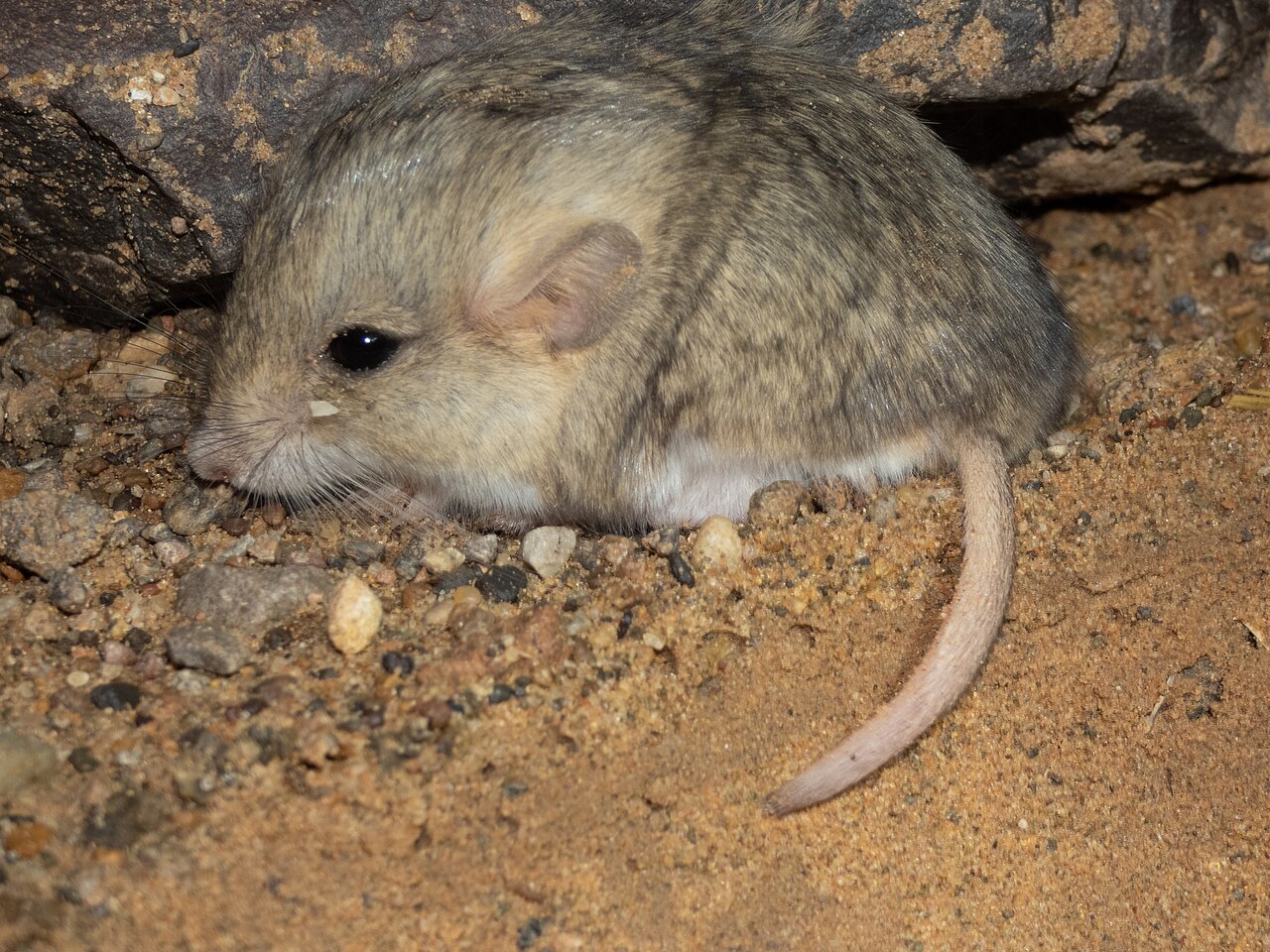
A short, thickset, almost round gerbil of nine to twelve centimetres, with short legs and a tail of only five to six and a half centimetres, about half the head-body length; all other gerbils in this region have a tail longer than the body. The tail is the main character: thick, club-shaped, pink and almost hairless, and it varies in size with the seasons because fat is stored in it. The back is sandy yellow to grey, each hair with a dark grey base and a small black tip; the belly is pure white. The eyes are large, oval and black and set high in the head; the ears are small for a gerbil (12 to 16 mm). The hind feet are short and broad (22 to 24 mm). Weight in the wild 22 to 45 grams, in captivity over eighty grams. The skull has a very large braincase and greatly inflated auditory bullae, so that the head is broad and round.
Similar species
Confusion hardly occurs, because of the distinctive tail. All gerbils of the genus Gerbillus in the same landscape (Lesser Egyptian Gerbil, Flower's Gerbil, Gerbillus andersoni, Gerbillus dasyurus) are slim, have long hind legs and a thin, haired tail longer than the body ending in a tuft. They move by leaping; the Fat-tailed Gerbil moves with short steps. The Fat Sand Rat (Psammomys obesus) and the jirds of the genus Meriones are larger and more heavily built, but also have a long, haired tail with a dark terminal tuft. The only real possibility of confusion is a Gerbillus that has lost its tail: it has a tail stump, but this is thin and haired, not a pink club, and the animal is slimmer and higher on the legs. Captive Fat-tailed Gerbils are much fatter than wild animals; this should be taken into account when comparing terrarium photographs with field records.
Habitat
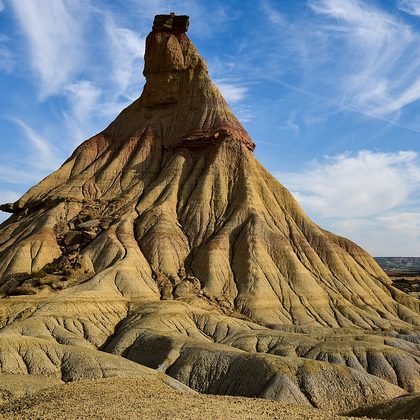
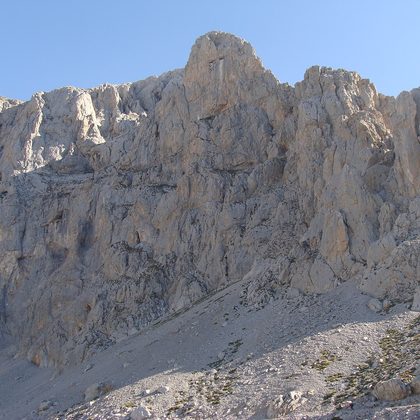
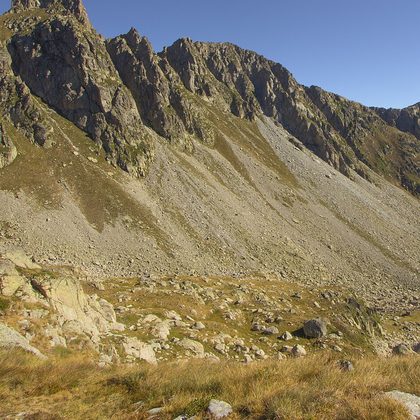
Bare, hard and dry areas: the high plateaus and hamadas of the northern Sahara, stony plateaus with hardly any vegetation, plains of hard, compacted sandy loam, scree slopes and wadi margins, with here and there a tussock of drinn grass or a colocynth plant. For the burrow a slope of firm sand or sandy loam is chosen in which a tunnel does not collapse; loose drifting sand is avoided, and in this the species differs from most Gerbillus species in the same area. The species also occurs in broad salt depressions and along the edge of dry steppe, as long as the ground is firm. It is absent above a thousand metres and in vegetated areas.
Where the animal is most at home, classified with EUNIS — the European standard for habitats.
Distribution
The arid regions of North Africa: Morocco and Western Sahara, northern Mauritania, Algeria, northern Mali, Tunisia, Libya and Egypt, with the type locality at Laghouat on the Algerian plateau. The northern part of the range comprises the Maghreb north of 29°N, the Libyan desert margin and north-western Egypt, including Wadi Natrun, after which one of the old names of the species was coined. The species occurs at low densities over a very large area and is nowhere numerous. Records are sparse and unevenly distributed, which is mainly related to the low observer effort in this region at night.
- Native
- dark = core range, pale = thinly spread
Way of life
Crepuscular and nocturnal and always on the ground. The species digs its own shallow burrow system and plugs the entrances by day. Largely a seed-eater: pips and fruits of colocynth and henbane, green succulent plant parts, and in addition a considerable proportion of insects; in the field the species has been described as often as insectivorous as granivorous, and the diet probably varies by season. The Fat-tailed Gerbil does not drink and obtains moisture from its food. Fat is stored in the tail: with a good food supply it swells and in lean periods it shrinks again. On cooling the animal enters torpor for days, with a greatly reduced metabolism. In the coldest weeks of the Saharan winter it therefore has an interrupted winter rest, with periods of foraging, rather than true hibernation. The species is solitary, sometimes in loose groups; animals released two kilometres away found their way back to their burrow. Gestation is nineteen to twenty-one days, with two to six young, which open their eyes at eight days and are weaned at three weeks; at two months they are adult. In captivity the species lives two to four years.
Where and when to look
After sunset drive at walking pace along a firm desert track on the Algerian or Tunisian plateau, or in north-western Egypt, and search with the headlights: in the first two hours after dark the animals cross, and the silhouette (small, round, short-tailed, walking rather than leaping) is immediately distinguishable from that of leaping gerbils. By day look for burrow systems on sandy slopes and count the entrances: three to twelve together with fresh spoil fans do not indicate a Gerbillus. Look in the sand for the continuous drag mark of the tail. The species occurs at low densities; often no more than one animal is seen per night.
Conservation status
Least Concern (LC, 2016). The habitat (bare hamada and hard sandy loam plains) is hardly brought into cultivation, and the species occurs over a very large area. Little, however, is known about the wild population: most knowledge of the species comes from laboratories and from keeping in terraria, where it is popular as an easily kept rodent, and not from field research. There is no clear picture of densities, population fluctuations or the effect of overgrazing on the steppe plants whose seeds it eats. There is no evidence of threat, but knowledge of wild populations is limited.
Scientific name
Pachyuromys duprasi | Lataste, 1880
Lataste described the species in 1880 and placed it straight away in the genus where it still stands. Pachyuromys is Greek, from pachys, 'thick', oura, 'tail', and mys, 'mouse', after the short tail in which the animal stores fat. duprasi honours a Dupras; Lataste gives no explanation of the dedication and who is meant has not been established. The specimen the first description was based on came from Algeria, Laghouat.