All species › Carnivores › Mustelids › European mink
European mink | Mustela lutreola
Europese nerts | Visón Europeo
The European mink is a small, semi-aquatic mustelid of streams, rivers and marshes. Since the start of the twentieth century it has declined by more than 90% and now occupies less than 3% of its former range. The IUCN assesses it as Critically Endangered. The Danube Delta population is regarded as the main viable population; the Spanish population was estimated at 142 animals in 2022 and the French at fewer than 250 in 2014.
Tracks
The print is 20 to 30 mm long without claws (on average 26.5 mm in males and 22.5 mm in females) and about as wide, with five toe pads and a four-lobed interdigital pad. Prints of European and American mink are practically indistinguishable. They differ from the polecat in the claws of the forefoot, which are about twice as long in the polecat, and in the shape of the main pad and the spacing of the toes. The normal gait is a bound, with an average bound length of 35 cm; trotting or walking gives strides of about 23 cm. The scat averages 5.6 cm long and 7.5 mm thick, cylindrical and usually bent, olive green to black. Deposition differs: American mink leave scats conspicuously on stones and form latrines, European mink hide theirs in dense bank vegetation.
Identification
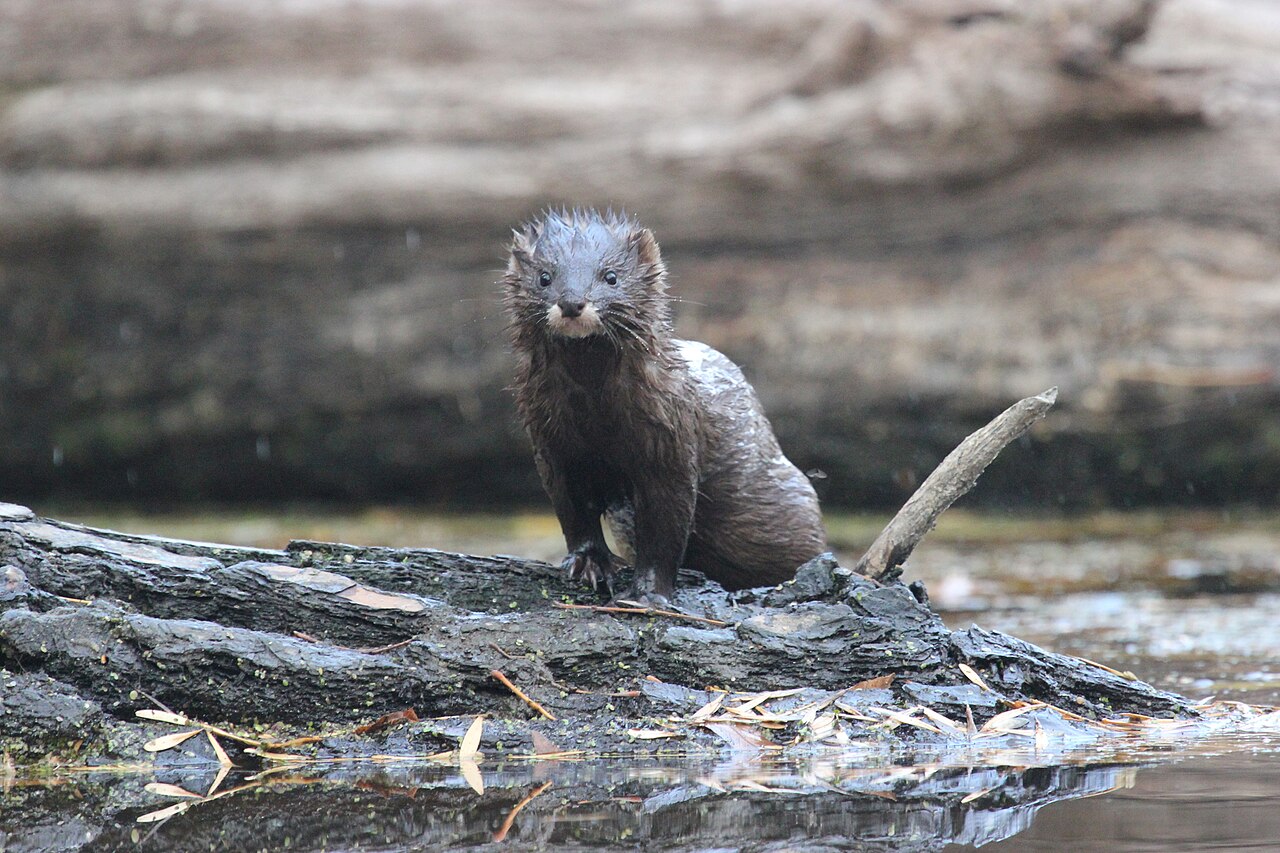
A slender, low-slung mustelid with short legs, a flat, narrow head and a tail about half the length of the body. The fur is short, dense and uniformly reddish brown to dark brown, slightly paler below. The decisive feature is the white around the mouth: both the upper and the lower lip are white, so that the white encircles the whole muzzle; there are sometimes also white patches on throat and chest. Males are larger than females: in Spain males weighed 360 to 960 g and females 338 to 460 g.
Similar species
The American mink is the main confusion species and also the main competitor. It is larger (males around 1500 g, females around 900 g), has a tail longer than half the body, and usually has white only on the lower lip and chin, not on the upper lip. Because white upper lips also occur in American mink, certain identification is often possible only in the hand or with DNA. The polecat has a pale underfur visible between the dark guard hairs and a white mask above the eyes and around the ears; young polecats are the most difficult. Hybrids between polecat and European mink occur in Spain and France.
Habitat
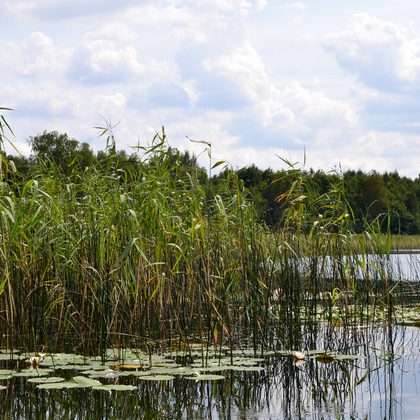
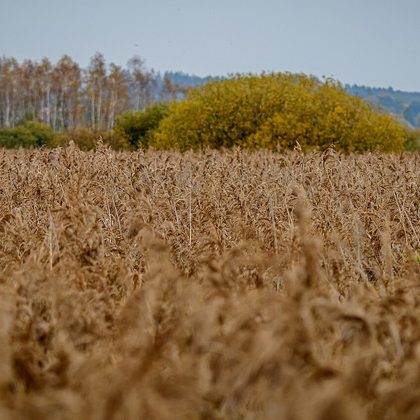
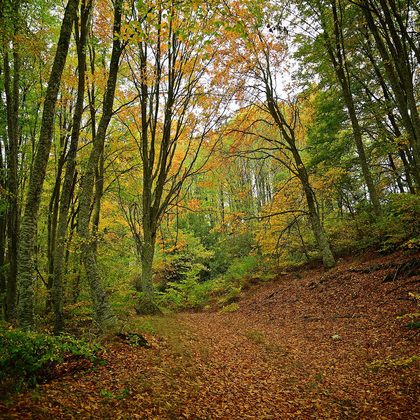
Streams, rivers and lakes with densely vegetated banks; it is rarely found more than 100 m from fresh water. In south-west France radio-tracked animals strongly preferred flooded habitats: open marsh, flooded woodland and wet heath, and rarely left the riparian woodland strips. In south-western Europe they used banks with bramble and scrub and little woodland. Rest sites are in crevices, among tree roots, in bramble thickets or in burrows, dug themselves or taken over from a water vole.
Where the animal is most at home, classified with EUNIS — the European standard for habitats.


Distribution
Formerly from northern Spain and France to beyond the Urals; now gone from Austria, Bulgaria, the Czech Republic, Germany, Hungary, Montenegro, Poland, Serbia and Slovakia, among others. Separate populations remain in northern Spain and south-west France, the Danube Delta (Romania and Ukraine), Russia and Estonia. The species appeared in Spain only after 1950. The Spanish population lives in the Ebro basin and its tributaries, in Navarre, La Rioja, the Basque Country, Castilla y León and Aragon. The French population is probably no longer connected to the Spanish one. On the Estonian island of Hiiumaa, 149 captive-bred animals were released between 2000 and 2004, and in August 2025 a first release of ten young followed in the Charente valley in France.
- Native
- dark = core range, pale = thinly spread
Way of life
Mainly nocturnal and crepuscular. It swims and dives well but also hunts on the bank. Food consists of small mammals, birds, amphibians, fish, crayfish and insects; the water vole is often the main prey. In northern Spain scats contained 36.9% small mammals (mainly wood mouse), 30.6% fish (mainly barbel) and 17.8% birds. In Belarus three of nine animals studied specialised in frogs and one in crayfish. Home ranges average 32 ha for males and 26 ha for females; males occupy adjoining river sections with little overlap. Mating is in February and March; 2 to 7, usually 4 or 5, young are born in April and May. Eyes open at 30 to 36 days, the young are weaned at ten weeks and mature at 9 to 10 months.
Where and when to look
A sighting in the wild is rare, and any mink along a Spanish or French river may be an American mink. If you see one, try to get the upper lip in the picture, and report the animal with a photograph to the regional conservation authority. Scats lie hidden in bank vegetation and cannot be told from those of American mink; identification ultimately rests on the animal itself or on DNA.
Conservation status
Critically Endangered (CR, 2016). It is estimated to occupy less than 3% of its original range and has declined by more than 90% since the start of the twentieth century. Causes are fur trapping, loss and fragmentation of banks and wetlands through hydroelectric schemes, channelisation and pollution, and competition from released and escaped American mink. Accidental trapping and poisoning during control of coypu and small carnivores, traffic, hybridisation with the polecat and low genetic variability also play a part. In Spain the population was estimated at 142 animals (130–157) in autumn 2022, after a decline of 70 to 80% in ten years; in France it was estimated at fewer than 250 in 2014. A European zoo breeding programme has existed since 1992; American mink are controlled in Spain and France.
Scientific name
Mustela lutreola | (Linnaeus, 1761)
Linnaeus described the species in 1761 as Viverra Lutreola; because it was later moved to another genus, the author and year stand in brackets. Mustela is the Latin word for 'weasel'. Its further origin is uncertain: it is usually read as a diminutive of mus, 'mouse', after the animal's small size or its mousing. lutreola is a Latin diminutive of lutra, 'otter', so 'little otter', after the animal's life in the water. The specimen the first description was based on came from Finland.