All species › Bats › Free-tailed bats › European free-tailed bat
European free-tailed bat | Tadarida teniotis
Europese bulvleermuis | Murciélago Rabudo
The European free-tailed bat is the only member of the free-tailed bat family (Molossidae) in Europe. It hunts fast and high in open air, from 10 to more than 100 m above the ground, and its echolocation calls lie around 12 kHz, within the audible range of many people. Roosts are in crevices in rock faces, cliffs, quarries and tall buildings.
No photograph of a living wild animal of this species with a suitable Creative Commons licence exists. Do you have one that meets the rules? Send it in.
Tracks
A sign without a sighting is sound: on summer and autumn evenings the high, metallic ticks of hunting bats that are themselves invisible can be heard over towns, gorges and rock faces. In the roosts, narrow crevices in rock faces, cliffs, quarries, bridges and tall buildings, the bats make loud social calls with which they defend small territories in communal roosts; these can be heard at the crevice by day or at emergence. Below a crevice in a rock face or wall there are sometimes droppings, relatively large for a bat, with moth remains. Groups usually number several dozen, from solitary males to maternity colonies of up to about 160 bats.
Identification
A large, robust bat with a wingspan of 40 to 45 cm and long, narrow wings. The tail projects well beyond the rear edge of the tail membrane, a family character. The ears are large, blackish and point forwards; their inner margins form a V-shaped notch on the forehead, and folded forward the ears reach beyond the muzzle. The tragus is short and hidden behind the large, nearly rectangular antitragus. The upper lip has four deep wrinkles on each side. The fur is velvety, ashy grey to brownish grey or reddish brown on the back without spots or frosting, and very pale brown to cream below. Wings, tail membrane and the underside of forearm and legs are blackish. Head-body 82 to 87 mm, tail 37 to 57 mm, ear 25 to 33 mm, forearm 56 to 64 mm, weight 20 to 40 g. Echolocation calls are narrowband, long (around 15 ms) and low, with a peak frequency around 11 to 13 kHz; in Tunisia the average was 12.2 kHz. Many people hear them with the naked ear as a series of sharp, metallic ticks from above.
Similar species
With its free tail, large forward-pointing ears and wrinkled upper lip the species cannot be confused with other European bats in the hand. In flight the greater noctule (Nyctalus lasiopterus) and the common noctule (Nyctalus noctula) are the most similar: they too hunt high and fast on narrow wings. On a bat detector their calls are higher, around 15 to 25 kHz, and usually inaudible to the naked ear; the greater noctule can come close to the range of the free-tailed bat. In the Nile Valley and the Levant the naked-rumped tomb bat (Taphozous nudiventris) is of similar size, with calls around 23 kHz; it has a naked rump, backward-pointing ears and a tail lying on the tail membrane. Swifts hunting high at dusk are sometimes taken for free-tailed bats in silhouette; swifts make no ticking sounds.
Habitat
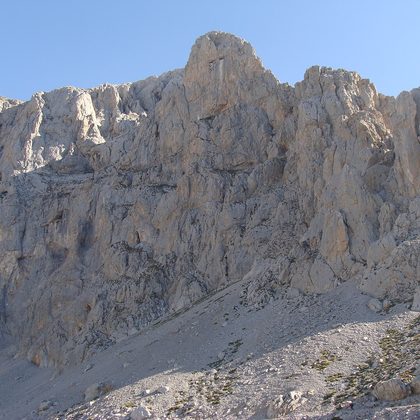
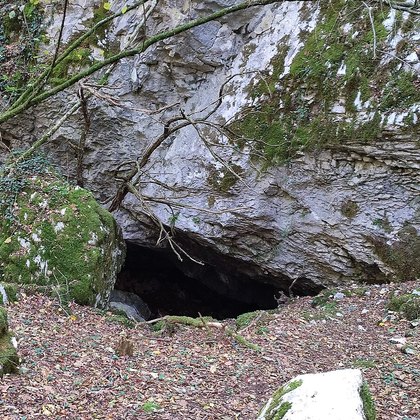
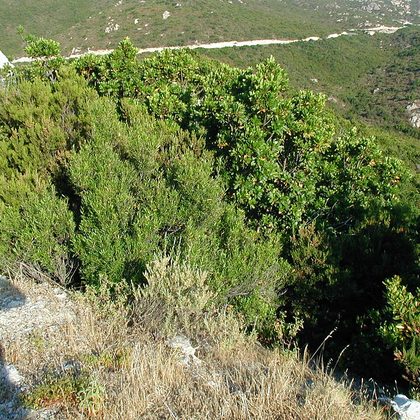
From temperate regions to semi-desert, from sea level to 3100 m. The decisive factor is the presence of vertical rock faces, cliffs or tall buildings with deep crevices; in North Africa the species lives mainly in rocky terrain. It hunts over a wide range of landscapes, from mountain valleys and coasts to woodland, farmland and towns, usually 5 to 15 km from the roost. Roosts are in rock crevices, cliffs, quarries, caves, buildings and bridges, in summer and winter within the same area.
Where the animal is most at home, classified with EUNIS — the European standard for habitats.




Distribution
The Mediterranean Basin, from the Iberian Peninsula and its islands east through southern Europe to the Balkans, the Caucasus and the Middle East, and in North Africa Morocco, Algeria, Tunisia, Libya and Egypt as far as South Sinai; also on the Canary Islands. Further east, discontinuously, Iran, Turkmenistan, Uzbekistan, south-eastern Kazakhstan, Kyrgyzstan, Tajikistan and Afghanistan, with isolated populations in eastern Nepal and northern Myanmar. The northern limit in Europe runs through the southern Alps, including Switzerland. East Asian populations formerly included in this species are now treated as T. insignis. Two subspecies based on colour have not been recognised since 2008, because the colour forms overlap throughout the range.
- Native
- dark = core range, pale = thinly spread
Way of life
Nocturnal. In Europe activity begins 39 to 65 minutes after sunset and can last up to ten hours without a rest. The species hunts in open air at 10 to over 100 m, mainly on moths (up to 88% of the diet in France, Israel and Kyrgyzstan), supplemented by beetles, lacewings and bugs. Many moths can hear ultrasonic calls; the low frequency of the free-tailed bat lies below their sensitivity. In Europe and Lebanon the species is seasonally monoestrous, with one young around June. It is sedentary and uses roosts in the same area in summer and winter. In winter it does not enter a long, continuous hibernation but uses short bouts of torpor and is active on mild nights. Falcons and owls are known predators.
Where and when to look
On a summer evening at a gorge, a sea cliff or in the old centre of a Mediterranean town, the ticks of hunting bats can often be heard without equipment, especially by younger people. A bat detector at 12 kHz makes them audible to everyone. At a known roost the social calls can be heard from the crevices, and at dusk the emergence can be watched: the bats drop from the crevice and then gain height quickly. The species can also be heard on mild evenings in winter.
Conservation status
Least Concern (LC, 2016); the population trend is unknown. Reported threats are disturbance and loss of roosts in buildings, deforestation in parts of the range, pesticide use and possible effects of wind turbines. The species is listed in Annex IV of the Habitats Directive and is covered by the Bern Convention and the EUROBATS Agreement.
Scientific name
Tadarida teniotis | (Rafinesque, 1814)
Rafinesque described the species in 1814 as Cephalotes teniotis; because it was later moved to another genus, the author and year stand in brackets. Tadarida was invented by Rafinesque in 1814 without any explanation; the word belongs to no known language and remains unexplained. teniotis is Greek for 'ribbon-eared', from tainia, 'band, ribbon', and ous, genitive ōtos, 'ear'; Rafinesque gives no explanation, and it presumably refers to the broad ears joined across the forehead. The specimen the first description was based on came from Italy, Sicily.