All species › Bats › Bent-winged bats › Schreibers's Long-fingered Bat
Schreibers's Long-fingered Bat | Miniopterus schreibersii
Langvleugelvleermuis | Murciélago de cueva
Schreibers's long-fingered bat is a cave-dwelling bat of southern Europe, North Africa and the Near East and the only European member of the family Miniopteridae. It lives in caves, mines and tunnels throughout the year, forms colonies of thousands to tens of thousands of individuals and moves over the year between roosts tens to hundreds of kilometres apart. Since 2023 it has been listed as Vulnerable on the global Red List.
Tracks
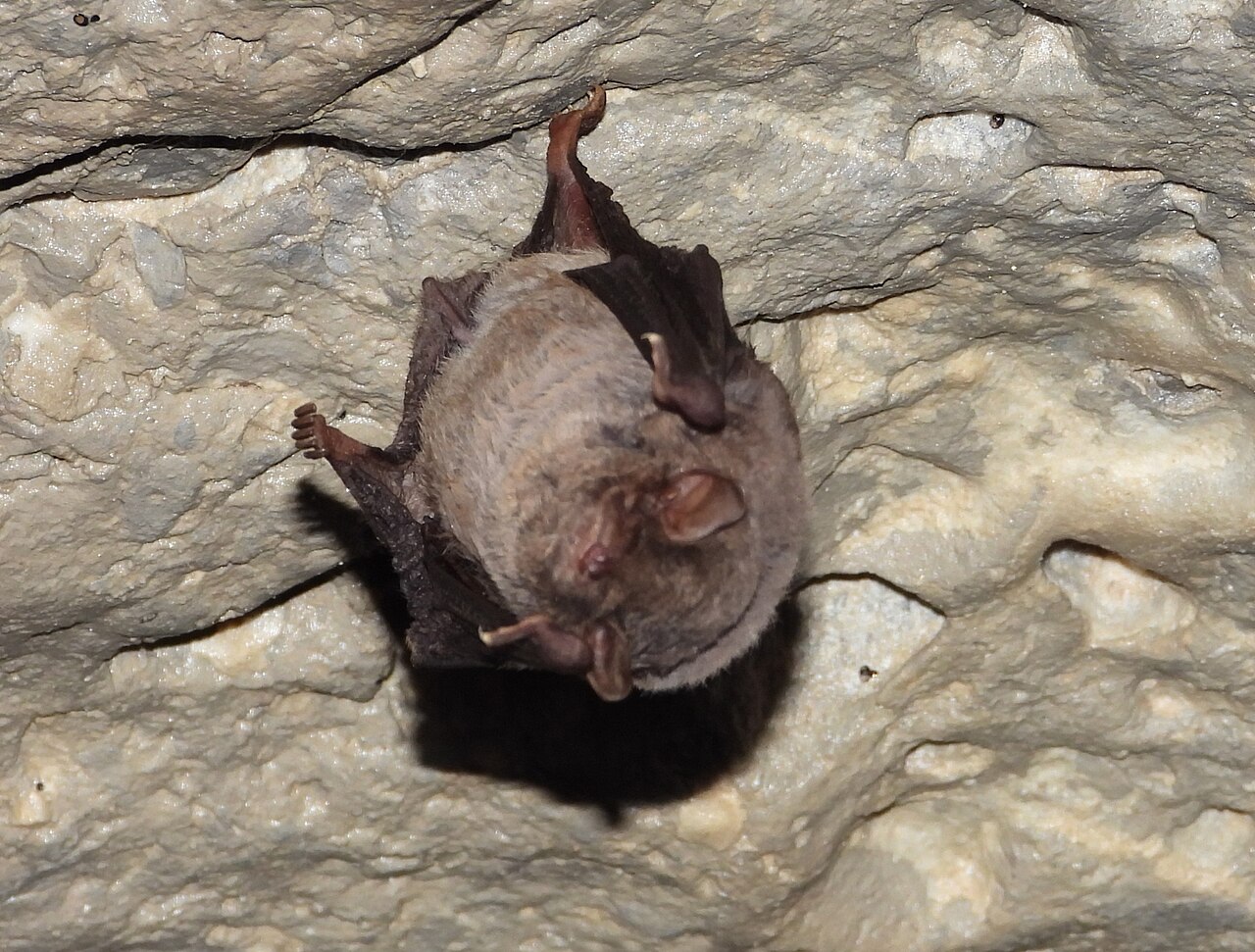
Signs are found almost only in caves, mine galleries and tunnels. Beneath a colony's roosting spots droppings lie in heaps or layers on the floor; the pellets are small, black and crumble into insect fragments with moth remains. On the ceiling above a roost used for many years a dark stain often forms. The bats hang in dense clusters against the ceiling, body against body, not scattered in crevices; a cluster of several thousand is visible from the cave floor as a continuous dark patch. At emergence, from about twenty minutes to an hour after sunset, the bats leave the entrance in a sustained stream. Prey remains are scarce because prey is eaten in flight. On a bat detector the species sounds like a series of dry ticks at about 50 to 55 kHz. In spring and autumn the numbers in a cave change from week to week as bats move between winter, transitional and maternity roosts.
Identification
A medium-sized bat with a short, high-domed skull, a short muzzle and small, triangular ears set wide apart and barely rising above the crown; the tragus is slender, 5.5 to 7 mm long and curved slightly forward. The fur is short, dense and silky, uniformly grey to ashy on the back and slightly paler below; the hairs are darker at the base. Wings and tail membrane are dark. The family character lies in the wing: the second phalanx of the third finger is about three times as long as the first and is folded back at rest, giving a long, narrow wing. Wingspan about 30 to 35 cm, forearm 43 to 47 mm, weight 10 to 14 g. The flight is fast and direct, in open space, above tree canopies, along woodland edges and over rivers. Echolocation consists of downward frequency-modulated calls with a peak between about 49 and 62 kHz and an end frequency around 46 to 56 kHz; calls last 2 to 14 ms.
Similar species
Three Miniopterus species occur within the guide area. The Maghrebian long-fingered bat (M. maghrebensis) in Morocco and Tunisia and the pallid long-fingered bat (M. pallidus) in Anatolia and the Levant cannot be told from Schreibers's long-fingered bat externally; separation rests on DNA and skull measurements. Where the range boundaries lie is not fully known in either region, and limited hybridisation with M. pallidus has been documented in Anatolia. Outside those border regions the species is recognised by the domed head, the short ears and the long, narrow wing with the folded finger segment. In caves it often roosts alongside the greater and lesser mouse-eared bats (Myotis myotis, M. blythii), long-fingered bat (Myotis capaccinii) and horseshoe bats; the Myotis species have longer ears with a straight, pointed tragus and a longer muzzle, and horseshoe bats have a noseleaf and hang wrapped in their wings. On a bat detector the peak frequency overlaps with that of the soprano pipistrelle (Pipistrellus pygmaeus) around 55 kHz; long-fingered bat calls are often longer and more irregular in rhythm, but a recording does not always settle the matter.
Habitat
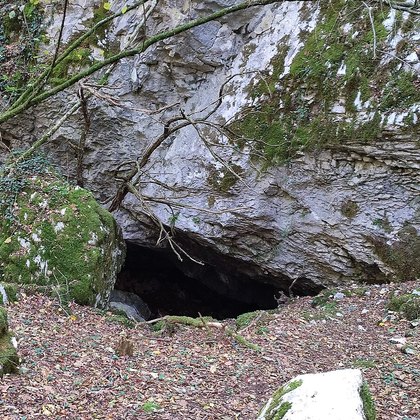
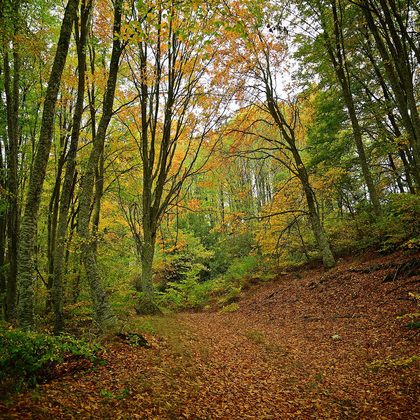
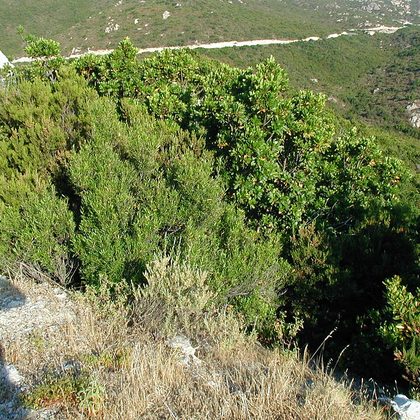
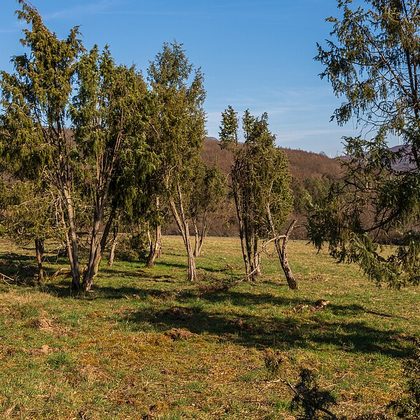
The species uses a wide range of landscapes: semi-desert steppe, Mediterranean scrub and woodland and, in the north of the range, humid deciduous forest. Maternity colonies are mostly below 1000 m, sometimes up to 1200 m; non-breeding and hibernating colonies occur up to about 1400 m. Roosts are caves and cave-like cavities such as mines and tunnels; single bats or small groups also use rock crevices or buildings. Foraging areas lie over rivers and water, along woodland edges, in clearings, orchards and parks, and in France also around lit streets in built-up areas. Dense pine forest and closed woodland are avoided; riverine woodland and forest edges serve as commuting routes.
Where the animal is most at home, classified with EUNIS — the European standard for habitats.



Distribution
Southern Europe from the Iberian Peninsula east to Anatolia and western Georgia, north to central France, Slovakia and Romania, and in the south the Maghreb, Libya, Syria, Lebanon and Israel, including most Mediterranean islands. There are historical records from Germany, Switzerland and the Czech Republic; a first record from Poland was published in 2020. In the Maghreb the species occurs alongside M. maghrebensis, in the Levant alongside M. pallidus, and older North African data under the name M. schreibersii may refer to either. Until 2014 these forms and a range of African and Asian populations were included in M. schreibersii; genetic work has since restricted the species to Europe, North Africa and the Near East. Large colonies are known from Bulgaria (up to 65,000 bats in a single cave), Croatia, Portugal and Spain.
- Native
- dark = core range, pale = thinly spread
Way of life
The species hunts flying insects in fast flight in open air. Moths make up more than 70% of the diet, over 90% in summer, mainly noctuids and geometrids; lacewings, flies, caddisflies and beetles make up the rest. Lactating females forage up to almost 30 km from the roost. Mating takes place in September and early October; fertilisation follows immediately, but the embryo implants only after hibernation in March or April (delayed implantation). The single young is born in late June or early July, in Portugal in early June, flies after about 40 days and is fully grown after two months; females usually breed from their second year. Hibernation lasts 2 to 5 months, shorter in the south, and is interrupted by active spells and roost changes; hibernacula range from about 4 to 10 °C. Populations form networks of roosts over thousands of square kilometres, with separate winter, transitional, maternity and mating roosts. Typical movements are around 100 km, the longest known over 800 km. The maximum recorded age is 16 years.
Where and when to look
The species is best observed at emergence from a known colony entrance on a summer evening: from outside the cave, without entering and without shining light in the bats' faces. With a bat detector tuned to about 52 kHz the emergence can be followed as a continuous series of ticks. A cave with a colony is not entered during the maternity period (May to August) or in winter, because disturbance at those times causes death of young or depletion of fat reserves; in many countries access to such caves is regulated by law or closed. Within the ranges of M. maghrebensis and M. pallidus a field observation can only be recorded as Miniopterus sp. unless genetic material has been examined.
Conservation status
Vulnerable (VU, 2023). Because the bats gather in few large roosts, the loss or disturbance of a single cave can affect a large part of a regional population. The species has disappeared from Germany and Ukraine and has been close to extinction in Switzerland since the 1960s; in Austria the number of hibernating bats fell from about 2,500 to one or two, and all maternity colonies there have been lost. Reported causes are cave tourism and disturbance, the sealing or conversion of mines and tunnels, and changes in foraging habitat. In 2002 large numbers died within a short period in France, Spain and Portugal; Lloviu virus, a filovirus, was later detected in dead bats from Spain. The species is listed in Annexes II and IV of the Habitats Directive, which requires the designation of Special Areas of Conservation for it, and is covered by the Bern Convention and the EUROBATS Agreement.
Scientific name
Miniopterus schreibersii | (Kuhl, 1817)
Kuhl described the species in 1817 as Vespertilio Schreibersii; because it was later moved to another genus, the author and year stand in brackets. Miniopterus is Greek, from minyos, 'small' (compare minythein, 'to lessen'), and pteron, 'wing'; Bonaparte gave no explanation, but he presumably meant the very short first phalanx of the third finger, which lets the long wing-tip fold back. schreibersii honours Carl Franz Anton von Schreibers (1775–1852), director of the imperial natural history cabinet in Vienna, who sent Kuhl the animal from the Banat. The specimen the first description was based on came from Romania, Coronini.