All species › Hedgehogs, shrews and moles › Shrews › Appenine Shrew
Appenine Shrew | Sorex samniticus
Italiaanse bosspitsmuis | Musaraña De Los Apeninos
The Apennine Shrew is a Sorex found only on the Italian mainland, from the Po Plain to Calabria and Apulia. It lives in low mountains and hill country, along streams, in marshy spots, along dry-stone walls and woodland edges, and does not go high. Genetically it stands apart: it is related to both the Common Shrew group and the Tundra Shrew group but belongs to neither, and is placed in a species group of its own. It has been found in low numbers everywhere, and little is known of its way of life.
No photograph of a living wild animal of this species with a suitable Creative Commons licence exists. Do you have one that meets the rules? Send it in.
Tracks
No signs are known that are specific to this species; droppings, runs and tunnels cannot be told from those of other shrews. The species is recorded by live-trapping and in owl pellets, especially those of the Barn Owl. In pellets, Sorex skulls and lower jaws are recognisable by their red-brown tooth tips; separating them from the Valais and Common Shrews requires skull measurements and a specialist key.
Identification
A fairly large, stocky Sorex with a short tail, usually no longer than half the head-body length. The coat is uniformly chestnut brown: back and belly have the same shade, the belly only slightly paler, with no sharp boundary between them, so the three-toned pattern of the Common Shrew is absent. The tooth tips are red-brown. The karyotype, 2n = 52 with only acrocentric chromosomes and a single Y chromosome, separates the species from related shrews but cannot be seen in the field. Head-body 6.8 to 7.8 cm, tail 3.3 to 4.5 cm, hind foot 11 to 13 mm, weight 6.5 to 10 g.
Similar species
The most difficult confusions are the Valais Shrew (Sorex antinorii), which lives in the Italian Alps and the Apennines, and in the north the Common Shrew (Sorex araneus). Both have a three-toned coat and a relatively longer tail, so an animal with a short tail and an even chestnut-brown coat points to the Apennine Shrew. Because coat colour and tail length vary in young and worn animals, certain identification is only possible genetically or from the skull. The Eurasian Pygmy Shrew (Sorex minutus) is much smaller and has a long, thick tail. White-toothed shrews (Crocidura) and the Etruscan Shrew (Suncus etruscus) have white teeth, prominent ears and long scattered hairs on the tail. The Water Shrew (Neomys fodiens) and Mediterranean Water Shrew (Neomys milleri), which live along the same streams, are blackish with a sharply demarcated pale belly and have swimming fringes on the feet.
Habitat
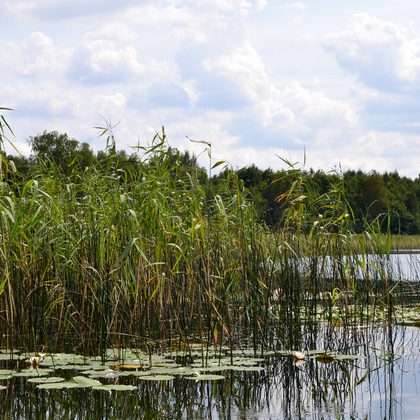
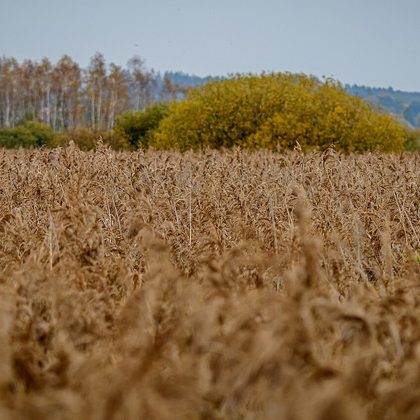
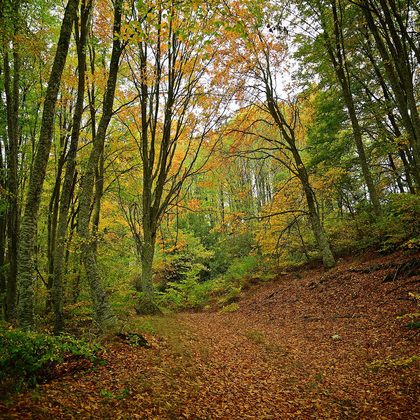
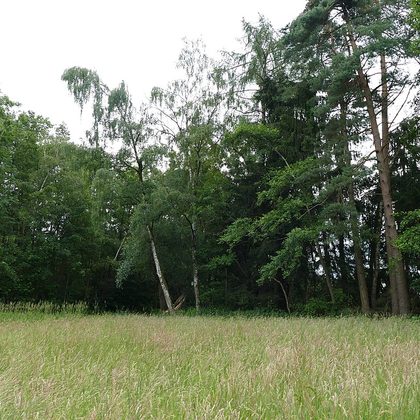
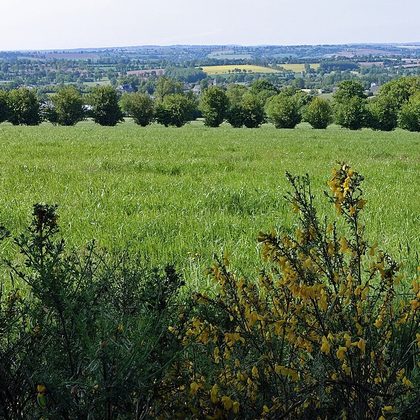
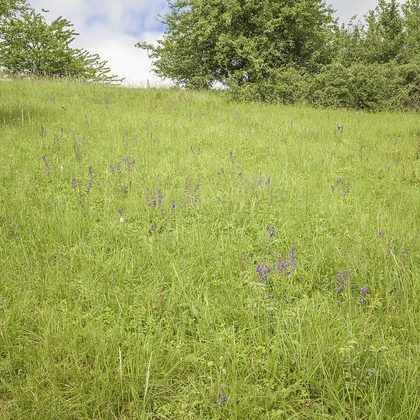
Damp places in hill country and low mountains: stream valleys, banks and marshy spots, woodland edges and open woodland, and linear features such as hedges, dry-stone walls, fences and road embankments. The species occurs from sea level to about 1,200 m but not higher, and avoids dry ground. Where woodland becomes denser and more extensive, the species becomes scarcer.
Where the animal is most at home, classified with EUNIS — the European standard for habitats.
Distribution
An endemic of Italy, confined to the mainland. The range runs from the Po Plain, where the species occurs locally north of the Po, along the whole peninsula to Calabria and Apulia, except the Salento peninsula. It is absent from all islands, large and small. The type locality is in Molise, in the province of Campobasso.
Way of life
Nothing has been published on the daily rhythm, food or range size of this species; what is known concerns breeding. Lactating females have been caught in May and pregnant females with three to six embryos in June, and the first independent young appear from May. Otherwise its way of life can be assumed to resemble that of other Sorex species: activity in short bouts around the clock, a diet of invertebrates, no hibernation and a lifespan of at most about eighteen months. That assumption has not been tested for this species.
Where and when to look
An Apennine Shrew can hardly be recognised in the field; confirming it requires trapping or pellets. The best chance of a record lies in vegetated stream banks, wet rough ground and old dry-stone walls in the Apennine hill country below 1,200 m. Analysing Barn Owl pellets from farms and churches in these areas yields most records. A live animal with a short tail and an even chestnut-brown coat is worth a photograph, with the tail clearly in view. Trapping shrews in Italy requires a permit.
Conservation status
Least Concern globally (2016), and also listed as not threatened on the Italian Red List. The species has a fairly large range within Italy but has been found in low numbers everywhere. No specific threats have been identified. Because the species depends on damp places, stream banks and linear landscape features, canalisation of streams, removal of hedges and dry-stone walls, and drying out reduce the habitat available to it. It is listed on Appendix III of the Bern Convention.
Scientific name
Sorex samniticus | Altobello, 1926
Altobello described the species in 1926 and placed it straight away in the genus where it still stands. Sorex is the Latin word for a shrew. samniticus means 'Samnite', from Samnium, the ancient region of the Apennines; Altobello described the animal from Molise, which formed part of it. The specimen the first description was based on came from Italy, Campobasso.