All species › Passerines › Finches › Yellow-Fronted Canary
Yellow-Fronted Canary | Crithagra mozambica
Mozambiquesijs | Serín Frentiamarillo
The Yellow-Fronted Canary is the small, bright yellow canary of the eastern and northern bushveld: a lively, loud songster with a clear yellow eyebrow, a dark malar stripe and a yellow rump. It is one of the commonest seedeaters of gardens, woodland edge and old fields.

Voice
A persistently repeated, clear and melodious song of short phrases, zee-zee-zeree-cheree-chee, often from a high perch or in song flight. The call is a short rising tsirrip or a soft chee-oo, heard constantly from feeding groups.
Recording: Marna Buys — CC BY-NC-SA 4.0 · converted to mono · xeno-canto
Identification
11–13 cm, compact, with a small grey conical bill. The male has a grey-green crown with a yellow forehead patch, a broad yellow eyebrow, a dark eyestripe and a narrow dark malar stripe that frame a yellow cheek. The back is olive-green with faint streaks, the rump bright lemon-yellow and the underparts plain yellow. The tail is dark with white tips. The female is duller, with a faintly streaked green-grey back and a narrow, broken necklace of greyish spots across the breast. Juveniles are paler and finely streaked on the breast.
Confusion species
Yellow Canary (Crithagra flaviventris) is larger and bulkier, with a heavier bill and a green, not yellow, rump; it lives mainly in the dry west. Brimstone Canary (Crithagra sulphurata) is clearly larger, with a heavy, bulbous bill and a duller green-yellow face lacking sharp head stripes. Lemon-Breasted Canary (Crithagra citrinipectus) has a yellow throat and breast shield sharply contrasting with a white belly, and a black chin in the male. Black-Throated Canary (Crithagra atrogularis) is grey-brown with only a yellow rump.
Habitat
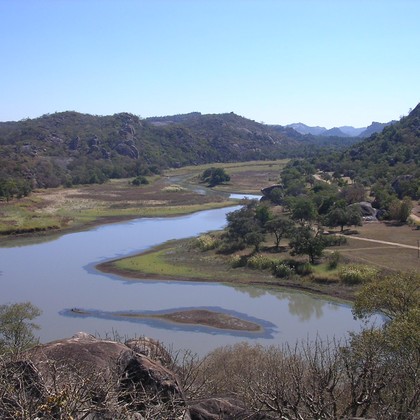
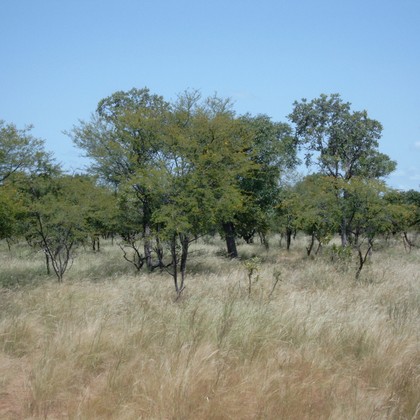
Open woodland and savanna with scattered trees, forest and riverine edges, fallow fields, plantations, gardens and parks, from sea level to middle altitudes. It feeds in pairs and small groups on the ground and in low herbage on seeds of grasses and weeds, also buds and insects. Outside the breeding season it joins other canaries and waxbills at water.
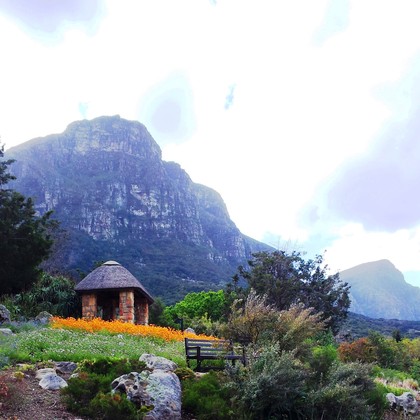
Where the bird is most at home, classified by the vegetation units of southern Africa.
Range and movements
In the region common in north-eastern South Africa (Limpopo, Mpumalanga, KwaZulu-Natal and the eastern Eastern Cape), in Eswatini, throughout Mozambique, Zimbabwe, Malawi, Zambia and Angola, and in northern Botswana and north-eastern Namibia (Kavango, Zambezi); absent from the arid west and the Karoo. Beyond the region across much of sub-Saharan Africa from Senegal to Ethiopia; introduced to Mauritius, Réunion and elsewhere.
- Resident
- Summer visitor (c. Oct–Mar)
- Winter visitor (c. Apr–Sep)
- Passage (Mar–Apr, Oct–Nov)
- dark = core range, pale = thinly spread
How and when to look
A good reference species for the other yellow canaries: learn the head pattern and the yellow rump, best seen as the bird flushes. At garden seed feeders and at waterholes in Kruger, Hluhluwe or Mana Pools it is seen almost daily. It is widely kept as a cagebird, so escapes can turn up outside the natural range.
Conservation status
Not threatened. Common to very common and benefits from farmland and gardens. Trapping for the cagebird trade plays a local role, but without demonstrable effect on numbers.
Scientific name
Crithagra mozambica | (Müller, 1776)
Müller described the species in 1776 as Fringilla mozambica; because it was later moved to another genus, the author and year stand in brackets. The genus Crithagra was introduced in 1827 by Swainson. Crithagra comes from the Greek krithē, 'barley', and agra, 'hunting' — a 'barley hunter', for the seed-eating diet of these canaries and seedeaters. mozambica refers to Mozambique, where the first specimen came from. The specimen the first description was based on came from Mozambique.