All species › Passerines › Chats and flycatchers › Thyolo Alethe
Thyolo Alethe | Chamaetylas choloensis
Cholobergalethe | Alete de Cholo
The Thyolo Alethe is a large, thrush-like forest-floor bird found only in the mid-altitude montane forests of southern Malawi and northern Mozambique. It is one of the rarest birds of the region and lives in forest remnants that are shrinking steadily; anyone hoping to see it should look for swarms of driver ants.

Voice
The song is a series of soft, clear and rather wistful whistles, tee-tew-tee, mainly heard at dawn and dusk. At ant swarms it gives a sharp chuk and a plaintive, rising hoo-eet; the alarm is a dry rattle.
No recording with a suitable Creative Commons licence is available for this species yet.
Identification
17–20 cm, a hefty alethe with a strong black bill and long, flesh-coloured legs. The upperparts are warm dark brown to chestnut-brown, the head slightly darker and greyer brown, without a supercilium. The underparts are clean white, with grey-brown breast sides and flanks. The outer tail feathers have broad white tips, which flash as white corners when the bird spreads its tail or flies off. The sexes are alike; juveniles are darker with orange-brown spots. It perches upright on low branches, flicks its tail and often stays motionless for long periods.
Confusion species
White-Chested Alethe Chamaetylas fuelleborni is very similar but lacks the white tail corners and has a slightly greyer head; within the region it lives in northern Malawi and elsewhere in montane forests further north, so the two barely overlap. Orange Ground Thrush Geokichla gurneyi has orange underparts and white wing bars. Red-Capped Robin-Chat Cossypha natalensis is smaller and rusty orange below. Olive Thrush Turdus olivaceus has an orange belly and a yellow bill.
Habitat
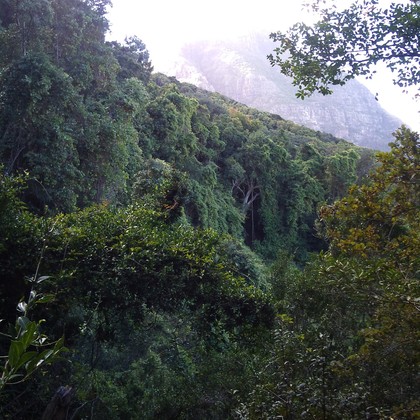
The understorey and floor of moist, evergreen mid-altitude montane forest with a closed canopy and abundant leaf litter, mainly between 1,000 and 1,700 m, locally down to 700 m. It follows swarms of driver ants and catches insects and other invertebrates fleeing ahead of them; it also picks food from the forest floor. The nest is a cup of moss and leaves in a hollow in a tree or stump, usually a few metres above the ground.
Where the bird is most at home, classified by the vegetation units of southern Africa.
Range and movements
Within the region in southern Malawi on Mulanje, Thyolo, the Zomba and Malosa mountains, the Shire Highlands and some hills around Mangochi, and in northern Mozambique on Namuli, Mabu, Chiperone and Inago. The species is endemic to this small area and occurs nowhere else in the world.
- Resident
- dark = core range, pale = thinly spread
How and when to look
Mulanje and the forest remnants around Thyolo are the most accessible sites. Walk slowly through the forest in the early morning and search for an ant swarm, betrayed by the calls of ant-followers and rustling in the litter. Stand still there: the alethe often perches low on a branch and then stands out by its white underparts and white tail corners.
Conservation status
Vulnerable (2018). The range is small and fragmented, and the mid-altitude forest in which the species lives has been cleared in many places for tea, cultivation and firewood; on Namuli the forest on the middle slopes has largely gone, and in the Shire Highlands and on Thyolo often only small patches remain within tea estates. The discovery of populations on Mabu and elsewhere in Mozambique has raised estimates of the world population.
Scientific name
Chamaetylas choloensis | (Sclater, 1927)
Sclater described the species in 1927 as Alethe choloensis; because it was later moved to another genus, the author and year stand in brackets. The genus Chamaetylas was introduced in 1860 by Heine. Chamaetylas comes from the Greek khamai, 'on the ground', and tulas, 'thrush', for these plump, upright, long-legged birds of the forest floor and low undergrowth (Keith et al., 1992). choloensis refers to Cholo Mountain (now Thyolo) in southern Malawi, where the species was discovered. The specimen the first description was based on came from Thyolo (Cholo) Mountain, Malawi.