All species › Passerines › Chats and flycatchers › White-Chested Alethe
White-Chested Alethe | Chamaetylas fuelleborni
Witborstalethe | Alete Pechiblanco
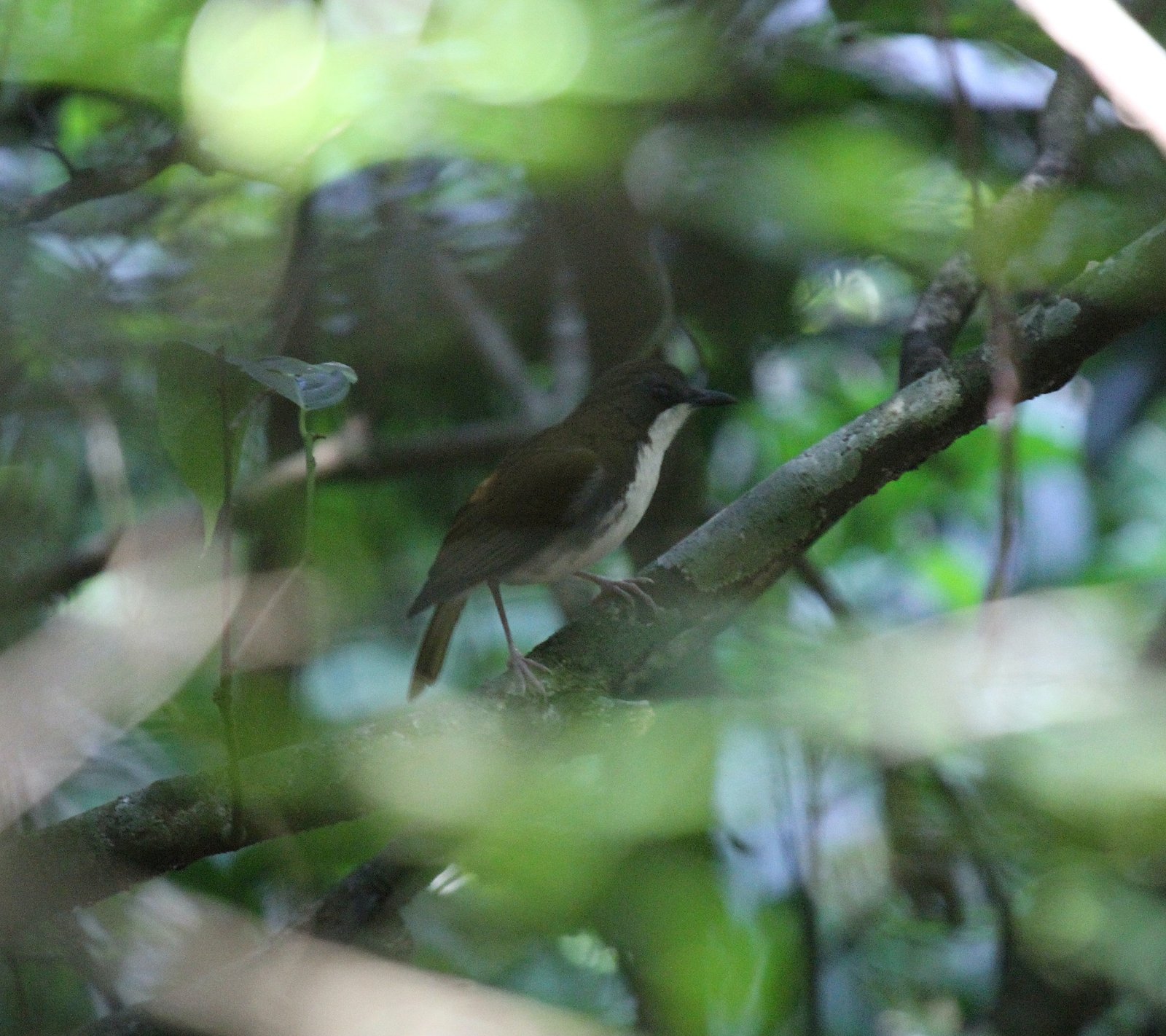
The White-Chested Alethe is a sturdy, shy bird of the forest floor with a rufous back and gleaming white underparts, found in the region only in the montane forests of Malawi, northern Mozambique and the extreme north-east of Zambia. It readily attends driver-ant columns to catch the insects they flush.
Voice
The song, mainly at dawn and dusk, is a series of slow, mournful whistles, fwee-fyoo…fee-fyoo-wee, often repeated at length from the undergrowth. The call is a plaintive, descending hweeeoo, and when alarmed a sharp tchik. At ant swarms its persistent calling betrays its presence.
Recording: isaac kilusu — CC BY-NC-SA 4.0 · converted to mono · xeno-canto
Identification
A robust, thrush-like bird of 18 to 20 cm. Head and nape are dark slate-grey to brownish-black, merging into a warm chestnut back, wings and tail. The entire underparts from throat to undertail coverts are pure white, with grey to olive-brown flanks. The eye is dark, the bill black and the legs flesh-coloured to greyish-pink. The sexes are alike. Juveniles are dark with ochre spots. Keeps to or just above the forest floor, hopping with drooped wings and flicking its tail.
Confusion species
Thyolo Alethe (Chamaetylas choloensis) of the mountains of southern Malawi and Mozambique also has white underparts, but an olive-brown head without grey, white tips to the outer tail feathers and a more southerly, very restricted range; the two barely overlap within the region. Brown-Chested Alethe (Chamaetylas poliocephala) has a grey head with a white supercilium and a brownish breast. Spotted Ground Thrush (Geokichla guttata) is heavily spotted below and has white wing bars.
Habitat
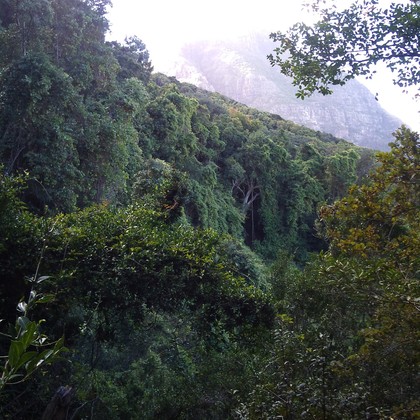
Moist evergreen montane and mid-altitude forest with an open understorey and deep leaf litter, from about 900 to 2400 m; locally also dense streamside forest at lower levels. Forages on the forest floor for ants, beetles and other invertebrates, often in the wake of driver ants.
Where the bird is most at home, classified by the vegetation units of southern Africa.

Range and movements
In Malawi in the montane forests of the north and centre, including Misuku, Nyika and Viphya; on the Zambian side of the Nyika Plateau and in the Mafinga Mountains; in northern Mozambique on the Njesi Plateau and a few isolated mountains. Outside the region in the mountains and coastal forests of Tanzania.
- Summer visitor (c. Oct–Mar)
- Passage (Mar–Apr, Oct–Nov)
- dark = core range, pale = thinly spread
How and when to look
Search quiet forest trails on the Nyika Plateau or in the Viphya in early morning and listen for the slow whistled song. If you find a driver-ant swarm, wait quietly nearby: alethes, White-Starred Robins and thrushes gather there and are far less shy.
Conservation status
Not threatened. The species has a fragmented habitat that depends on intact evergreen forest. Logging, cultivation and fires in the mountains of Malawi and Mozambique are shrinking the forest patches, and numbers are declining locally as a result.
Scientific name
Chamaetylas fuelleborni | (Reichenow, 1900) (GBIF: Muscicapa adusta)
Reichenow described the species in 1900 as Alethe fülleborni; because it was later moved to another genus, the author and year stand in brackets. The genus Chamaetylas was introduced in 1860 by Heine. Chamaetylas comes from the Greek khamai, 'on the ground', and tulas, 'thrush', for these plump, upright, long-legged birds of the forest floor and low undergrowth (Keith et al., 1992). fuelleborni honours the German physician and naturalist Friedrich Fülleborn (1866–1933), who collected in German East Africa. The specimen the first description was based on came from Tandala, southwestern Tanzania.