All species › Passerines › Chats and flycatchers › Thrush Nightingale
Thrush Nightingale | Luscinia luscinia
Noordse nachtegaal | Ruiseñor Ruso
The Thrush Nightingale is a Palearctic migrant that winters from December to April in dense thickets in the north-east of the region. It lives so secretively that it is almost only detected by its powerful song, delivered from impenetrable scrub from February onwards.

Voice
The song is loud and varied, with deep, clucking chook-chook series, hard rattles and pure whistles, but lacking the crescendo piu-piu-piu of Common Nightingale; the dry, castanet-like bursts are typical. In the wintering area it sings mainly from February to April, also at night. Calls are a high whistled heeet and a low, croaking errr.
Recording: Zsombor Károlyi — CC BY-NC-SA 4.0 · shortened to the first 60 s, mono · xeno-canto
Identification
A fairly large, upright songbird of 16 cm with a round head, a large dark eye and long pink legs. The upperparts are plain dark olive-brown, the tail dull rufous-brown and not strongly contrasting. The underparts are dirty white with a grey-brown breast that is faintly spotted or mottled, and a pale throat bordered by a dark malar stripe. There is a narrow pale eye-ring but no obvious supercilium. The sexes are alike. It forages on the ground under dense cover, often cocking its tail and drooping its wings.
Confusion species
Common Nightingale (Luscinia megarhynchos), barely recorded in the region, is warmer brown with a brighter rufous tail and a plain, unmarked breast. Rufous-Tailed Scrub Robin (Cercotrichas galactotes) has a bold white supercilium and a rufous tail, fanned to show black-and-white tips. White-Browed Scrub Robin (Cercotrichas leucophrys) has a white eyebrow, white wing bars and a streaked breast. Great Reed Warbler (Acrocephalus arundinaceus) also sings loudly from cover, but is paler, has a long pointed bill and lives in reeds and rank vegetation near water.
Habitat
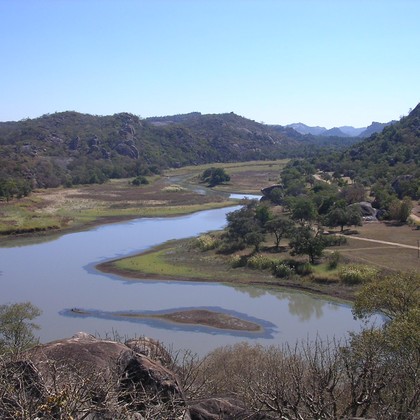
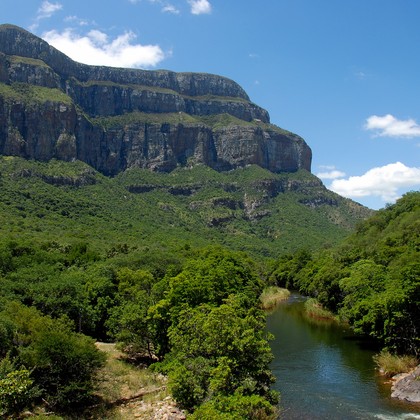
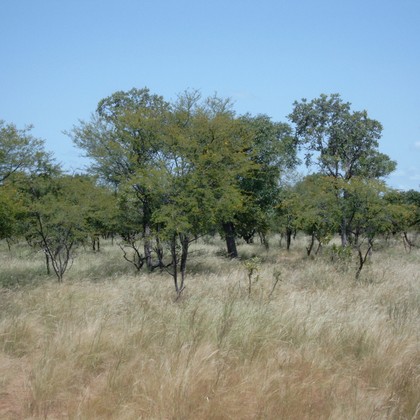
Dense, often thorny thickets in savanna and woodland, tangled scrub along rivers and dry watercourses, termite-mound thickets and the edges of riverine forest; mostly below 1,500 m. Forages on the ground in leaf litter.
Where the bird is most at home, classified by the vegetation units of southern Africa.
Range and movements
Within the region mainly in the north-east: Zambia (especially the east and the Luangwa Valley), Malawi, Zimbabwe, Mozambique, northern Botswana, the Zambezi Region of Namibia and in South Africa mainly Limpopo and northern Mpumalanga (Kruger National Park), more rarely to KwaZulu-Natal; scarce in eastern Angola. Breeds from eastern Europe and Scandinavia to western Siberia and winters in East and southern Africa, from Kenya to northern South Africa.
- Summer visitor (c. Oct–Mar)
- dark = core range, pale = thinly spread
How and when to look
From December to April, most often recorded from February to early April when the birds sing. Stand at dense thickets in Kruger, the Luangwa or the Zambezi Valley early in the morning and listen for the clucking and rattling bursts. It is seen less often than heard: wait patiently by a gap in the bushes, as the bird sometimes comes briefly to the edge.
Conservation status
Not threatened. The breeding population is large and has expanded westwards in recent decades. In the wintering area suitable thicket is lost locally to clearing and overgrazing, but the species also uses neglected and secondary scrub.
Scientific name
Luscinia luscinia | (Linnaeus, 1758)
Linnaeus described the species in 1758 as Motacilla Luscinia; because it was later moved to another genus, the author and year stand in brackets. The genus Luscinia was introduced in 1817 by Forster. Luscinia is the Latin word for 'nightingale'. The specific name repeats the genus name. The specimen the first description was based on came from Sweden.