All species › Passerines › Chats and flycatchers › Collared Flycatcher
Collared Flycatcher | Ficedula albicollis
Withalsvliegenvanger | Papamoscas Collarino
The Collared Flycatcher is a Palearctic migrant whose world population winters almost entirely in the miombo of south-central Africa. It is present from November to March and is most conspicuous in February and March, when the males moult into their black-and-white breeding dress.

Click a thumbnail to switch the photo above.
Voice
The call is a thin, high seep or zeet, sometimes with a soft tek. The song, heard in miombo from February, is slow and measured, with high squeaky and scratchy notes and long pauses, simpler and thinner than that of European Pied Flycatcher.
Recording: Walter Wallner — CC BY-NC-SA 4.0 · shortened to the first 60 s, mono · xeno-canto
Identification
A compact flycatcher of 13 cm with a short black bill and black legs. The breeding male is black and white, with a broad white collar, a large white forehead patch, a white rump and a large white wing panel that continues onto the primary bases. Outside the breeding season, when most birds arrive, the male is grey-brown like the female but keeps black wings and tail. The female is grey-brown above and dirty white below, with a white wing panel, a narrow white patch at the primary bases and often a greyish neck-side and pale rump. It flicks its wings and tail and sallies from a branch for flying insects or gleans from leaves.
Confusion species
European Pied Flycatcher (Ficedula hypoleuca), an extremely rare vagrant in the region, lacks the collar and has a smaller forehead patch and a black rump; females and non-breeding birds are barely separable in the field, but Pied usually shows little or no white at the primary bases. Spotted Flycatcher (Muscicapa striata) has a streaked crown and breast and no white in the wing. Chinspot Batis (Batis molitor) is smaller and shorter-tailed, with a grey head, a black eye mask and a yellow eye; the female has a chestnut chin spot.
Habitat
Tall, closed miombo and other deciduous woodland, especially the canopy; also woodland edges, riverine forest and large trees in gardens and parks. Often joins mixed foraging flocks of tits, flycatchers and warblers.
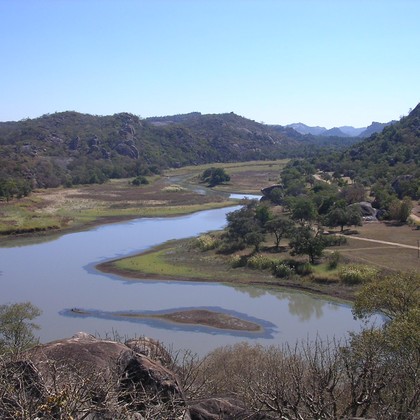
Where the bird is most at home, classified by the vegetation units of southern Africa.

Range and movements
Within the region mainly in Zambia, Malawi and Zimbabwe (particularly the plateau and the east), and also central and northern Mozambique and eastern Angola; rare in northern Botswana, the Zambezi Region of Namibia and South Africa (Limpopo). Breeds from central and eastern Europe into Russia, with smaller populations on Gotland and Öland, and winters almost exclusively in south-central Africa, from southern Tanzania and the Congo to Zimbabwe.
- Summer visitor (c. Oct–Mar)
- Winter visitor (c. Apr–Sep)
- Passage (Mar–Apr, Oct–Nov)
- dark = core range, pale = thinly spread
How and when to look
From November to March; from February the features are more distinct. Search tall miombo for mixed bird parties and watch for a small grey-brown bird with a bright white wing panel sallying from a branch. Males moulting into breeding plumage show a patchy white collar and forehead patch early on.
Conservation status
Not threatened. The European breeding population is large. Because almost the entire population winters in a relatively small part of Africa, the species is vulnerable to the ongoing clearance of miombo for charcoal, cultivation and tobacco growing.
Scientific name
Ficedula albicollis | (Temminck, 1815)
Temminck described the species in 1815 as Muscicapa albicollis; because it was later moved to another genus, the author and year stand in brackets. The genus Ficedula was introduced in 1760 by Brisson. Ficedula is Latin for a small fig-eating bird, from ficus 'fig'; it was believed to turn into the blackcap in winter. albicollis is Latin albus 'white' and collum 'neck', after the male's white collar. The specimen the first description was based on came from Europe (not specified in the original description).