All species › Woodpeckers and allies › Woodpeckers › Stierling's Woodpecker
Stierling's Woodpecker | Dendropicos stierlingi
Stierlings specht | Pito de Stierling
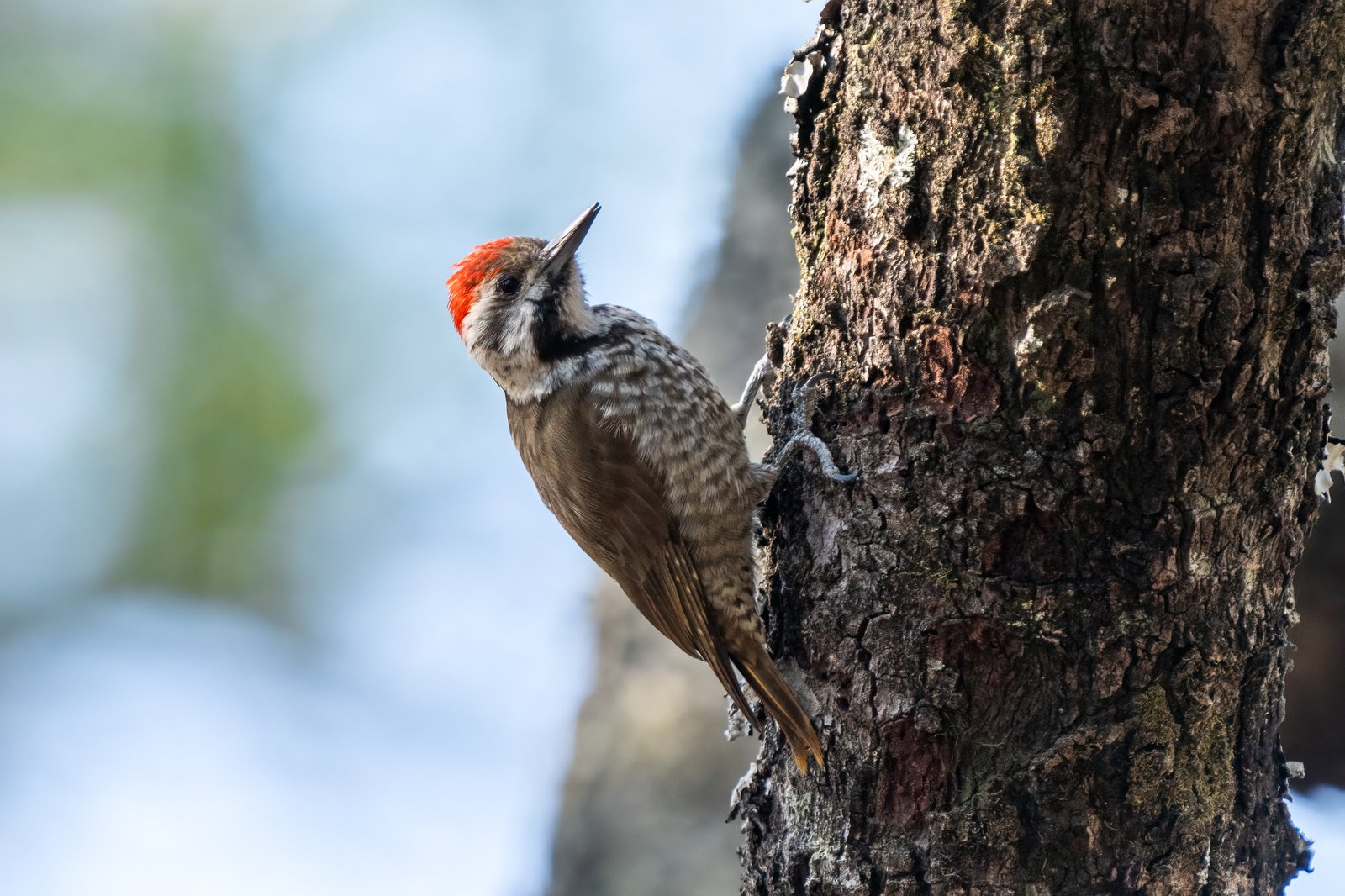
Stierling's Woodpecker is a small woodpecker with a plain brown back and a heavily scaled breast, and one of the few birds almost entirely restricted to the miombo of Malawi, Mozambique and Tanzania. Within the region it is a sought-after speciality of the dry miombo of southern Malawi.
Voice
A rather quiet species. A soft, rapidly repeated kwik-kwik-kwik and a dry rattling chrrr between pair members. It drums briefly and softly on dead branches.
No recording with a suitable Creative Commons licence is available for this species yet.
Identification
About 18 cm. The upperparts are plain olive-brown without bars or spots, and the wings are almost unmarked. The face is white with a brown ear-patch and a brown moustachial stripe. The underparts are white, the breast and flanks densely marked with dark brown scales and arrowhead spots, finer towards the belly. The male has a brown crown with a red hind crown and nape; in the female the hind crown is black. Juveniles are duller, with some red in the crown.
Confusion species
Cardinal Woodpecker (Dendropicos fuscescens) is smaller, with a clearly pale-barred back and streaked rather than scaled underparts. Bennett's Woodpecker (Campethera bennettii) and Speckle-Throated Woodpecker (Campethera scriptoricauda) are larger, with a spotted greenish back and a pale spotted or speckled throat, and often feed on the ground. The combination of a plain brown back and a scaled white breast is unique in the region.
Habitat
Tall, well-developed miombo with Brachystegia and Julbernardia, both on level ground and on rocky hills. It forages singly or in pairs on thin branches and twigs in the canopy, often in mixed-species flocks, feeding mainly on ants, beetles and larvae.
Where the bird is most at home, classified by the vegetation units of southern Africa.

Range and movements
Within the region confined to southern and central Malawi (including around Zomba, Liwonde and the Dedza plateau) and northern and central Mozambique, west of the coastal plain. Beyond the region only in southern Tanzania. Absent from Zambia and further south.
- Resident
- dark = core range, pale = thinly spread
How and when to look
In the miombo of Liwonde NP or on the slopes of the Zomba plateau, look for mixed flocks with Miombo Tits, batises and other canopy birds; the woodpecker works quietly through the outer twigs and is often first noticed by its soft tapping. The plain brown back is the first thing to catch the eye as the bird climbs away.
Conservation status
Not threatened, but with a small global range and dependent on undisturbed miombo. Logging, charcoal production and the conversion of woodland to farmland, particularly in southern Malawi, are reducing its habitat.
Scientific name
Dendropicos stierlingi | Reichenow, 1901
Reichenow described the species in 1901 and placed it straight away in the genus where it still stands. The genus Dendropicos was introduced in 1849 by Malherbe. Dendropicos combines the Greek dendron, 'tree', with the Latin picus, 'woodpecker': a 'tree woodpecker'. stierlingi honours the German army doctor Stierling, who collected birds in German East Africa (Tanzania) and Nyasaland (Malawi) around 1900. The specimen the first description was based on came from Songea, Tanzania.