All species › Woodpeckers and allies › Woodpeckers › Bearded Woodpecker
Bearded Woodpecker | Chloropicus namaquus
Baardspecht | Pito Namaqua
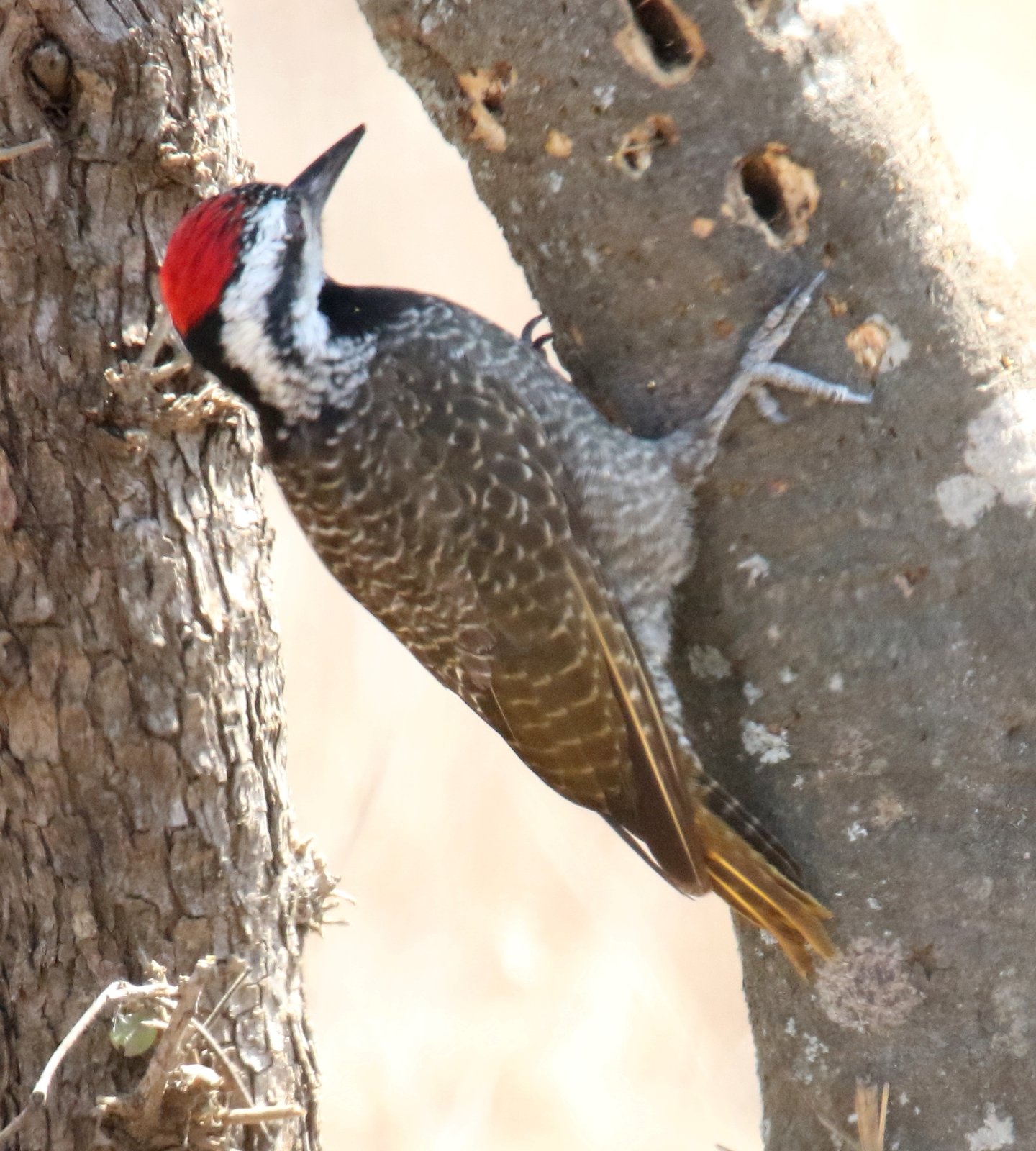
The Bearded Woodpecker is the largest woodpecker of the savanna and the loudest drummer of them all. Its loud, slowly fading drum and black-and-white face with a broad black beard distinguish it from the other woodpeckers in the region.
Voice
A loud, powerful drum of ten to twenty strokes that slows at the end, often repeated in series and audible at great distance; also a sharp wik-wik-wik-wik and a hard chik.
Recording: Marna Buys — CC BY-NC-SA 4.0 · shortened to the first 60 s, mono · xeno-canto
Identification
About 24 cm, large and powerful, with a long chisel-shaped bill. The face is white with a black ear-patch and a broad black moustachial stripe, separated by a white stripe. The upperparts are greyish olive-brown finely barred white, the underparts dark grey-olive densely and finely barred white. The male has a black forehead dotted white and a red hind crown; in the female the whole crown is black dotted white. Juveniles of both sexes show some red in the crown.
Confusion species
Cardinal Woodpecker (Dendropicos fuscescens) is much smaller, with a less contrasting face, a brown forehead and streaked underparts. Stierling's Woodpecker (Dendropicos stierlingi) has a plain brown back and is confined to the miombo of Malawi and northern Mozambique. Golden-Tailed Woodpecker (Campethera abingoni) is green and streaked, without a black face pattern.
Habitat
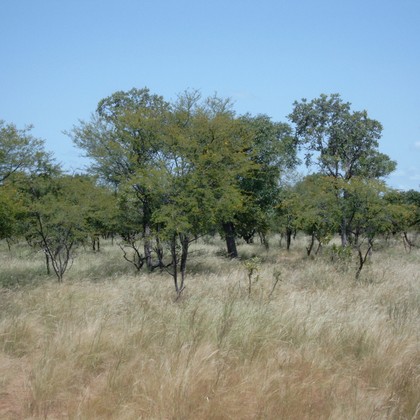
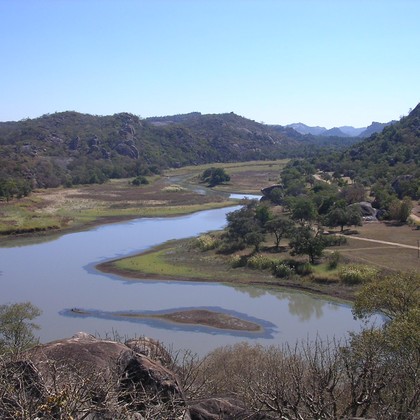
Acacia savanna, mopane, broadleaved woodland and riverine forest with large live and dead trees, extending into the dry thornveld of Namibia and the Kalahari where big camel thorns stand. It forages on trunks and thick branches and hacks deep holes in dead wood.
Where the bird is most at home, classified by the vegetation units of southern Africa.

Range and movements
Widespread in the north and centre of the region: Angola, Zambia, Malawi, Mozambique, Zimbabwe, most of Botswana, northern and central Namibia, northern and north-eastern South Africa (North West, Limpopo, Mpumalanga, northern KwaZulu-Natal) and Eswatini. Absent from the south and south-west. Beyond the region across the savannas of sub-Saharan Africa, from Chad and Ethiopia to Tanzania.
- Resident
- Summer visitor (c. Oct–Mar)
- Winter visitor (c. Apr–Sep)
- Passage (Mar–Apr, Oct–Nov)
- dark = core range, pale = thinly spread
How and when to look
In the bushveld listen for the long, fading drum, then look for a large dead tree or a projecting dead branch; the bird drums from fixed posts. It is a regular sight in the Kruger National Park, Etosha and along the Chobe.
Conservation status
Not threatened and common; the IUCN lists it under the older name Dendropicos namaquus. Removal of dead trees and large camel thorns for firewood reduces nest sites and feeding places locally.
Scientific name
Chloropicus namaquus | (Lichtenstein, 1793)
Lichtenstein described the species in 1793 as Picus Namaquus; because it was later moved to another genus, the author and year stand in brackets. The genus Chloropicus was introduced in 1845 by Malherbe. Chloropicus comes from the Greek chlōros, 'green', and the Latin picus, 'woodpecker' — for the olive-green upperparts of these woodpeckers. namaquus refers to Namaqualand, the land of the Nama in western South Africa and southern Namibia. The specimen the first description was based on came from Damaraland, Namibia.