All species › Passerines › Sparrows › Southern Grey-Headed Sparrow
Southern Grey-Headed Sparrow | Passer diffusus
Mozambiquemus | Gorrión Sudafricano
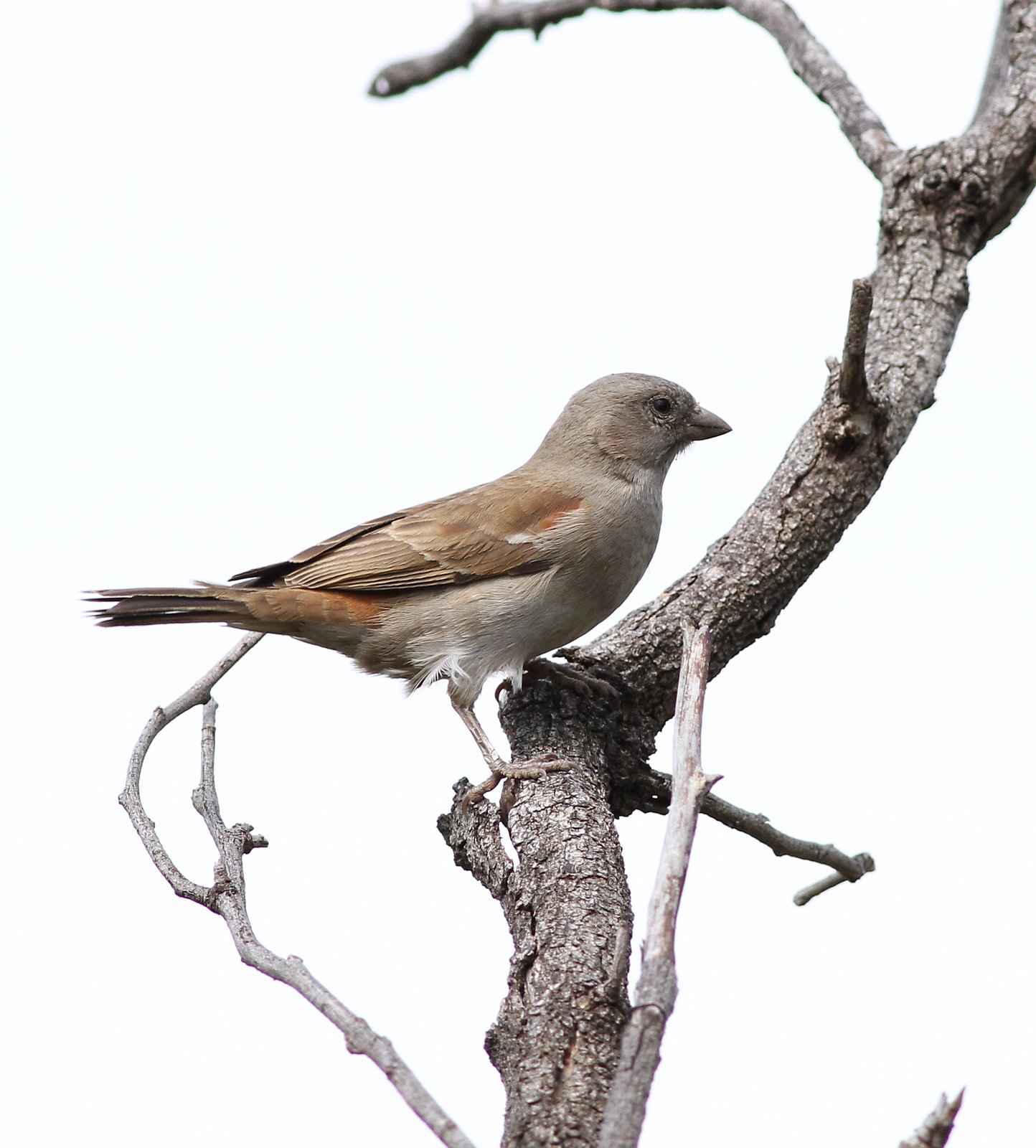
The Southern Grey-Headed Sparrow is the common grey-headed sparrow of most of the region: a plain, uniformly grey sparrow with a rufous back and a white shoulder spot. It lives in savanna and woodland and in recent decades has settled widely in villages, farmyards and suburban gardens.
Voice
A simple, slowly repeated cheep, chirp, cheep, often kept up for long periods as song, and a churring churrrr in alarm. Groups chirp softly while foraging.
Recording: Walter Wallner — CC BY-NC-SA 4.0 · shortened to the first 60 s, mono · xeno-canto
Identification
15 to 16 cm. The head is plain pale grey, with no black and no eyebrow, grading into a pale grey breast; the throat is dirty white and not conspicuous. Mantle and shoulders are warm brown to cinnamon, the lower back and rump rufous. A small white spot on the median wing coverts flashes as a white shoulder bar in flight. The belly is dirty white. The bill is black when breeding, horn-coloured otherwise. The sexes are alike; juveniles are browner and duller.
Confusion species
Northern Grey-Headed Sparrow (Passer griseus) of extreme northern Angola, Zambia and Malawi is bulkier and darker, with a dark ash-grey head, a sharply defined white throat and more rufous on the back; intermediates occur in the contact zone. Female House Sparrow (Passer domesticus) has a buff eyebrow and a streaked back. Yellow-Throated Bush Sparrow (Gymnoris superciliaris) has a broad white supercilium. The plain grey head with the rufous back and white shoulder spot is diagnostic.
Habitat
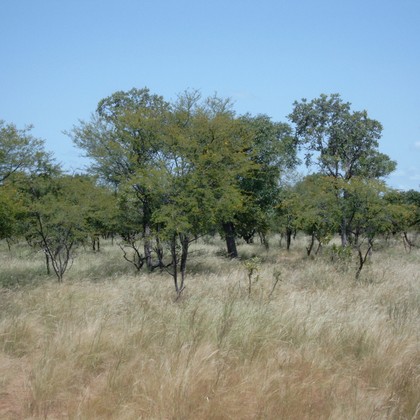
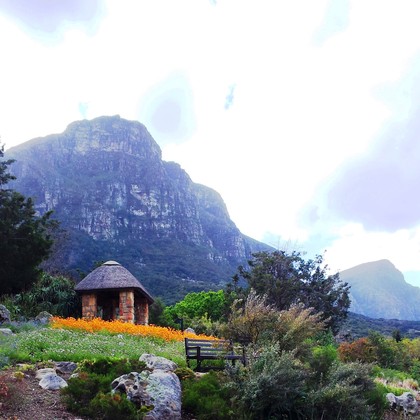
Open savanna, thornveld, mopane and mixed woodland, dry riverbeds, farmyards, camps, villages and gardens. It forages on the ground for seeds and insects, in small flocks outside the breeding season. It nests in tree holes, old barbet and woodpecker holes, hollow poles, nest boxes and sometimes old swallow or weaver nests.
Where the bird is most at home, classified by the vegetation units of southern Africa.

Range and movements
Within the region widespread in southern Angola, Zambia (south of the northern fringe), southern and central Malawi, Mozambique, Zimbabwe, Botswana, Namibia (not in the bare Namib), Eswatini, locally Lesotho and much of South Africa; scarce or absent in the south-western Western Cape and parts of the arid Karoo. Barely found outside the region: only contiguously in southern DR Congo and southern Tanzania.
- Resident
- Summer visitor (c. Oct–Mar)
- Winter visitor (c. Apr–Sep)
- Passage (Mar–Apr, Oct–Nov)
- dark = core range, pale = thinly spread
How and when to look
A common bird of rest camps and farmyards, where it often occurs together with Cape and House Sparrows. A grey head without any black markings quickly rules out the other sparrows. In northern Zambia and Malawi check the throat pattern so as not to miss Northern Grey-Headed Sparrow.
Conservation status
Not threatened. Common and widespread; it has spread into the south and west of South Africa with the expansion of farms, trees and gardens. There is no evidence of decline.
Scientific name
Passer diffusus | (Smith, 1836)
Smith described the species in 1836 as Pyrgita diffusa; because it was later moved to another genus, the author and year stand in brackets. The genus Passer was introduced in 1760 by Brisson. Passer is the Latin word for 'sparrow'. diffusus is Latin for 'spread out, diffuse'; exactly what Smith referred to — the wide range or the indistinct markings — is uncertain. The specimen the first description was based on came from near Kuruman, Northern Cape, South Africa.