All species › Passerines › Weavers › Southern Brown-Throated Weaver
Southern Brown-Throated Weaver | Ploceus xanthopterus
Bruinkeelwever | Tejedor Gorjipardo Sureño
The Southern Brown-Throated Weaver is a small weaver of reedbeds and papyrus swamps. The breeding male is bright yellow with a chocolate-brown throat patch, a combination no other weaver in the region shows. It builds a small, neat nest without an entrance tube, slung between reed stems.

Voice
A soft, sizzling, grating chatter, softer and thinner than that of the masked weavers, and a short tsik or zik-zik contact call.
Recording: Magnus Wadstein — CC BY-NC-SA 4.0 · converted to mono · xeno-canto
Identification
14–15 cm. The breeding male is bright golden yellow with an olive-yellow back, a dark chocolate to reddish-brown patch on chin and throat, sometimes with a brown wash around the eye, a black bill and a dark eye. Outside the breeding season the male resembles the female. The female is olive-brown above with faint streaking, pale brown to yellowish on breast and flanks and whitish on the belly, with a dark eye and a pale, pinkish-horn bill. Juveniles resemble the female.
Confusion species
No other yellow weaver in the region has a brown throat; males of Southern Masked Weaver (Ploceus velatus) and Lesser Masked Weaver (Ploceus intermedius) have a black mask. Eastern Golden Weaver (Ploceus subaureus) is slightly larger, the male with an orange head and a reddish eye. Females and non-breeding birds closely resemble other weavers: the female Southern Brown-Throated Weaver is buffier and browner than other female weavers, with a pale bill and a dark eye, and is almost always found in reeds or papyrus. The small tubeless nest between reed stems is also characteristic.
Habitat
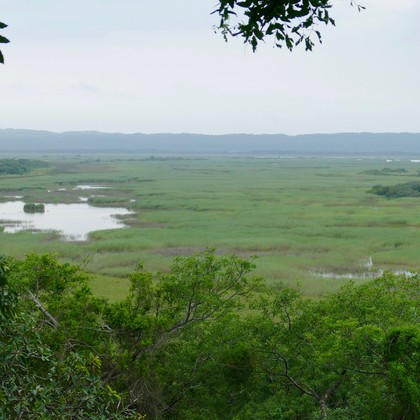
Reedbeds, papyrus and bulrush swamps and floodplains along rivers, lakes and lagoons, also mangrove edges and damp rank growth along the coast. It breeds solitarily or in loose groups; the nest is a small, round, finely woven ball of reed leaves with a side entrance and no tube, slung between two or three reed stems. Outside the breeding season it forages in small flocks, sometimes with bishops, in grassland and fields. It eats seeds and insects.
Where the bird is most at home, classified by the vegetation units of southern Africa.

Range and movements
Within the region in the large wetlands of the north and east: the Okavango Delta, Linyanti and Chobe in Botswana, the Zambezi Region (Caprivi) in Namibia, south-eastern Angola, the Zambezi and Kafue in Zambia, the Zambezi Valley in Zimbabwe, Malawi, the coastal plain and Zambezi Valley in Mozambique, and north-eastern KwaZulu-Natal in South Africa. The range lies largely within the region, with extensions into adjacent East and Central Africa.
- Resident
- Summer visitor (c. Oct–Mar)
- Passage (Mar–Apr, Oct–Nov)
- dark = core range, pale = thinly spread
How and when to look
Best in the breeding season in the Okavango Delta, along the Chobe or in the swamps of northern KwaZulu-Natal, from a boat or a path along the reeds. Males sing from the tops of reed stems near their nests; the brown throat is visible from afar. In winter the small flocks of nondescript brownish weavers in the reeds are best identified by this nest and habitat picture.
Conservation status
Not threatened; locally common in suitable wetlands. It is sensitive to the draining and burning of reedbeds and to changes in the flow regime of the large rivers.
Scientific name
Ploceus xanthopterus | (Hartlaub & Finsch, 1870)
Hartlaub & Finsch described the species in 1870 as Hyphantornis xanthopterus; because it was later moved to another genus, the author and year stand in brackets. The genus Ploceus was introduced in 1816 by Cuvier, GLCFD. Ploceus comes from the Greek plokeus, 'plaiter, weaver', for the tightly woven, ball-shaped nest that gives weavers their name. xanthopterus comes from the Greek xanthos, 'yellow', and pteron, 'wing' — for the yellow-edged wing feathers. The specimen the first description was based on came from lower Shire Valley, Malawi.