All species › Passerines › Weavers › Lesser Masked Weaver
Lesser Masked Weaver | Ploceus intermedius
Kleine textorwever | Tejedor Intermedio
The Lesser Masked Weaver is a small masked weaver of savanna and thornveld in the north and east of the region. The breeding male has a black mask that extends over the forehead onto the forecrown, a pale eye and blue-grey legs. It breeds in busy colonies, often in trees over water.

Click a thumbnail to switch the photo above.
Voice
A rapid, grating and sizzling chatter, very like that of Southern Masked Weaver but thinner, delivered with quivering wings below the nest, and a short chuk contact call. A colony produces a sustained hiss.
Recording: isaac kilusu — CC BY-NC-SA 4.0 · converted to mono · xeno-canto
Identification
12–14 cm. The breeding male is bright yellow, with a black mask over forehead, forecrown, face and throat that ends in a point on the throat, and a yellow-green, lightly streaked back. The eye is pale yellow to whitish, the bill black and the legs blue-grey. Outside the breeding season the male resembles the female. The female is olive-green above, yellow on throat and breast and whitish on the belly, with a pale eye, a horn-coloured bill and blue-grey legs as well. Juveniles resemble the female but have a darker eye.
Confusion species
In the male Southern Masked Weaver (Ploceus velatus) the mask stops above the bill base, leaving the forehead yellow; the eye is red and the legs are pinkish. Village Weaver (Ploceus cucullatus) is larger, with a black-blotched back and a red eye. Katanga Masked Weaver (Ploceus katangae) of northern Zambia has a yellow forehead and a rufous wash around the mask. In females the pale eye and blue-grey legs are the best features; females of the other masked weavers have a brown or reddish eye and pinkish legs.
Habitat
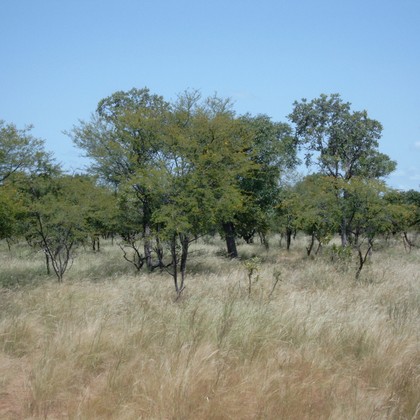
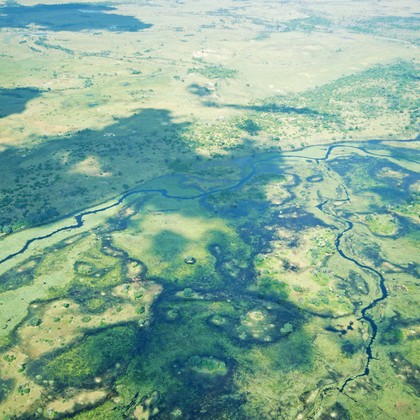
Acacia savanna, thornveld, mopane and open woodland, often near rivers, pans and dams, also in villages and gardens. It breeds in colonies, often in trees over water and regularly together with Village Weaver. The nest is a compact, round nest of fine grass and leaf strips with a short entrance tube underneath. It eats seeds, insects and nectar.
Where the bird is most at home, classified by the vegetation units of southern Africa.

Range and movements
In the north and east of the region: Limpopo, Mpumalanga and northern KwaZulu-Natal in South Africa, Eswatini, Mozambique, Zimbabwe, northern and eastern Botswana, north-eastern Namibia, Zambia, Malawi and southern Angola. It is absent from the cool interior of the Highveld and from the dry west. Beyond the region through East Africa north to Ethiopia and Somalia.
- Resident
- Summer visitor (c. Oct–Mar)
- Winter visitor (c. Apr–Sep)
- Passage (Mar–Apr, Oct–Nov)
- dark = core range, pale = thinly spread
How and when to look
Best in summer at dams and rivers in the Kruger National Park, the lowveld of Eswatini or northern Botswana, where colonies hang in trees over the water, often mixed with Village Weaver. Look at the forehead first: black in this species, yellow in Southern Masked Weaver. In females the pale eye and blue-grey legs are decisive.
Conservation status
Not threatened; common in suitable habitat and widespread. It is parasitised by the Diederik Cuckoo.
Scientific name
Ploceus intermedius | Rüppell, 1845
Rüppell described the species in 1845 and placed it straight away in the genus where it still stands. The genus Ploceus was introduced in 1816 by Cuvier, GLCFD. Ploceus comes from the Greek plokeus, 'plaiter, weaver', for the tightly woven, ball-shaped nest that gives weavers their name. intermedius is Latin for 'intermediate' — as the species seemed intermediate in its features between other masked weavers. The specimen the first description was based on came from Shewa (Shoa), Ethiopia.