All species › Passerines › Weavers › Orange Weaver
Orange Weaver | Ploceus aurantius
Koningswever | Tejedor Anaranjado
The Orange Weaver is a small, slender-billed weaver of swamps, mangroves and riverbanks in West and Central Africa, occurring within the region only in north-western Angola. The breeding male is bright orange-yellow with an orange head and throat.

Click a thumbnail to switch the photo above.
Voice
Short chet notes and a sizzling, crackling song reminiscent of radio static.
Recording: Étienne Leroy — CC BY-NC-SA 4.0 · converted to mono · xeno-canto
Identification
12–14 cm, with a rather long, slender bill. The breeding male is mainly bright yellow with an orange head and throat, black lores and an olive-yellow back; the bill is black and the eye pale grey to whitish. Outside the breeding season the male is duller and browner, with a streaked back and a paler bill. The female is greenish yellow above with a white belly and a pale, pinkish bill; eye colour varies from whitish to reddish-brown. Juveniles resemble the female.
Confusion species
Eastern Golden Weaver (Ploceus subaureus) does not occur in Angola. Holub's Golden Weaver (Ploceus xanthops) is much larger, with a heavy bill, and uniformly golden yellow. Village Weaver (Ploceus cucullatus) is larger, with a black head or mask in the male and a black-blotched back. Black-Necked Weaver (Ploceus nigricollis) has a black eye-stripe and a dark nape. In the male the orange head with black lores, the slender bill and the pale eye are characteristic; females are best identified by size, slender bill and white belly, combined with the waterside setting in the Angolan coastal lowlands.
Habitat
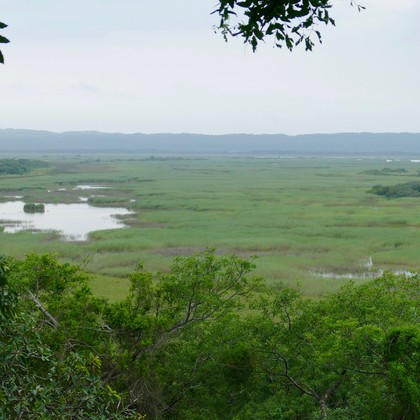
Swamps, reedbeds and papyrus along large rivers and lagoons, mangroves and damp scrub near water. It breeds in colonies in reeds or bushes low over the water; the nest is compact and finely woven. It eats mainly seeds and insects.
Where the bird is most at home, classified by the vegetation units of southern Africa.

Range and movements
Within the region only in the coastal lowlands of north-western Angola, with records around Luanda, at the mouth and along the lower reaches of the Cuanza, in Bengo and in Cuanza Norte and Cuanza Sul. Beyond the region from Sierra Leone along the coast and large rivers to DR Congo, with a separate population around Lake Victoria in Uganda, western Kenya and north-western Tanzania.
How and when to look
In the breeding season search the reedbeds and mangroves of the lower Cuanza and the lagoons south of Luanda for colonies of small, orange-tinged weavers low over the water. Take photographs or recordings if possible: records from the region are scarce.
Conservation status
Not threatened; widespread across its range. Within the region it is confined to a small part of Angola, where it is vulnerable to the draining and development of wetlands around Luanda.
Scientific name
Ploceus aurantius | (Vieillot, 1805)
Vieillot described the species in 1805 as Malimbus aurantius; because it was later moved to another genus, the author and year stand in brackets. The genus Ploceus was introduced in 1816 by Cuvier, GLCFD. Ploceus comes from the Greek plokeus, 'plaiter, weaver', for the tightly woven, ball-shaped nest that gives weavers their name. aurantius is Latin for 'orange' — for the male's orange-yellow plumage. The specimen the first description was based on came from Malembo, Cabinda (Angola).