All species › Bustards › Bustards and korhaans › Southern Black Korhaan
Southern Black Korhaan | Afrotis afra
Zwarte trap | Sisón Negro Alioscuro
The Southern Black Korhaan is a small, noisy bustard found only in south-western South Africa, in fynbos, renosterveld and the Succulent Karoo. The male, with its black neck and underparts, white ear patch and red bill, is unmistakable once it shows itself, and its rasping call is one of the best-known sounds of the Western Cape countryside.
Voice
A loud, rasping, repeated kerrak-kerrak-kerrak from the male, given from the ground or in a short, slow display flight; at times the series turns into a rapid krrr-a-krrr-a. The male calls mainly in the morning and after rain, and is often heard from afar before it is seen.
Recording: Raphaël Nussbaumer — CC BY-NC-SA 4.0 · converted to mono · xeno-canto
Identification
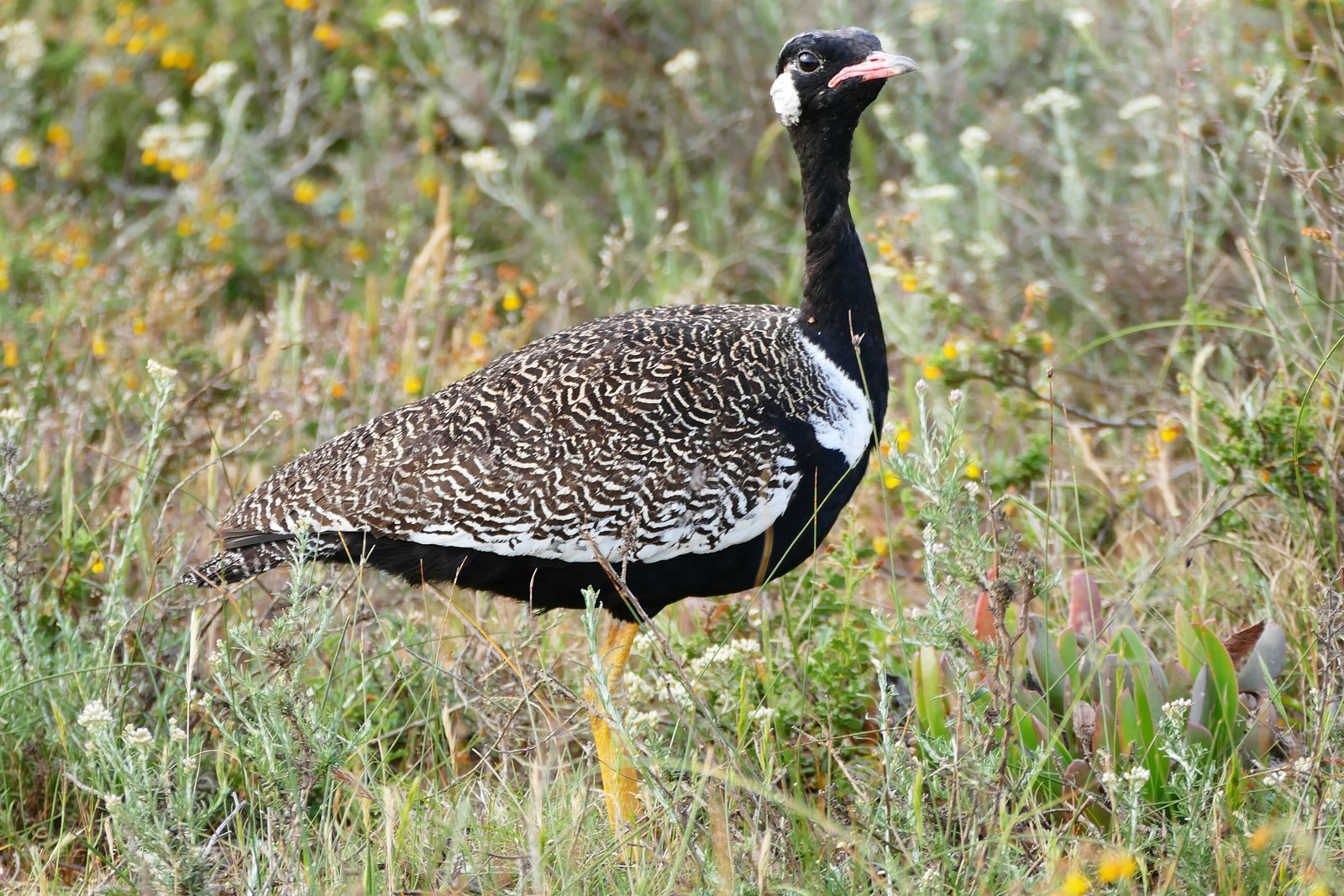
50–53 cm. The male has a black head, neck and underparts, a large white patch on the cheek and ear coverts and a narrow white band across the hindneck. The upperparts are finely barred black and cream. The bill is red with a dark tip, the legs bright yellow. In flight the male's primaries are wholly black, with no white patch. The female has a rufous, finely black-barred head, neck and breast and a black belly; her bill is duller pink. Juveniles resemble the female.
Confusion species
The Northern Black Korhaan (Afrotis afraoides) is almost identical, but the male shows a large white patch in the primaries in flight, and the female has a paler, whitish breast; the two species overlap only in a narrow zone along the edge of the Karoo, where hybrids also occur. The Red-Crested Korhaan (Lophotis ruficrista) does not occur in the south-west. The Blue Korhaan (Eupodotis caerulescens) has a blue-grey neck and underparts.
Habitat
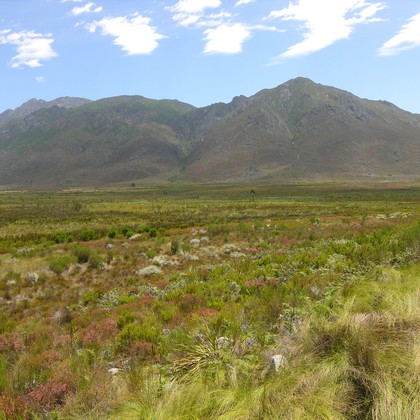
Fynbos and renosterveld, also the shrublands of the Succulent Karoo and the strandveld along the west coast, and adjacent pastures and fallow land between fields. It avoids dense, tall bush and prefers ground with low, open vegetation. It eats insects, especially beetles, termites and grasshoppers, as well as seeds and green plant material.
Where the bird is most at home, classified by the vegetation units of southern Africa.


Range and movements
Endemic to South Africa: the Western Cape and south-western Northern Cape (Namaqualand to around Springbok), east along the south coast and the western Karoo into the western Eastern Cape. Not known outside this area; the northern and eastern interior is occupied by the Northern Black Korhaan.
- Resident
- Winter visitor (c. Apr–Sep)
- Passage (Mar–Apr, Oct–Nov)
- dark = core range, pale = thinly spread
How and when to look
In spring (August to October) drive the gravel roads of the Swartland, the Overberg, West Coast National Park or Bontebok National Park and listen for the rasping calls. The male often stands on a termite mound or a patch of bare ground; the female presses herself flat among the bushes when threatened and is seen much less often.
Conservation status
Vulnerable. Its range has been heavily fragmented over the past century by the conversion of renosterveld and fynbos to wheat and vineyards, and numbers continue to fall. The species also suffers from collisions with power lines and disturbance by dogs. Protected remnants of renosterveld and extensively managed farms are important for its survival.
Scientific name
Afrotis afra | (Linnaeus, 1758)
Linnaeus described the species in 1758 as Otis afra; because it was later moved to another genus, the author and year stand in brackets. The genus Afrotis was introduced in 1855 by Gray. Afrotis combines the Latin Afer, 'African', with the Greek ōtis, 'bustard' — an 'African bustard'. afra is Latin for 'African'. The specimen the first description was based on came from Cape of Good Hope.