All species › Bustards › Bustards and korhaans › Red-Crested Korhaan
Red-Crested Korhaan | Lophotis ruficrista
Zuid-Afrikaanse kuiftrap | Sisón Moñudo Austral
The Red-Crested Korhaan is the small bustard of bushveld and thornveld, with a characteristic display flight: the male shoots straight up, then folds its wings and tumbles down as if shot, opening them again just above the ground. The rufous crest that gives it its name is only rarely seen.

Voice
The male starts with a series of dry clicks, tik-tik-tik-tik, that accelerate and change into a series of loud, piping notes, pee-oo pee-oo pee-oo, for up to a minute; mainly at dawn and dusk, often before the bird is seen.
Recording: JJSUN — CC BY-NC-SA 4.0 · converted to mono · xeno-canto
Identification
Small for a bustard, 48–53 cm. The upperparts are brown with conspicuous creamy-white V-shaped markings forming a scaly pattern on the back. The male has a black belly and breast, a grey head and neck and a pinkish-rufous crest on the hindcrown that usually lies flat; a white patch at the side of the breast separates the black underparts from the wing. The female has a brown head with dark markings, a white breast band and a black belly. The bill is dark with a pale base, the legs yellowish.
Confusion species
Males of the Northern Black Korhaan (Afrotis afraoides) and Southern Black Korhaan (Afrotis afra) have an all-black head and neck with a white ear patch and lack the V-markings on the back. The Black-Bellied Bustard (Lissotis melanogaster) is larger and longer-necked, with a black line down the foreneck in the male. The White-Bellied Bustard (Eupodotis senegalensis) has a white belly.
Habitat
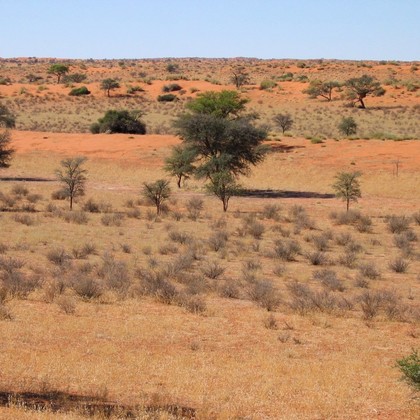
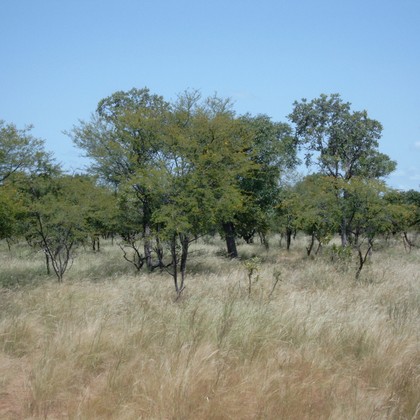
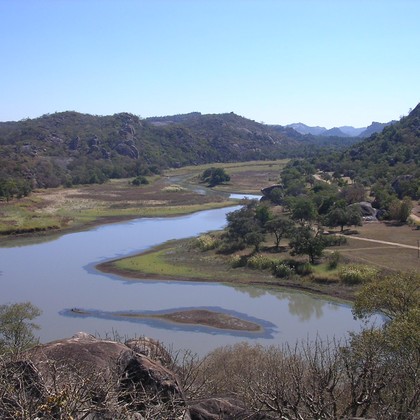
Dry, open to fairly dense bushveld and thornveld, especially Kalahari thornveld, acacia savanna and mixed woodland with bare or sparsely vegetated ground, also mopane. It lives solitarily and unobtrusively under bushes. It eats insects, especially termites, ants and beetles, as well as seeds and berries.
Where the bird is most at home, classified by the vegetation units of southern Africa.
Range and movements
Almost endemic to the region: Botswana, northern and central Namibia, Zimbabwe, southern Mozambique, northern South Africa (Limpopo, North West, the Mpumalanga lowveld and northern KwaZulu-Natal) and Eswatini, as well as southern Angola and south-western Zambia. Related species replace it in East and West Africa.
- Resident
- Summer visitor (c. Oct–Mar)
- Winter visitor (c. Apr–Sep)
- Passage (Mar–Apr, Oct–Nov)
- dark = core range, pale = thinly spread
How and when to look
In Kruger, Pilanesberg, Etosha or the Kalahari listen at dawn for the clicking and piping call, then look for a male calling from the ground, often half hidden under a bush. The display flight is seen most in spring and early summer; watch above the bushveld for a bird that suddenly rises vertically.
Conservation status
Not threatened and common across much of the bushveld. It declines locally where bushveld is converted to cropland, but tolerates lightly grazed land and cattle ranches well.
Scientific name
Lophotis ruficrista | (Smith, 1836)
Smith described the species in 1836 as Otis ruficrista; because it was later moved to another genus, the author and year stand in brackets. The genus Lophotis was introduced in 1848 by Reichenbach. Lophotis comes from the Greek lophos, 'crest', and ōtis, 'bustard' — for the male's rufous crest. ruficrista comes from the Latin rufus, 'rufous', and crista, 'crest' — for the male's pinkish-rufous crest, which is usually concealed. The specimen the first description was based on came from Near Latakoo (Dithakong), Northern Cape, South Africa.