All species › Tubenoses › Petrels and shearwaters › Scopoli's Shearwater
Scopoli's Shearwater | Calonectris diomedea
Scopoli's pijlstormvogel | Pardela Cenicienta Mediterránea
Scopoli's Shearwater is a large, brownish-grey shearwater with a yellow bill that skims the waves on slow, supple wingbeats and long glides on slightly bowed wings. In this guide the Atlantic form borealis, Cory's Shearwater, is included as a subspecies; that form is in fact the commonest in summer off the Cape.

Voice
Almost silent at sea; sometimes a brief squeal in squabbles over offal behind trawlers. At the northern colonies a wailing, hoarse, babyish aa-oo-aa that echoes from the rocks at night.
Recording: Pere Josa — CC BY-NC-SA 4.0 · converted to mono · xeno-canto
Identification
Large, 44 to 56 cm, with long, broad wings. The upperparts are warm grey-brown and the head soft grey, merging without a sharp border into the white throat, which gives a gentle, washed-out face. The stout bill is pale yellow with a dark band near the tip. The underparts are white and the underwing is white with a narrow dark margin. There is often a faint pale band across the uppertail coverts. In the nominate form the white on the underside of the primaries extends further towards the wingtip than in borealis, which is also larger and heavier-billed. It flies in a relaxed manner, on deeply drooping, bowed wings with few wingbeats.
Confusion species
Great Shearwater (Ardenna gravis) has a sharply demarcated dark cap, a white nape collar, an obvious white rump and a dark belly patch, and flies more stiffly. Flesh-Footed Shearwater (Ardenna carneipes) is wholly dark. Albatrosses such as Atlantic Yellow-Nosed Albatross (Thalassarche chlororhynchos) are much larger, with dark upperwing and back contrasting with a white head. At distance a gliding Scopoli's Shearwater can suggest a small albatross; note the uniform grey-brown upperparts and yellow bill.
Habitat
Open sea, both over the continental shelf and beyond, often where cold and warm water meet. It feeds at the surface on shoals of fish and squid, often with dolphins and tuna, and follows trawlers for offal. It rests in groups on the water. It breeds in burrows and rock crevices on islands in the Mediterranean and the eastern Atlantic.
Where the bird is most at home, classified by the vegetation units of southern Africa.
Range and movements
A common summer visitor off the Western and Southern Cape, from the Namibian coast to the Agulhas Bank, in smaller numbers off the Eastern Cape and KwaZulu-Natal and rarely off Mozambique. The Atlantic form borealis predominates; the nominate form is seen in smaller numbers. It breeds on Mediterranean islands (nominate) and on the Azores, Madeira, the Canaries and the Berlengas (borealis). It winters in the South Atlantic, off southern Africa and off South America.
- Summer visitor (c. Oct–Mar)
- Passage (Mar–Apr, Oct–Nov)
- dark = core range, pale = thinly spread
How and when to look
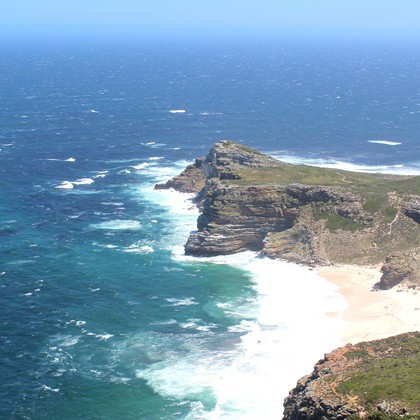
The best chance is on a pelagic trip from Cape Town or Simon's Town between November and April, at the trawlers along the edge of the continental shelf. From Cape Point, flocks can sometimes be seen close inshore in strong winds. To assign a bird to form, photograph the underwing; the extent of white on the primaries is the key feature.
Conservation status
Not threatened, but colonies in the Mediterranean are declining in many places. The main threats are bycatch in longline and gillnet fisheries, predation by rats and cats at the colonies, and lighting near breeding sites, which disorients young birds. Conservation projects run on many breeding islands.
Scientific name
Calonectris diomedea | (Scopoli, 1769)
Scopoli described the species in 1769 as Procellaria diomedea; because it was later moved to another genus, the author and year stand in brackets. The genus Calonectris was introduced in 1915 by Mathews & Iredale. Calonectris combines the Ancient Greek kalos 'good, noble' with the genus name Nectris, used for shearwaters by the German naturalist Heinrich Kuhl in 1820. diomedea refers to the Greek hero Diomedes, whose grieving companions were turned into white seabirds after his death. The specimen the first description was based on came from the Tremiti Islands, Italy.