All species › Tubenoses › Petrels and shearwaters › Flesh-Footed Shearwater
Flesh-Footed Shearwater | Ardenna carneipes
Australische grote pijlstormvogel | Pardela Paticlara
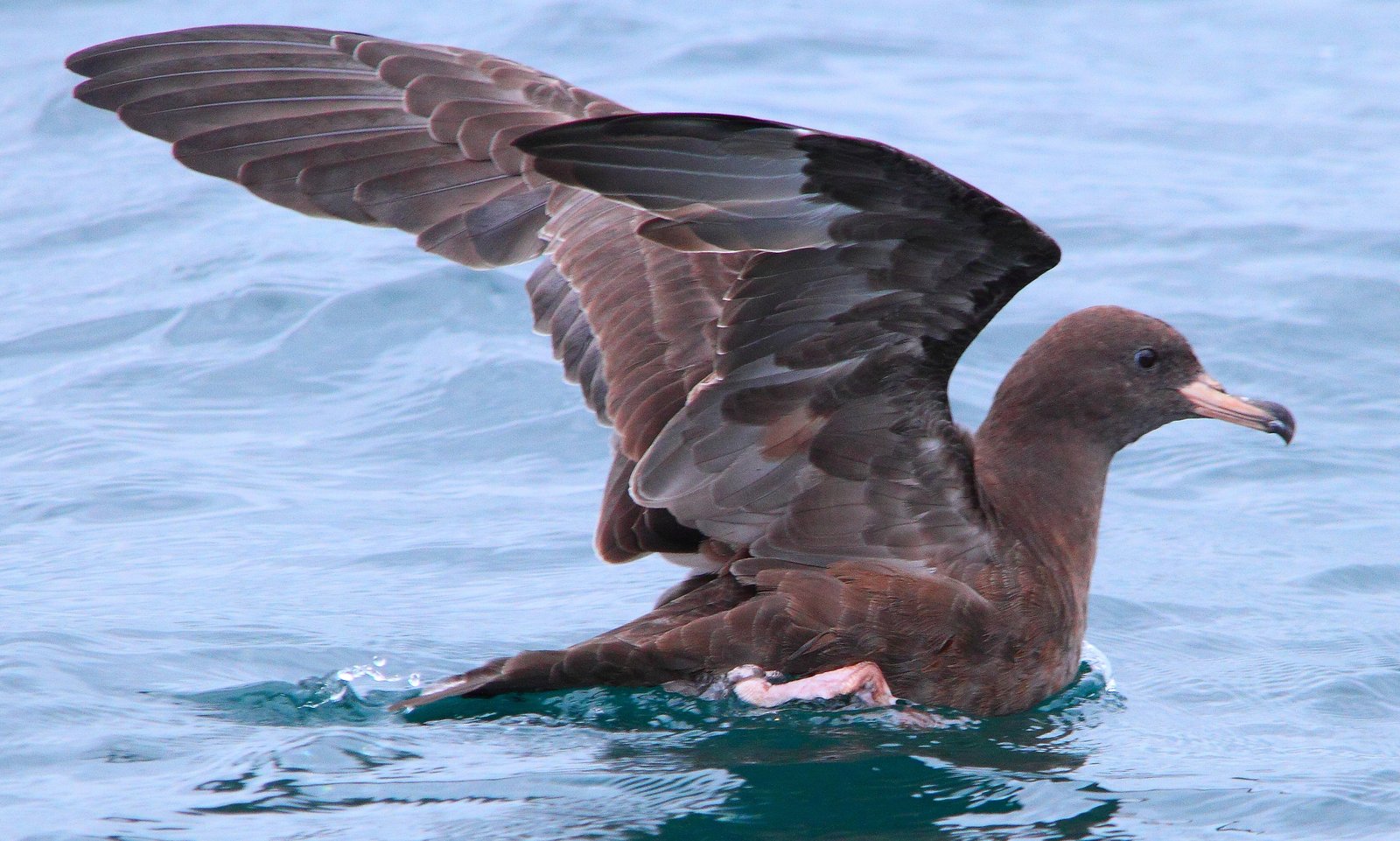
The Flesh-Footed Shearwater is a heavy, wholly dark brown shearwater with a pale pink, dark-tipped bill and flesh-coloured feet. It breeds in Australia, New Zealand and on Saint-Paul in the southern Indian Ocean, and birds from the western populations pass southern Africa on their way to and from the Arabian Sea.
Voice
Silent at sea except in squabbles over offal. At the colonies a groaning, wailing cooing from the burrows at night.
Recording: Barry Edmonston — CC BY-NC-SA 4.0 · converted to mono · xeno-canto
Identification
Medium-large, 40 to 48 cm, heavily built with broad wings and a short, rounded tail. Wholly dark chocolate brown, including the underwing, on which the bases of the primaries can flash silvery in bright light. The bill is thick and pale pink to horn-coloured with a sharply demarcated dark tip. The legs are flesh-pink and often visibly protrude beyond the tail. Sexes alike. It flies in a relaxed way, with slow, powerful beats and long glides on stiff wings, more leisurely than Sooty Shearwater.
Confusion species
Sooty Shearwater (Ardenna grisea) is slimmer, with a thin dark bill and a silvery underwing. White-Chinned Petrel (Procellaria aequinoctialis) is larger, with a wholly pale horn-coloured bill without a dark tip and black legs; the white chin is not always visible. Great-Winged Petrel (Pterodroma macroptera) has a short black bill and a wild, high-arcing flight. Dark jaegers show white wing flashes.
Habitat
Open sea, especially over the continental shelf and slope. It seizes fish and squid at the surface and makes shallow dives; it follows trawlers and longliners and readily takes discards. It breeds in burrows on forested or vegetated ground on islands.
Where the bird is most at home, classified by the vegetation units of southern Africa.
Range and movements
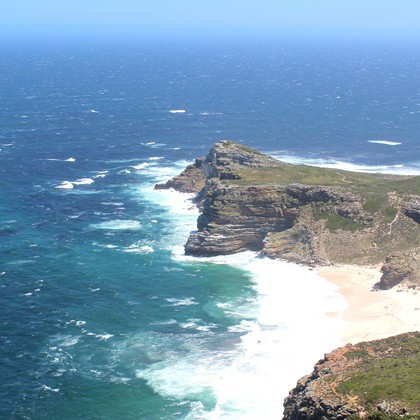
A scarce but regular visitor off the Southern and Eastern Cape and KwaZulu-Natal, particularly on the Agulhas Bank; rare off Mozambique and the Western Cape and only exceptional off Namibia. It breeds in south-western and south-eastern Australia, on the North Island of New Zealand and on Saint-Paul. Birds from Australia and the Indian Ocean winter in the Arabian Sea and around Sri Lanka, those from the east in the North Pacific.
- Winter visitor (c. Apr–Sep)
- dark = core range, pale = thinly spread
How and when to look
The chance is greatest on pelagic trips from Cape Town or Mossel Bay to trawlers on the Agulhas Bank. Among Sooty Shearwaters and White-Chinned Petrels the species stands out by its dark-tipped pink bill and calm, heavy flight. Photograph the bill and feet: these are the decisive features.
Conservation status
Near Threatened. Bycatch in longline and gillnet fisheries, ingestion of plastic, and loss and disturbance of breeding sites are reducing the population. On Lord Howe Island, an important colony, bycatch in Australian fisheries is a major problem.
Scientific name
Ardenna carneipes | (Gould, 1844) (GBIF: Puffinus carneipes)
Gould described the species in 1844 as Puffinus carneipes; because it was later moved to another genus, the author and year stand in brackets. The genus Ardenna was introduced in 1853 by Reichenbach. Ardenna goes back to Artenna, the spelling the Italian naturalist Ulisse Aldrovandi used for a seabird in 1603 and which Reichenbach cited when naming the genus. carneipes comes from the Latin carneus, 'flesh-coloured', and pes, 'foot' — for the pink feet. The specimen the first description was based on came from Small islands off Cape Leeuwin, Western Australia.