All species › Gamebirds › Pheasants and partridges › Red-Winged Francolin
Red-Winged Francolin | Scleroptila levaillantii
Roodvleugelfrankolijn | Francolín Alirrojo
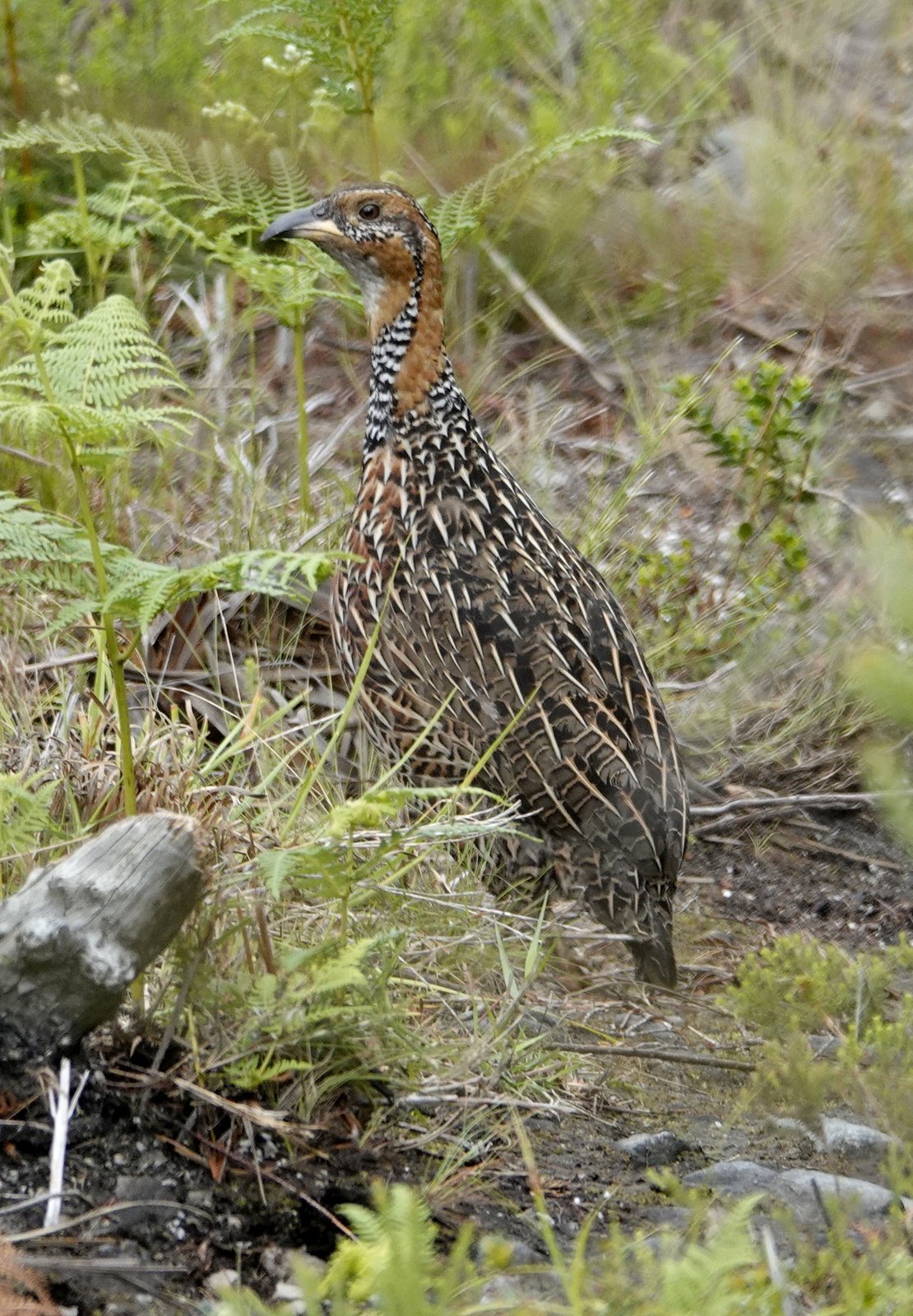
The Red-Winged Francolin is a large francolin of tall, dense montane grassland, with an intricate head pattern, a broad rufous neck band and, in flight, extensively rufous wings. It hides in long grass on mountain slopes and valley floors and is mostly identified by its call.
Voice
A clear, piping, three-part chee-chee-chirrip, often repeated in series and answered by several birds, especially at dawn; brighter and more metallic than the call of Shelley's Francolin. When flushed a fast, sharp chak-chak-chak.
Recording: Michael John O Mahony — CC BY-NC-SA 4.0 · converted to mono · xeno-canto
Identification
35–39 cm, stocky, with yellow legs. The head is richly patterned: a pale eyebrow, a black eye-stripe and a white to creamy throat, bordered by a black line that merges on the neck side into a broad rufous band across the lower neck. Below this, a necklace of black and white spots crosses the upper breast. The rest of the underparts are ochre-buff with rufous and dark blotches; the upperparts are brown, scaled and streaked with black, rufous and cream. In flight the primaries are largely rufous, a larger and brighter patch than in related species. The sexes are alike.
Confusion species
Shelley's Francolin Scleroptila shelleyi lacks the broad rufous neck band and has a belly with conspicuous black-and-white barring and blotching; the rufous in the wing is smaller. Grey-Winged Francolin Scleroptila afra has a grey-speckled throat and grey rather than rufous primaries. Orange River Francolin Scleroptila gutturalis of the drier west is paler, with a narrow rufous throat border and an almost unmarked pale belly.
Habitat
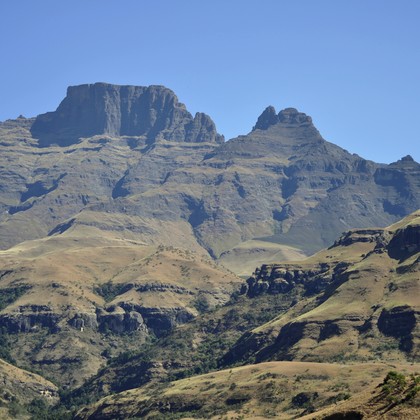
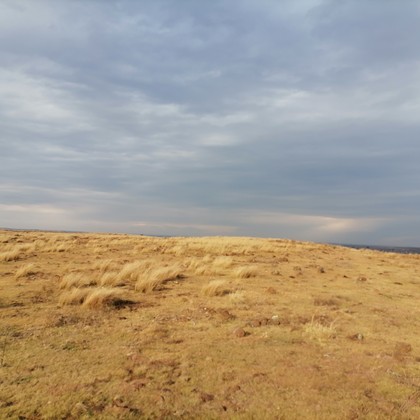
Dense, tall and fairly undisturbed grassland on mountain slopes, plateaus and in valleys, often in damp hollows, along grassland streams and at forest edges, from mid to high altitudes. It forages in pairs or small groups for seeds, bulbs, tubers and insects. It avoids closely grazed and frequently burnt grassland.
Where the bird is most at home, classified by the vegetation units of southern Africa.
Range and movements
In South Africa in the eastern highveld, the Drakensberg and the grasslands of Mpumalanga, KwaZulu-Natal, the eastern Free State and the Eastern Cape; also in Lesotho, Eswatini, locally in the eastern highlands of Zimbabwe, on the Nyika Plateau in Malawi and Zambia, and in the highlands of Angola. Beyond the region in the highlands of East and Central Africa, from Tanzania and DR Congo to Kenya and Uganda.
- Resident
- Summer visitor (c. Oct–Mar)
- Passage (Mar–Apr, Oct–Nov)
- dark = core range, pale = thinly spread
How and when to look
Listen at dawn on the grassy slopes of the Drakensberg, for example along the passes of the Eastern Cape Highlands or in the Mpumalanga highlands near Dullstroom. In flight the large rufous wing patch is the best feature; on the ground the bird usually stays out of sight. The Nyika Plateau is the best site in the north of the region.
Conservation status
Not globally threatened, but declining in southern Africa through conversion of grassland to forestry plantations and cropland, overgrazing and too frequent burning. It is hunted as a gamebird and is sensitive to intensive grassland management.
Scientific name
Scleroptila levaillantii | (Valenciennes, 1825)
Valenciennes described the species in 1825 as Perdix Levaillantii; because it was later moved to another genus, the author and year stand in brackets. The genus Scleroptila was introduced in 1849 by Blyth. Scleroptila comes from the Greek sklēros, 'stiff', and ptilon, 'feather' — 'stiff-feathered'. levaillantii honours the French explorer and ornithologist François Levaillant (1753–1824), who travelled in South Africa. The specimen the first description was based on came from Cape of Good Hope.