All species › Gamebirds › Pheasants and partridges › Finsch's Francolin
Finsch's Francolin | Scleroptila finschi
Finsch' frankolijn | Francolín de Finsch
Finsch's Francolin is a little-known red-winged francolin of the grassy plateaus and open miombo of Angola, which within the region otherwise reaches only the far north-west of Zambia. It is the plainest and most rufous-toned member of its genus.
No photograph of a living wild bird of this species with a suitable Creative Commons licence exists. Do you have one that meets the rules? Send it in.
Voice
A series of high, squeaky whistles running into a rhythmic phrase, kwee-kwee-kweerrik, mainly at dawn; in the breeding season birds call from a raised spot in the grass.
Recording: Derek Engelbrecht — CC BY-NC-SA 4.0 · converted to mono · xeno-canto
Identification
About 34 cm, bulkier than most relatives. The plumage is warm rufous-brown, with a plain cinnamon to rufous throat lacking any black border or necklace. The breast is rufous-brown with fine pale spots, and the belly paler ochre with faint chestnut markings. The upperparts are brown with black and chestnut blotches and pale shaft streaks. The head shows a faint pale supercilium. The primaries are bright rufous in flight. The legs are yellow. The sexes are alike.
Confusion species
Red-Winged Francolin (Scleroptila levaillantii), which shares the same Angolan plateaus, has a creamy throat surrounded by a broad black-and-white speckled necklace and more heavily barred underparts. Orange River Francolin (Scleroptila gutturalis) in south-western Angola has a white, black-bordered throat. The absence of any throat pattern is the best feature of Finsch's Francolin.
Habitat
Grassy plateaus and slopes with scattered trees, open miombo and grassland with termite mounds, mostly above 1000 m. It favours grass that has resprouted after burning. Food consists of seeds, bulbs, tubers and insects.
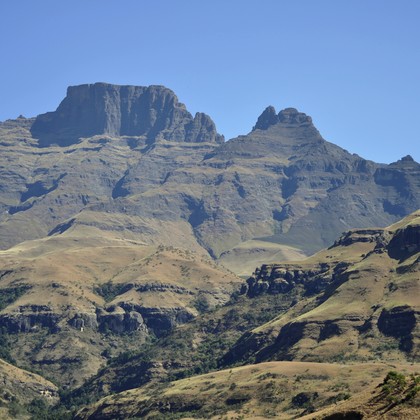
Where the bird is most at home, classified by the vegetation units of southern Africa.

Range and movements
Within the region mainly on the central and western plateaus of Angola, from Huíla and Huambo to Bié and Malanje, and in the far north-west of Zambia. Beyond the region it is scattered through the savannas of DR Congo, Republic of the Congo and Gabon.
- Resident
- dark = core range, pale = thinly spread
How and when to look
Look for it early in the morning on the grassy slopes of the Angolan highlands, for example around Huambo or the Tundavala plateau, and listen for the squeaky call. After a veld fire the birds are most often found on the resprouting grass.
Conservation status
Not threatened, but poorly studied. It is hunted intensively in places and loses grassland to cultivation and to frequent burning around villages. As a result it has become scarce in parts of the Angolan highlands.
Scientific name
Scleroptila finschi | (Bocage, 1881)
Bocage described the species in 1881 as Francolinus Finschi; because it was later moved to another genus, the author and year stand in brackets. The genus Scleroptila was introduced in 1849 by Blyth. Scleroptila comes from the Greek sklēros, 'stiff', and ptilon, 'feather' — 'stiff-feathered'. finschi honours the German ornithologist and explorer Otto Finsch (1839–1917). The specimen the first description was based on came from Caconda, Benguela (Angola).