All species › Passerines › Cisticolas › Red-Faced Cisticola
Red-Faced Cisticola | Cisticola erythrops
Roodmaskergraszanger | Cistícola Carirrojo
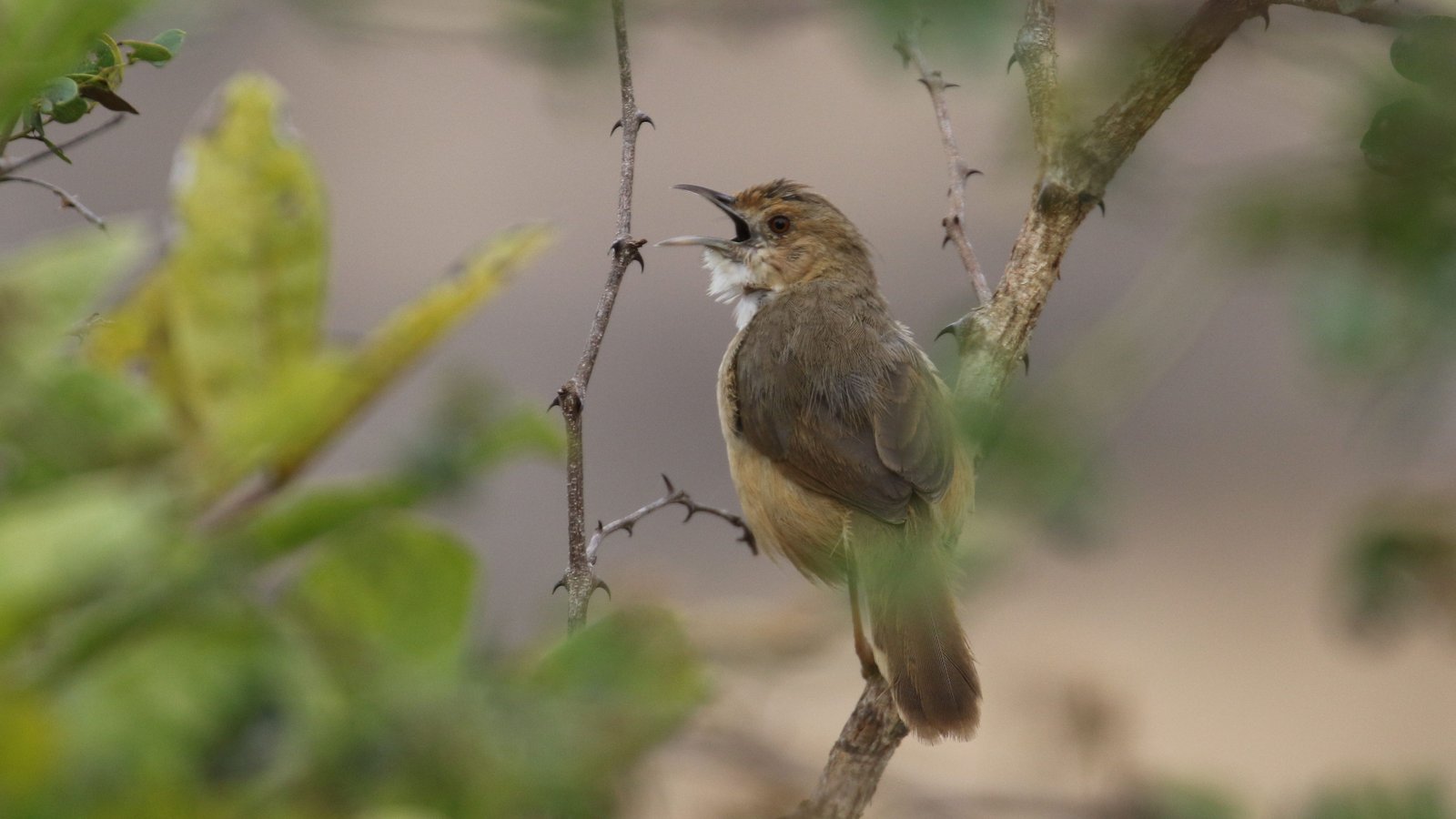
The Red-Faced Cisticola is an unstreaked cisticola of rank riverside vegetation, with a warm rufous face that distinguishes it in every plumage. It does not sing in a display flight but from bushes and reeds, with a loud, explosive series of notes delivered as a duet. Within the region it is widespread in the north and east, south to the lowveld of South Africa.
Voice
A very loud, explosive series rising in speed and pitch, wee-wee-wee-WEEP-WEEP-WEEP or chwee-chwee-chwee, often as a duet in which the partner joins in with rapid chip-chip notes. The contact and alarm call is a sharp tchip or a dry chrr. No display flight; it sings from within the vegetation or from a raised twig, and is also vocal outside the breeding season.
Recording: Jaap van der Waarde — CC BY-NC-SA 4.0 · converted to mono · xeno-canto
Identification
12–13 cm, a fairly large, sturdy cisticola with a medium-length tail. The upperparts are plain grey-brown without streaks, the crown the same colour as the back or slightly warmer, without a distinct rufous cap. Lores, supercilium, cheeks and ear coverts are bright rufous to ochre-red and form a 'mask' contrasting with the crown. The underparts are off-white with warm buff flanks and breast. The tail is grey-brown with a dark subterminal mark and pale tip. The bill is dark, the legs pink. Outside the breeding season the plumage is warmer and browner and the tail longer, but the rufous face remains. The sexes are alike; the male is slightly larger.
Confusion species
Singing Cisticola Cisticola cantans has a rufous crown and a rufous wing panel, but a pale rather than rufous face pattern, and sings with two- to three-syllable whistles. Rattling Cisticola Cisticola chiniana has a streaked back and a rufous-streaked crown and rattles from a bush in drier savanna. Levaillant's Cisticola Cisticola tinniens, Rufous-Winged Cisticola Cisticola galactotes and Luapula Cisticola Cisticola luapula also live in wet vegetation but have a black-streaked back. Chirping Cisticola Cisticola pipiens also has a streaked back and lives in papyrus and reeds. An unstreaked cisticola with a rufous face is a Red-Faced Cisticola.
Habitat
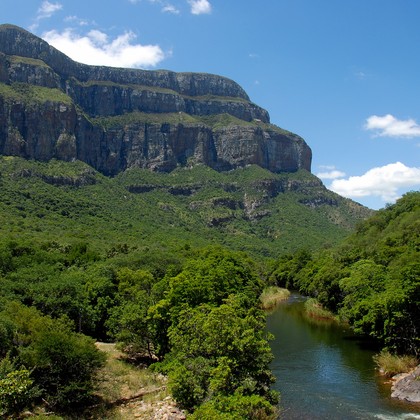
Rank, dense vegetation along rivers, streams and vleis: tall grass, reeds, scrub and creepers on banks and at forest edges, also at the edges of sugarcane and other fields and in overgrown gardens near water. It avoids open grassland without bushes. It forages low in the vegetation for insects, in pairs or family parties.
Where the bird is most at home, classified by the vegetation units of southern Africa.

Range and movements
Within the region widespread in Angola, except the arid south-west, and in Zambia, Malawi and Mozambique; in Zimbabwe in the Zambezi valley, the north and the east and along the rivers of the lowveld; in South Africa in the Limpopo and Mpumalanga lowveld and north-eastern KwaZulu-Natal; also in the lowveld of Eswatini. Beyond the region from Senegal east to Ethiopia and south through East Africa.
- Resident
- Summer visitor (c. Oct–Mar)
- Winter visitor (c. Apr–Sep)
- Passage (Mar–Apr, Oct–Nov)
- dark = core range, pale = thinly spread
How and when to look
Year-round; good places are the riverbanks in Kruger National Park (including along the Sabie and at the dams), Mkhuze and the Victoria Falls area. Listen for the explosive, rising series from the riverside scrub; the bird responds strongly to a brief recording but usually stays half-hidden in the vegetation. Thanks to its unstreaked plumage and rufous face it differs from most cisticolas.
Conservation status
Not threatened. Common over a large range. Suitable riverside vegetation is lost locally to clearing, overgrazing and cultivation of riverbanks, but the species also thrives in rank growth along canals and fields.
Scientific name
Cisticola erythrops | (Hartlaub, 1857)
Hartlaub described the species in 1857 as Drymoeca erythrops; because it was later moved to another genus, the author and year stand in brackets. The genus Cisticola was introduced in 1829 by Kaup. Cisticola combines the Ancient Greek kisthos 'rock-rose' with the Latin colere 'to dwell'. erythrops comes from the Greek eruthros, 'red', and ōps, 'face' — for the rufous face. The specimen the first description was based on came from Calabar, Nigeria.