All species › Passerines › Cisticolas › Yellow-Browed Camaroptera
Yellow-Browed Camaroptera | Camaroptera superciliaris
Geelbrauwcamaroptera | Camaróptera Cejigualda
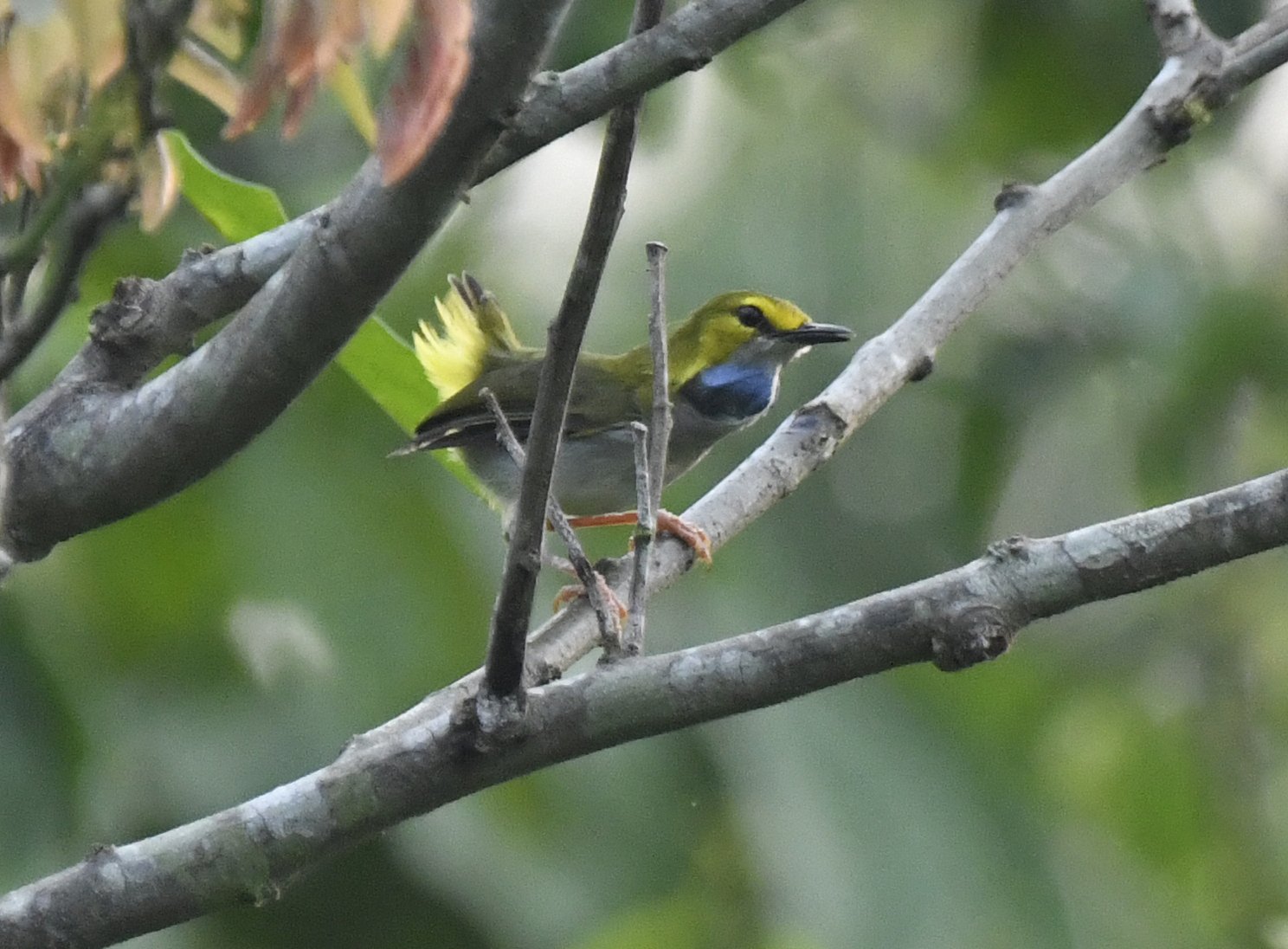
The Yellow-Browed Camaroptera is a small, almost tailless warbler of the edges of West and Central African rainforest, with a bright yellow supercilium in a grey face. Within the region it reaches only north-western Angola, at the southern edge of its range.
Voice
A series of high, plaintive, rising whistles, twee-twee-twee, often repeated at length from dense tangles and loud for such a small bird. Also a nasal, bleating miehh and soft ticking notes.
Recording: Pritam Baruah — CC BY-NC-SA 4.0 · converted to mono · xeno-canto
Identification
10–11 cm, with a very short tail, so that the bird looks compact and rounded. Crown, back, wings and tail are olive-green. A striking, bright yellow supercilium runs from the bill to behind the eye, above grey lores and ear-coverts. Chin and throat are white, breast and flanks grey, the belly white, with yellowish thighs and undertail coverts. The iris is pale brown to reddish-brown, the bill dark, the legs pink. The sexes are alike; juveniles are duller, with a less bright supercilium.
Confusion species
Bleating Camaroptera Camaroptera brachyura and Hartert's Camaroptera Camaroptera harterti have a longer, cocked tail and lack the yellow supercilium. Eremomelas and crombecs, such as Green Crombec Sylvietta virens of the same forest edges, have a different head and bill pattern and forage higher. The combination of yellow supercilium, grey face and virtually absent tail is unique in the region.
Habitat
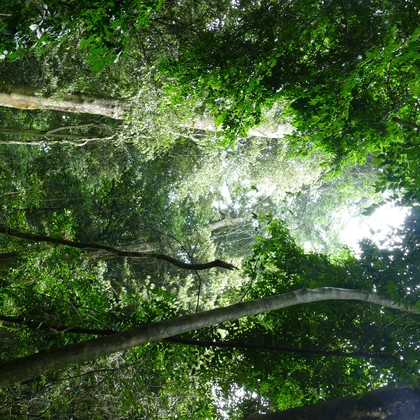
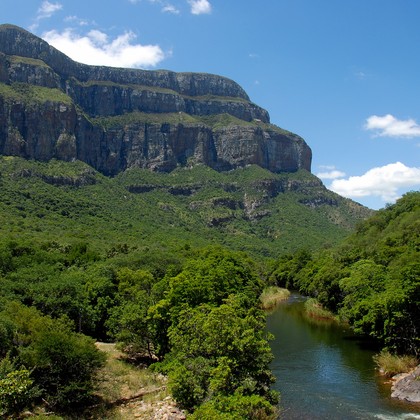
Dense tangles, lianas and scrub at the edges of moist lowland forest and gallery forest, clearings with regrowth, rank growth along streams and overgrown plantations. It keeps to the low and middle levels, often in creeper tangles, and often stays out of view.
Where the bird is most at home, classified by the vegetation units of southern Africa.
Range and movements
Within the region only in north-western Angola: Cabinda, and the lowland forests and northern escarpment of Zaire, Uíge and Cuanza Norte. Beyond the region from Guinea and Sierra Leone east through West Africa and the Congo Basin to Uganda.
- Resident
- dark = core range, pale = thinly spread
How and when to look
Year-round; in Cabinda (Maiombe) and in the forests of Uíge. Listen for the high, plaintive whistled series at forest edges and wait patiently by the tangle it comes from; the bird often appears briefly at the edge, the yellow supercilium conspicuous in the gloom.
Conservation status
Not threatened. Common over a very large range and tolerant of secondary growth. In Angola its habitat is limited and under pressure from logging and farming.
Scientific name
Camaroptera superciliaris | (Fraser, 1843)
Fraser described the species in 1843 as Sylvicola superciliaris; because it was later moved to another genus, the author and year stand in brackets. The genus Camaroptera was introduced in 1850 by Sundevall. Camaroptera comes from the Greek kamara, 'arch, vault', and pteron, 'wing' — for the short, strongly rounded wings. superciliaris is Modern Latin for 'eyebrowed', from supercilium, 'eyebrow' — for the yellow supercilium. The specimen the first description was based on came from Malabo, Bioko (Equatorial Guinea).