All species › Waterfowl › Ducks and geese › Red-Billed Teal
Red-Billed Teal | Anas erythrorhyncha
Roodbekpijlstaart | Ánade Piquirrojo
The Red-Billed Teal is a medium-sized brown dabbling duck with a bright red bill and a dark cap above pale cheeks. It is one of the most numerous ducks in southern Africa and can appear in thousands on temporary pans and flooded plains after the rains.

Click a thumbnail to switch the photo above.
Voice
Not very vocal. The male gives a soft, whistled whizzt in display, the female a soft, husky quack, kwek, in short series.
Recording: Lynette Rudman — CC BY-NC-SA 4.0 · shortened to the first 60 s, mono · xeno-canto
Identification
43–48 cm, with a fairly long neck and a pointed tail. The crown and hindneck are dark chocolate-brown to just below the eye, contrasting sharply with pale creamy-white cheeks and throat. The body is brown, densely scaled and spotted with pale buff. The bill is bright pinkish-red with a dark ridge on the upper mandible. In flight it shows a pale creamy to light buff speculum, without green, and a dark forewing. The sexes are alike; the female has a slightly duller bill. Juveniles are duller, with a brownish-pink bill.
Confusion species
Blue-Billed Teal Spatula hottentota has a similar pattern of dark cap and pale cheeks, but is much smaller, with a blue bill and a dark smudge on the ear-coverts. Cape Teal Anas capensis also has a pink bill, but a pale, freckled head without a cap and a green speculum with white borders. Yellow-Billed Duck Anas undulata is larger and darker, with a yellow bill. Females of Northern Pintail Anas acuta, a rare winter visitor, lack the dark cap and have a grey bill.
Habitat
Shallow fresh water with plenty of fringing and floating vegetation: vleis, flooded grassland, pans, farm dams, sewage ponds and marsh edges. It feeds by dabbling on seeds, aquatic plants, rice and grain, and also on aquatic insects, snails and small crustaceans; flocks also forage on stubble fields near water. It nests on the ground in grass or reeds close to water.
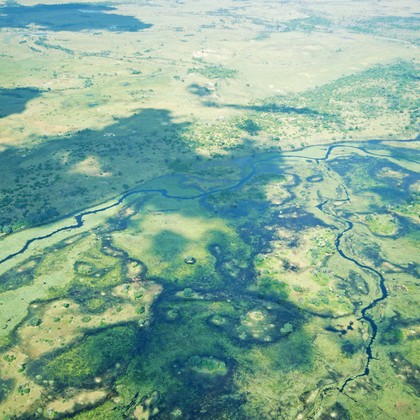
Where the bird is most at home, classified by the vegetation units of southern Africa.

Range and movements
Found across almost the whole region, most numerous in Botswana (Okavango Delta and Makgadikgadi), Namibia (the north and Caprivi), Zimbabwe, Zambia and the pans of the South African highveld and Free State; also in Malawi, Mozambique, Eswatini, Lesotho and southern Angola. Absent only from the bare Namib and the driest parts of the western Karoo. Beyond the region it occurs in East Africa north to Ethiopia and on Madagascar.
- Resident
- Summer visitor (c. Oct–Mar)
- Winter visitor (c. Apr–Sep)
- Passage (Mar–Apr, Oct–Nov)
- dark = core range, pale = thinly spread
How and when to look
After the summer rains on newly filled pans and temporary pools, where large flocks gather; in the dry winter on permanent dams and sewage ponds. The red bill and dark cap are clearly visible at a distance. Check flocks carefully for Blue-billed and Cape Teals, which often swim among them.
Conservation status
Not threatened and common. A popular quarry species, locally shot around grain fields. Populations fluctuate with rain and floods, and it has benefited from dams and irrigation. Avian influenza and botulism occasionally cause mass mortality on shallow waters.
Scientific name
Anas erythrorhyncha | Gmelin, 1789
Gmelin described the species in 1789 and placed it straight away in the genus where it still stands. The genus Anas was introduced in 1758 by Linnaeus. Anas is the Latin word for 'duck'. erythrorhyncha comes from the Greek eruthros, 'red', and rhunkhos, 'bill', for the pinkish-red bill. The specimen the first description was based on came from Cape of Good Hope.