All species › Waterfowl › Ducks and geese › Cape Teal
Cape Teal | Anas capensis
Kaapse taling | Cerceta del Cabo
The Cape Teal is a small, pale dabbling duck with a finely speckled head and a pink bill, the characteristic duck of saline and brackish pans in the dry west of the region. Where other ducks are scarce, on saltworks, sewage ponds and shallow coastal lagoons, it is often the most numerous.

Click a thumbnail to switch the photo above.
Voice
Mostly silent. The male gives a thin, high whistle, chee-oo, mainly in flight and in display; the female a soft, hoarse quack, kwek-kwek.
Recording: African Bioacoustics Community — CC BY-NC-SA 4.0 · converted to mono · xeno-canto
Identification
44–48 cm, compact and round-headed. The plumage is pale greyish-buff with dark scaling and spotting on the back, flanks and breast; the head is almost white and finely freckled grey, without pattern. The bill is pink with a dark base, the eye orange-red in the male and browner in the female. In flight it shows a striking wing pattern: a dark green speculum broadly bordered white in front and behind, so that a white panel flashes on the inner wing. The sexes are alike; the male is slightly larger. Juveniles are duller, with a greyer bill.
Confusion species
Red-Billed Teal Anas erythrorhyncha also has a red to pink bill, but a dark brown cap to below the eye contrasting sharply with pale cheeks, and a creamy rather than green-and-white speculum. Blue-Billed Teal Spatula hottentota is smaller, with a blue bill, a dark cap and a dark smudge on the ear-coverts. Yellow-Billed Duck Anas undulata is larger and darker, with a yellow bill.
Habitat
Shallow saline and brackish waters: pans, saltworks, coastal lagoons, estuaries and sewage ponds, also temporary rain pools and farm dams with bare shores. It feeds by dabbling and upending, sometimes diving, on aquatic insects, small crustaceans, larvae and seeds. It nests on the ground in dense cover, often on an islet or close to water.
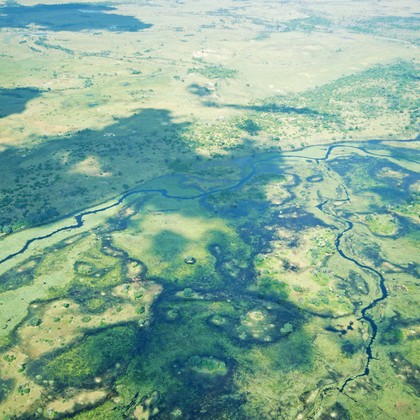
Where the bird is most at home, classified by the vegetation units of southern Africa.

Range and movements
Commonest in the west and south: the Western and Northern Cape, the pans of the Free State and highveld, the coast and inland pans of Namibia and the pans of Botswana. Scarcer and irregular in Zimbabwe, south-western Angola and southern Mozambique; a vagrant to Zambia and Malawi. Beyond the region it occurs in the East African Rift from Tanzania to Ethiopia, with isolated sites around Lake Chad and in Sudan.
- Resident
- Summer visitor (c. Oct–Mar)
- Winter visitor (c. Apr–Sep)
- Passage (Mar–Apr, Oct–Nov)
- dark = core range, pale = thinly spread
How and when to look
Saltworks and sewage ponds along the Western Cape and Namibian coasts, such as at Walvis Bay, are the best places; groups often swim among the flamingos and waders. In flight watch for the white wing panel, which gives the species away at once. After good rains inland it quickly appears on newly filled pans.
Conservation status
Not threatened. The species is locally common and has benefited from saltworks, sewage treatment and farm dams. Numbers fluctuate with rainfall; in dry years large groups move to the coast and to permanent waters.
Scientific name
Anas capensis | Gmelin, 1789
Gmelin described the species in 1789 and placed it straight away in the genus where it still stands. The genus Anas was introduced in 1758 by Linnaeus. Anas is the Latin word for 'duck'. capensis is Latin for 'of the Cape', after the Cape of Good Hope, where the type material came from. The specimen the first description was based on came from Cape of Good Hope.