All species › Passerines › Sunbirds › Purple-Banded Sunbird
Purple-Banded Sunbird | Cinnyris bifasciatus
Purperbandhoningzuiger | Suimanga Bandeado
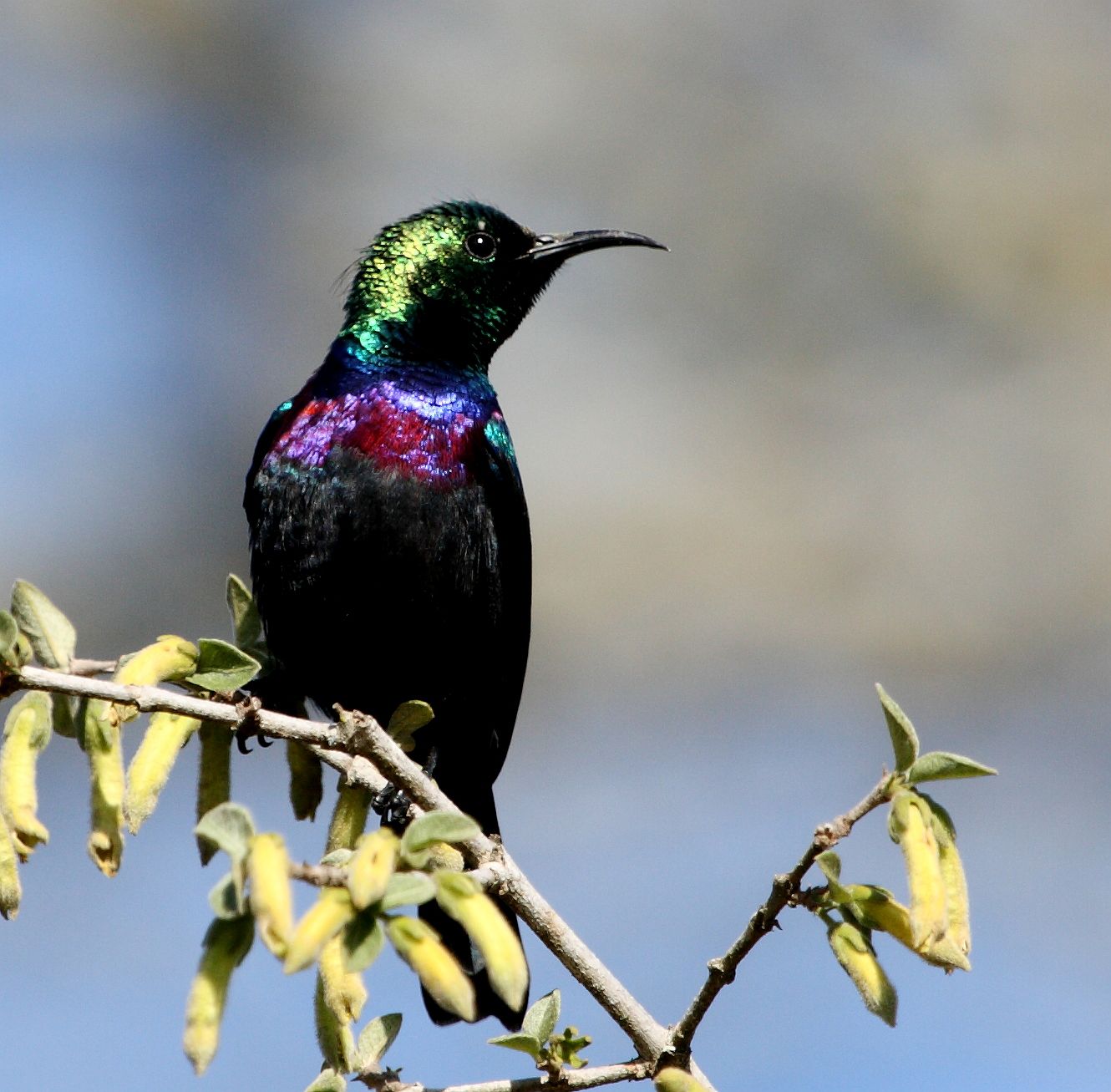
The Purple-Banded Sunbird is a small, short-billed sunbird of coastal forest, riverine forest and moist woodland. The male is a scaled-down version of Marico Sunbird, with a narrow purple breast band above a black belly.
Click a thumbnail to switch the photo above.
Voice
A high tsik or tchip call. The song is a short, high series that accelerates and then drops in pitch, tsi-tsi-tsi-tsiu-tsiu-tsiu, ending in a dry twitter.
Recording: Luca Forneris — CC BY-NC-SA 4.0 · converted to mono · xeno-canto
Identification
10 to 12 cm, with a short, moderately decurved bill. The male has a metallic green head, back and throat, then a narrow blue band and a narrow, glossy purple to violet-brown breast band; the belly is dull black. After breeding males moult into an eclipse dress resembling the female, with a dark throat patch and scattered green feathers. The female is olive-grey above with a pale supercilium, and pale yellow below with faint fine streaking on the breast.
Confusion species
Marico Sunbird (Cinnyris mariquensis) is clearly larger, with a long heavy bill and a broader wine-red band, and lives in drier thornveld. Neergaard's Sunbird (Cinnyris neergaardi) of the sand forest of Zululand and southern Mozambique has a red breast band. White-Bellied Sunbird (Cinnyris talatala) has a white belly. Females are very similar: female Marico is larger and more heavily streaked, female White-bellied unstreaked and dirty white below.
Habitat
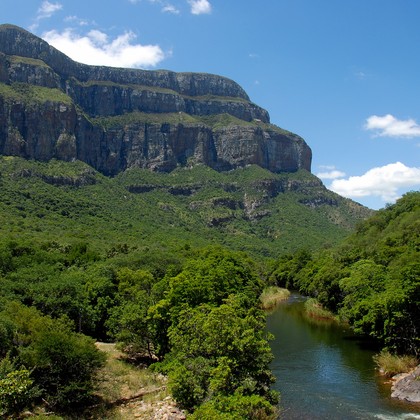
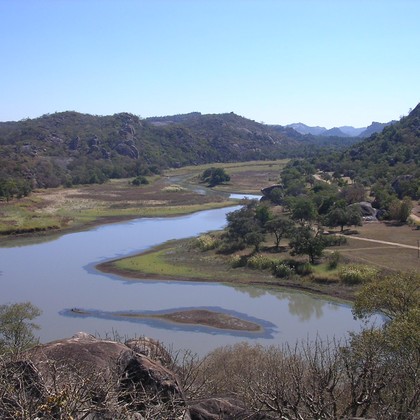
Coastal forest, edges of dry and moist forest, riverine forest, dense thicket, mangroves and moist woodland, also gardens in the coastal belt. It feeds both high in the canopy and in low flowering shrubs, often in mixed parties of sunbirds.
Where the bird is most at home, classified by the vegetation units of southern Africa.

Range and movements
In the east of the region: the coastal plain of Mozambique, eastern Zimbabwe, southern and central Malawi, eastern and northern Zambia, and in South Africa north-eastern KwaZulu-Natal (Zululand) with an extension into eastern Eswatini; in winter wanderers reach further south along the coast. A separate western population lives along the coast of Angola. Beyond the region from Tanzania to the Kenyan coast, and in the west from Gabon to Congo.
- Resident
- Summer visitor (c. Oct–Mar)
- Winter visitor (c. Apr–Sep)
- Passage (Mar–Apr, Oct–Nov)
- dark = core range, pale = thinly spread
How and when to look
Best found at flowering trees and shrubs in Zululand (iSimangaliso, Mkhuze) and in the coastal forests of Mozambique. Look for the short bill and small size; in an eclipse male a dark throat gives it away. It is one of the sunbirds that often stays high in the canopy, so watch for calling birds overhead.
Conservation status
Not threatened. Locally common; declining locally through clearance of coastal forest, but stable overall.
Scientific name
Cinnyris bifasciatus | (Shaw, 1812)
Shaw described the species in 1812 as Certhia bifasciata; because it was later moved to another genus, the author and year stand in brackets. The genus Cinnyris was introduced in 1816 by Cuvier, GLCFD. Cinnyris derives from the Greek kinnuris, the name of a small bird mentioned by the lexicographer Hesychius that cannot be identified further. bifasciatus is Latin for 'two-banded', for the male's narrow blue and broad maroon breast bands. The specimen the first description was based on came from Malembo, Cabinda, Angola.