All species › Passerines › Sunbirds › Shelley's Sunbird
Shelley's Sunbird | Cinnyris shelleyi
Shelleys honingzuiger | Suimanga de Shelley
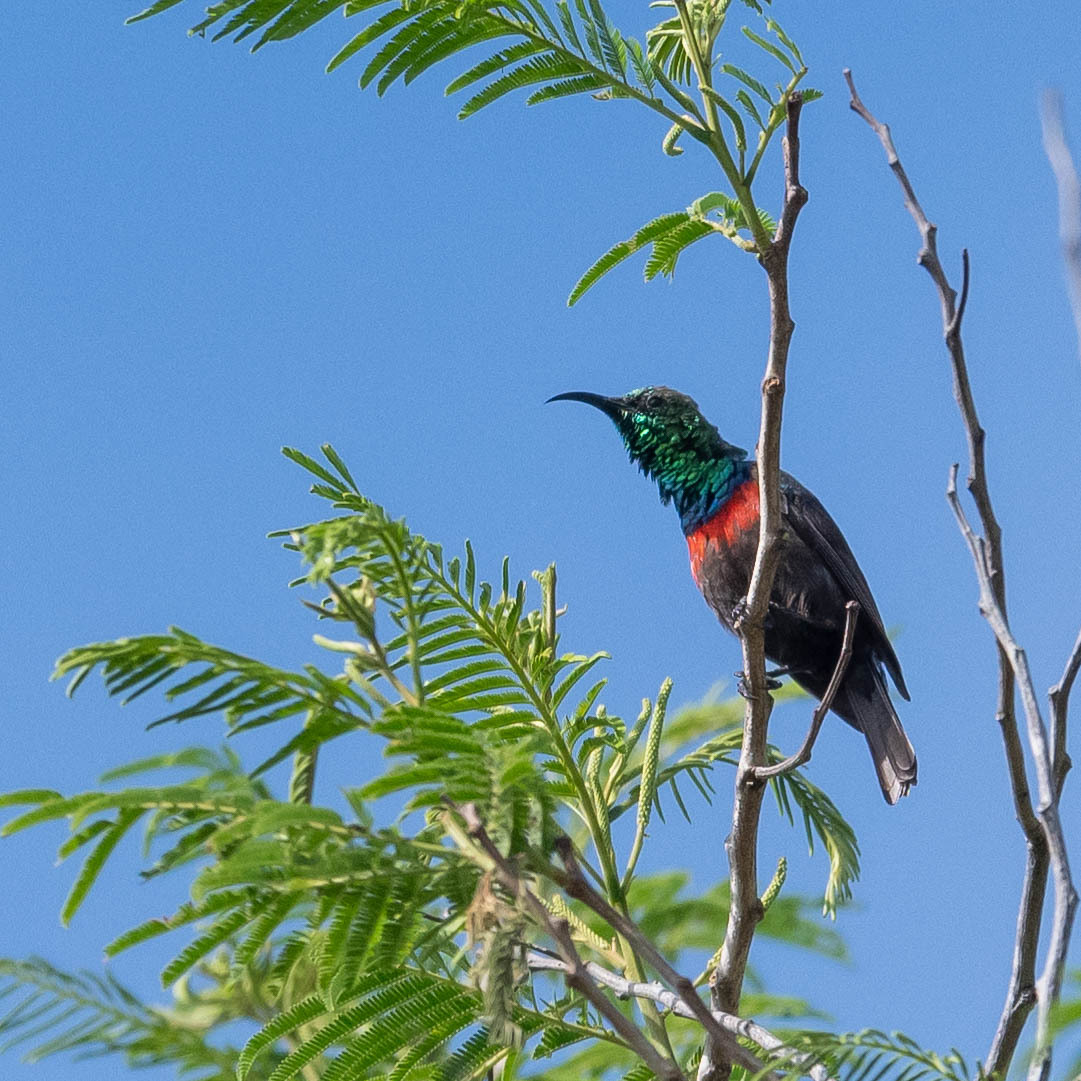
Shelley's Sunbird is a little-known sunbird of the Zambezi and Luangwa valleys. The male combines a scarlet breast band with a black belly, a combination shared in the region only by Neergaard's Sunbird.
Voice
A sharp tchik or tcheep call. The song is a rapid, high twittering series, tcheep-tcheep-tchirrrr, like that of Marico Sunbird but thinner.
Recording: Dries Van de Loock — CC BY-NC-SA 4.0 · converted to mono · xeno-canto
Identification
12 to 13 cm, with a medium-length decurved bill. The male has a metallic green head, back and throat, then a narrow glossy blue band and a broad scarlet breast band; belly and undertail coverts are dull black. Yellow pectoral tufts are shown in display. The female is olive-brown above and dirty yellowish-white below with fine, faint streaking on the breast, without obvious markings.
Confusion species
Eastern Miombo Sunbird (Cinnyris manoensis) and Western Miombo Sunbird (Cinnyris gertrudis) have a narrower red band and a grey-olive, not black, belly. Neergaard's Sunbird (Cinnyris neergaardi) is very similar but smaller and shorter-billed, and lives far to the south-east in sand forest. Marico Sunbird (Cinnyris mariquensis) has a wine-red, not scarlet, band. Females are barely separable in the field from those of related species and are best named in company with a male.
Habitat
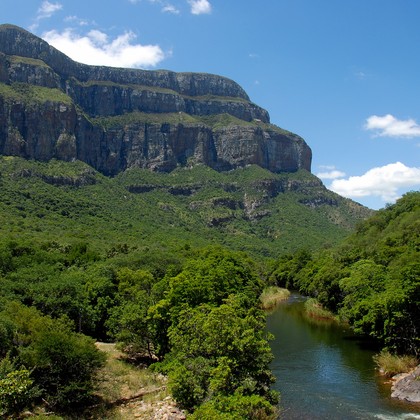
Miombo and other open broadleaved woodland with flowering trees, riverine woodland, mopane edges and dense bushes along rivers in hot lowland valleys. It visits mistletoes (Loranthaceae) and flowering Erythrina and Brachystegia edges in particular.
Where the bird is most at home, classified by the vegetation units of southern Africa.


Range and movements
Within the region mainly in the Luangwa and middle Zambezi valleys of Zambia, also in parts of northern and eastern Zambia, Malawi (mainly the south and along the Shire), western Mozambique (Tete and Niassa) and scarcely in the Zambezi Valley of northern Zimbabwe. Beyond the region in south-eastern DR Congo and southern Tanzania; the Tanzanian birds are nowadays often treated as a separate species.
- Resident
- Summer visitor (c. Oct–Mar)
- Winter visitor (c. Apr–Sep)
- Passage (Mar–Apr, Oct–Nov)
- dark = core range, pale = thinly spread
How and when to look
Search the Luangwa Valley and the Zambezi (Lower Zambezi, Mana Pools) at flowering mistletoe in the dry season, from June to October. With any red-banded male, look at the belly: black means Shelley's, grey-olive one of the miombo sunbirds.
Conservation status
Not threatened. Generally scarce and patchily distributed; the trend is unknown. Clearance of riverine woodland and miombo is a local threat.
Scientific name
Cinnyris shelleyi | Alexander, 1899
Alexander described the species in 1899 and placed it straight away in the genus where it still stands. The genus Cinnyris was introduced in 1816 by Cuvier, GLCFD. Cinnyris derives from the Greek kinnuris, the name of a small bird mentioned by the lexicographer Hesychius that cannot be identified further. shelleyi honours the British ornithologist George Ernest Shelley (1840–1910), author of The Birds of Africa. The specimen the first description was based on came from Zambezi River, c. 100 km below its confluence with the Kafue.