All species › Passerines › Sunbirds › Orange-Tufted Sunbird
Orange-Tufted Sunbird | Cinnyris bouvieri
Bouviers honingzuiger | Suimanga de Bouvier
The Orange-Tufted Sunbird is a small, dark sunbird of grassy savanna and forest edges in northern Angola and north-western Zambia. The male owes its English name to the orange and yellow pectoral tufts.

Voice
A high, sharp tchit call. The song is a rapid, high, dry twittering series lasting a few seconds, not very musical.
Recording: Josh Engel — CC BY-NC-SA 3.0 · shortened to the first 60 s, mono · xeno-canto
Identification
11 to 12 cm, with a medium-length decurved bill. The male has a metallic green head, back and throat, with a purple-blue sheen on the forehead and uppertail coverts. Below the throat comes a narrow violet-blue band and then a broader, dark chestnut to chestnut-purple breast band; the belly is dark olive-brown. The pectoral tufts are orange and yellow. The female is olive-brown above and pale yellow below with faint dark streaking on the breast.
Confusion species
Purple-Banded Sunbird (Cinnyris bifasciatus) has a black belly and no orange tufts, and in Angola lives along the coast, not on the plateau. Olive-Bellied Sunbird (Cinnyris chloropygius) has a red breast band and an olive-green belly. Western Miombo Sunbird (Cinnyris gertrudis) also has a red band and a grey belly. Females of these species are hardly separable in the field.
Habitat
Grassy savanna with bushes, edges of gallery forest and dambos, open woodland near forest and abandoned cultivation with flowering shrubs; often in hilly country and on plateaus.
Where the bird is most at home, classified by the vegetation units of southern Africa.
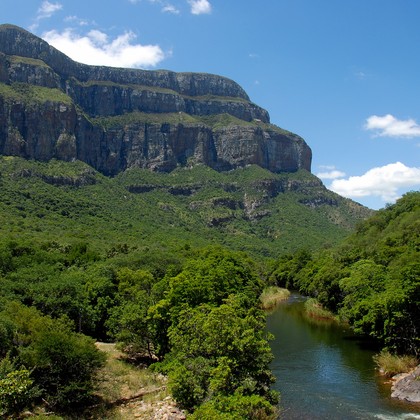

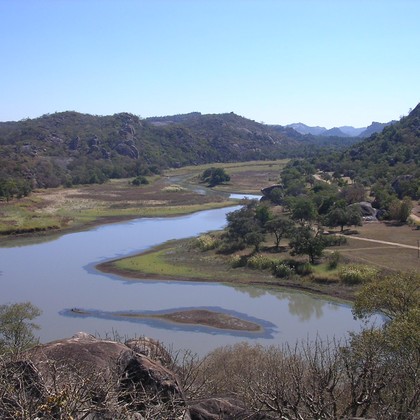
Range and movements
Within the region in northern Angola (mainly the Lunda provinces and the northern plateau) and extreme north-western Zambia, around Mwinilunga. Beyond the region patchily from Cameroon and Gabon through Congo and DR Congo to Uganda, western Kenya and north-western Tanzania.
- Winter visitor (c. Apr–Sep)
- dark = core range, pale = thinly spread
How and when to look
In Zambia the Mwinilunga area, with its mosaic of grassland, dambo and gallery forest, is the only place with a reasonable chance. With a dark male, wait for it to lift its wings: the orange tufts and the dark, not black, belly separate it from Purple-Banded Sunbird.
Conservation status
Not threatened. Locally common across its large range, but scarce and poorly known within the region itself.
Scientific name
Cinnyris bouvieri | Shelley, 1877
Shelley described the species in 1877 and placed it straight away in the genus where it still stands. The genus Cinnyris was introduced in 1816 by Cuvier, GLCFD. Cinnyris derives from the Greek kinnuris, the name of a small bird mentioned by the lexicographer Hesychius that cannot be identified further. bouvieri honours the French naturalist and natural-history dealer Aimé Bouvier (1844–1919). The specimen the first description was based on came from Landana, Cabinda, Angola.