All species › Passerines › Indigobirds and whydahs › Pin-Tailed Whydah
Pin-Tailed Whydah | Vidua macroura
Dominicanerwida | Viuda Colicinta
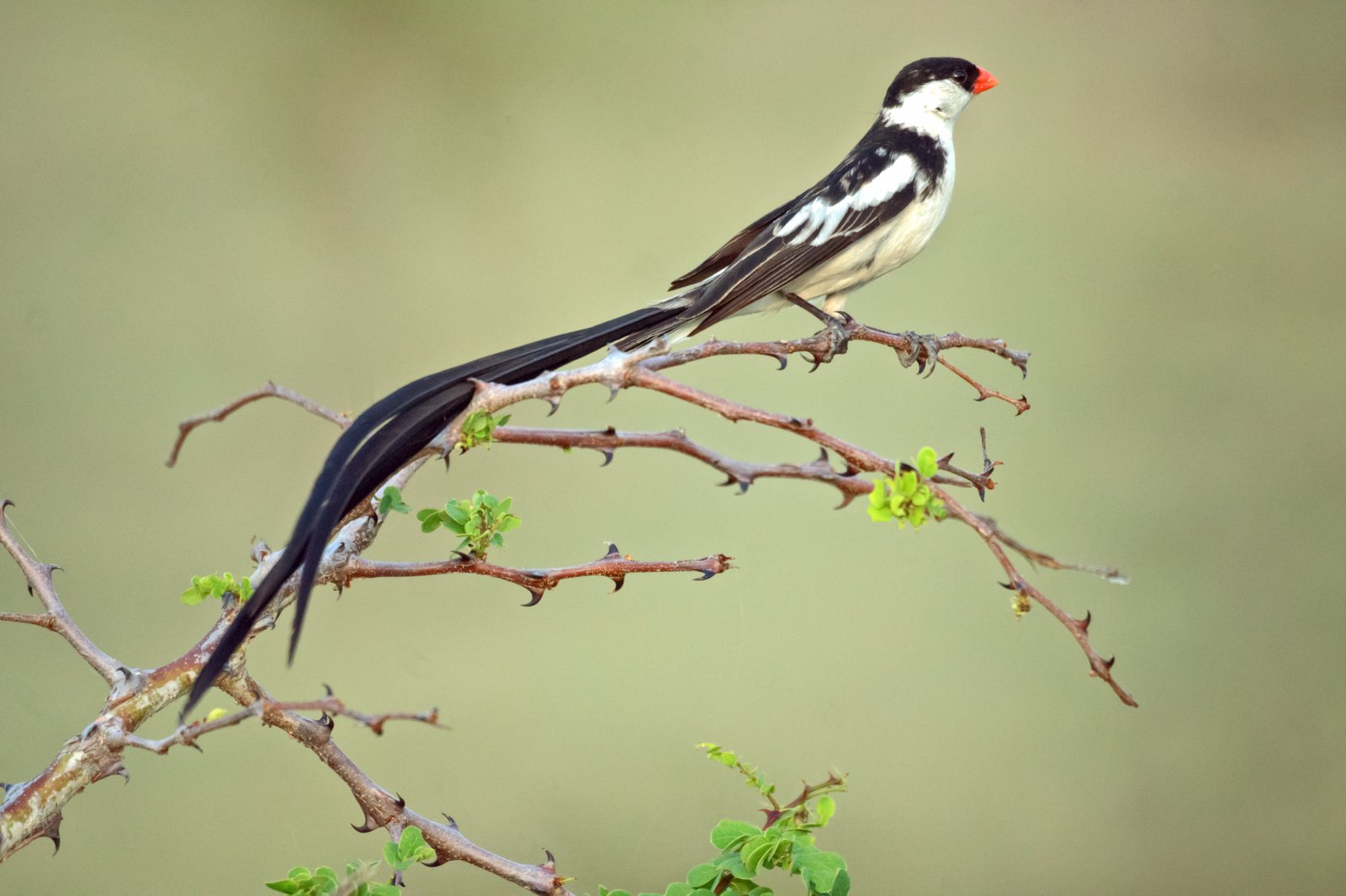
The Pin-Tailed Whydah is the most widespread and familiar whydah of the region: a black-and-white male with a red bill and a long, thin tail that dances tirelessly above a female. It parasitises mainly the Common Waxbill.
Click a thumbnail to switch the photo above.
Voice
The song is a high, squeaky, twittering jumble of notes, tseet-tseet-tsweet, usually given in the display flight. The call is a sharp chip. Unlike the other Vidua species, the male hardly mimics its host's song.
Recording: Filippo Ceccolini — CC BY-NC-SA 4.0 · converted to mono · xeno-canto
Identification
12–34 cm; the body measures 12–13 cm, and the breeding male adds four narrow black central tail feathers of 18–22 cm. Crown, back and tail are black, the face, collar and underparts white, the wings black with a white patch on the coverts. The bill is bright coral-red, the legs dark. The female is brown with black streaking on the back, a head with black and buff longitudinal stripes and pale underparts; her bill is reddish, brighter when breeding. The non-breeding male resembles the female but keeps a red bill and a sharper head pattern. Juveniles are plain grey-brown with a dark bill.
Confusion species
The breeding male is unmistakable. The male Shaft-Tailed Whydah (Vidua regia) has golden-buff underparts and tail feathers with bare shafts ending in a small vane. Females and non-breeding males of Shaft-Tailed Whydah have a less sharply striped head with a rufous cheek, and those of the paradise whydahs (Vidua paradisaea, Vidua obtusa) have a dark grey bill. Female bishops (Euplectes) are larger, with a heavier, horn-coloured bill and without the contrasting head stripes.
Habitat
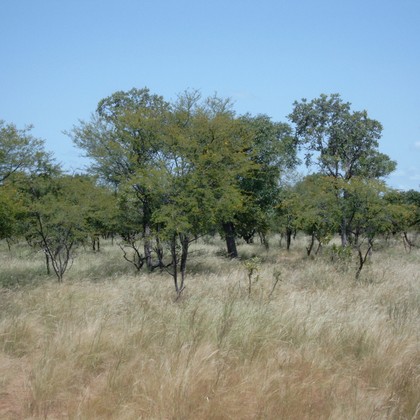
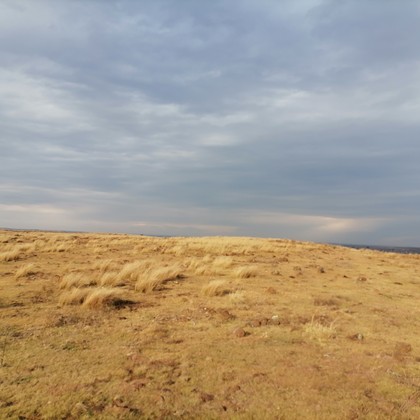
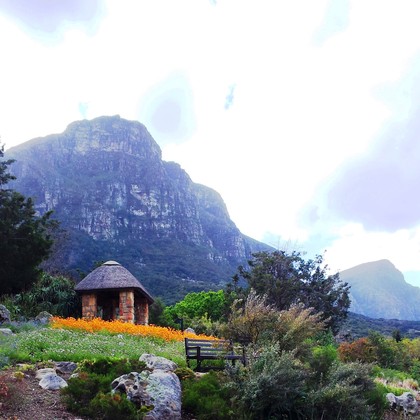
Open grassland, grassy savanna and woodland edges, farmland, riverbanks, parks and gardens; it avoids truly arid areas. It eats mainly grass seeds from the ground and readily visits feeders, where the male fiercely chases off other seedeaters. It lays its eggs mainly in the nests of Common Waxbill (Estrilda astrild), less often with Swee Waxbill (Coccopygia melanotis) and Orange-Breasted Waxbill (Amandava subflava).
Where the bird is most at home, classified by the vegetation units of southern Africa.
Range and movements
Over almost the entire region, from the Cape to Angola and Malawi: throughout South Africa, Lesotho and Eswatini except the driest parts of the Karoo, and further in Zimbabwe, Mozambique, Zambia, Malawi, Angola, northern and eastern Botswana and northern Namibia. It is absent from the Namib and scarce in the Kalahari. Beyond the region it occurs across almost all of sub-Saharan Africa; introduced to Puerto Rico and California, among other places.
- Resident
- Summer visitor (c. Oct–Mar)
- Winter visitor (c. Apr–Sep)
- Passage (Mar–Apr, Oct–Nov)
- dark = core range, pale = thinly spread
How and when to look
In summer at almost every bird feeder and in every grassy garden. Watch the display: the male hovers half a metre above the female on quivering wings with an undulating tail and bobs up and down. Outside the breeding season mixed flocks of females and non-breeding males roam about; red bills and striped heads give them away among the waxbills.
Conservation status
Not threatened; common and benefits from gardens, feeders and farmland. The host species suffers little, as the chicks are raised alongside the host young.
Scientific name
Vidua macroura | (Pallas, 1764)
Pallas described the species in 1764 as Fringilla (macroura); because it was later moved to another genus, the author and year stand in brackets. The genus Vidua was introduced in 1816 by Cuvier, GLCFD. Vidua is the Latin word for 'widow'. macroura is Greek, from makros 'long' and oura 'tail', after the male's greatly elongated tail feathers. The specimen the first description was based on came from Angola.