All species › Passerines › Indigobirds and whydahs › Broad-Tailed Paradise Whydah
Broad-Tailed Paradise Whydah | Vidua obtusa
Breedstaartparadijswida | Viuda Coliancha
The Broad-Tailed Paradise Whydah is the paradise whydah of miombo and other broad-leaved woodland. The breeding male closely resembles the Long-Tailed Paradise Whydah, but carries a shorter tail that stays broad along its whole length. It parasitises only the Orange-Winged Pytilia.

Click a thumbnail to switch the photo above.
Voice
The male sings from a high branch a mixture of high notes of its own and imitations of the calls and song of the Orange-Winged Pytilia, including a whistled twee-oo and a soft rolling chrr. The call is a dry chip. Because it mimics a different host from Long-Tailed Paradise Whydah, the song is the best character.
Recording: Thibaut Chansac — CC BY-NC-SA 4.0 · converted to mono · xeno-canto
Identification
15–30 cm; the body measures 15 cm, and the breeding male adds elongated central tail feathers up to about 15–18 cm long: a short pair with a thread-like tip and a long pair that is broad throughout and ends bluntly rounded. Head, throat, back and tail are black, the nape band narrow and golden-yellow, the breast deep chestnut and the belly creamy white. The female and the non-breeding male are streaked brown above and pale buff below, with a black-and-white striped head and a dark grey bill, almost identical to Long-Tailed Paradise Whydah. Juveniles are plain grey-brown with faint head stripes.
Confusion species
Long-Tailed Paradise Whydah (Vidua paradisaea) has a longer, tapering tail, a paler, more orange-brown breast and a broader yellow nape band, and lives mainly in dry thornveld. Females of the two species are barely separable in the field; habitat and the presence of the host help. Females of Pin-Tailed Whydah (Vidua macroura) and Shaft-Tailed Whydah (Vidua regia) have a red or pink bill.
Habitat
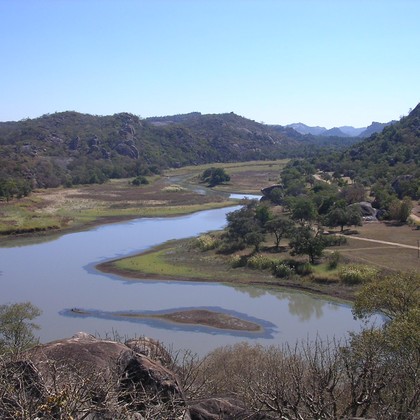
Miombo and other open, mixed broad-leaved woodland with a grassy understorey, often along woodland edges and clearings. It feeds on seeds from the ground, often in mixed flocks. It lays its eggs in the nests of Orange-Winged Pytilia (Pytilia afra); the chicks' mouth markings mimic those of the host young.
Where the bird is most at home, classified by the vegetation units of southern Africa.

Range and movements
In the north and east of the region: Zimbabwe (mainly the north, centre and east), central and northern Mozambique, Zambia, Malawi and Angola; scarce in northern Botswana and the Zambezi Region of Namibia, and only rare in the extreme north-east of South Africa. Beyond the region north to Tanzania, southern Kenya, Uganda and southern DR Congo.
- Resident
- dark = core range, pale = thinly spread
How and when to look
Look for it in the miombo of Zimbabwe, Zambia or Malawi between January and April, when the males sing from treetops. With every paradise whydah check the tail tip: blunt and broad means this species. If Orange-Winged Pytilias are calling nearby, a singing male is likely to be copying their sounds.
Conservation status
Not threatened; locally fairly common, but its dependence on miombo makes it sensitive to logging and the conversion of woodland to farmland.
Scientific name
Vidua obtusa | (Chapin, 1922)
Chapin described the species in 1922 as Steganura aucupum obtusa; because it was later moved to another genus, the author and year stand in brackets. The genus Vidua was introduced in 1816 by Cuvier, GLCFD. Vidua is the Latin word for 'widow'. obtusa is Latin for 'blunt' — for the broad, blunt central tail feathers that distinguish it from the Long-tailed Paradise Whydah. The specimen the first description was based on came from Luchenza, Malawi.