All species › Gannets and cormorants › Gannets and boobies › Northern Gannet
Northern Gannet | Morus bassanus
Jan-van-gent | Alcatraz Atlántico
The Northern Gannet is the large white gannet of the North Atlantic, whose young birds move south along the coast of West Africa in winter. The odd individual reaches the coast of Angola and so enters the range of the Cape Gannet.

Voice
Silent at sea. At the colony a rasping, guttural arrah-arrah, speeding up into hoarse croaking during disputes.
Recording: Simon Gillings — CC BY-NC-SA 4.0 · converted to mono · xeno-canto
Identification
87–100 cm long, wingspan 165–180 cm; slightly larger than Cape Gannet. Adults are white with a soft yellow head and neck and only the primaries black; secondaries and tail are white. Short black throat stripe, blue-grey bill with black grooves, pale eye-ring and black lore. Juveniles are dark grey-brown with fine white spots and turn white over four to five years via a piebald intermediate plumage, in which the secondaries are often partly black. Cigar-shaped with a pointed tail and bill; flies with stiff wingbeats and plunge-dives into the sea.
Confusion species
Cape Gannet (Morus capensis) has black secondaries, an all-black tail, a more golden head and a much longer throat stripe. Australasian Gannet (Morus serrator) also has black secondaries and a tail with a black centre and white outer feathers. Immatures in transitional plumage with partly black secondaries can be confused with one another; check the length of the throat stripe and the white outer tail feathers.
Habitat
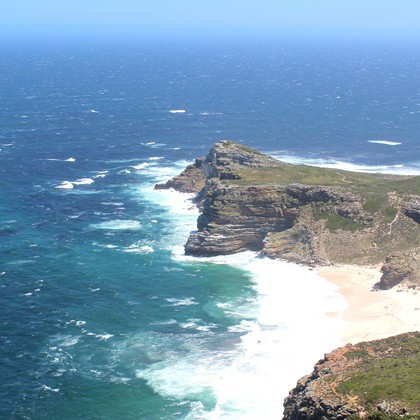
Cool, productive seas over the continental shelf. Plunge-dives from a height for mackerel, herring and other shoaling fish. Breeds in dense colonies on cliffs and rocky islands.
Where the bird is most at home, classified by the vegetation units of southern Africa.
Range and movements
Within the region known only from the coast of Angola, where birds from Lobito and Benguela, among other places, are preserved as museum specimens; reports further south cannot be separated from Cape Gannet and have not been accepted. It breeds in the North Atlantic, from Canada and Iceland to Norway, Britain, Ireland and France. Outside the breeding season birds disperse south to the Gulf of Mexico and West Africa, young birds into the Gulf of Guinea.
How and when to look
Check flocks of feeding Cape Gannets off Angola for an adult with white secondaries and a white tail; seen from below in flight this is the clearest feature. Photographs from above and below are essential.
Conservation status
Not globally threatened. After centuries of persecution the population grew strongly, but in 2022 avian influenza killed tens of thousands of breeding birds in the large colonies of Scotland, Canada and France; recovery is being monitored.
Scientific name
Morus bassanus | (Linnaeus, 1758)
Linnaeus described the species in 1758 as Pelecanus Bassanus; because it was later moved to another genus, the author and year stand in brackets. The genus Morus was introduced in 1816 by Vieillot. Morus comes from the Greek moros, 'foolish' — the same root behind the English 'booby' for related gannets and boobies, for the birds' unwary, awkward-looking bearing on land at their breeding colonies. bassanus means 'of Bass Rock', the rock in the Firth of Forth that holds one of the largest colonies. The specimen the first description was based on came from Bass Rock, Scotland.