All species › Gannets and cormorants › Gannets and boobies › Australasian Gannet
Australasian Gannet | Morus serrator
Australische jan-van-gent | Alcatraz Australiano
The Australasian Gannet is a rare visitor from Australia and New Zealand that settles in Cape Gannet colonies. Some birds stay for years, pair with Cape Gannets and even raise young.
Voice
Like Cape Gannet: a harsh, nasal arrah-arrah at the colony, mostly silent at sea.
Recording: Chris Benesh — CC BY-NC-SA 3.0 · converted to mono · xeno-canto
Identification
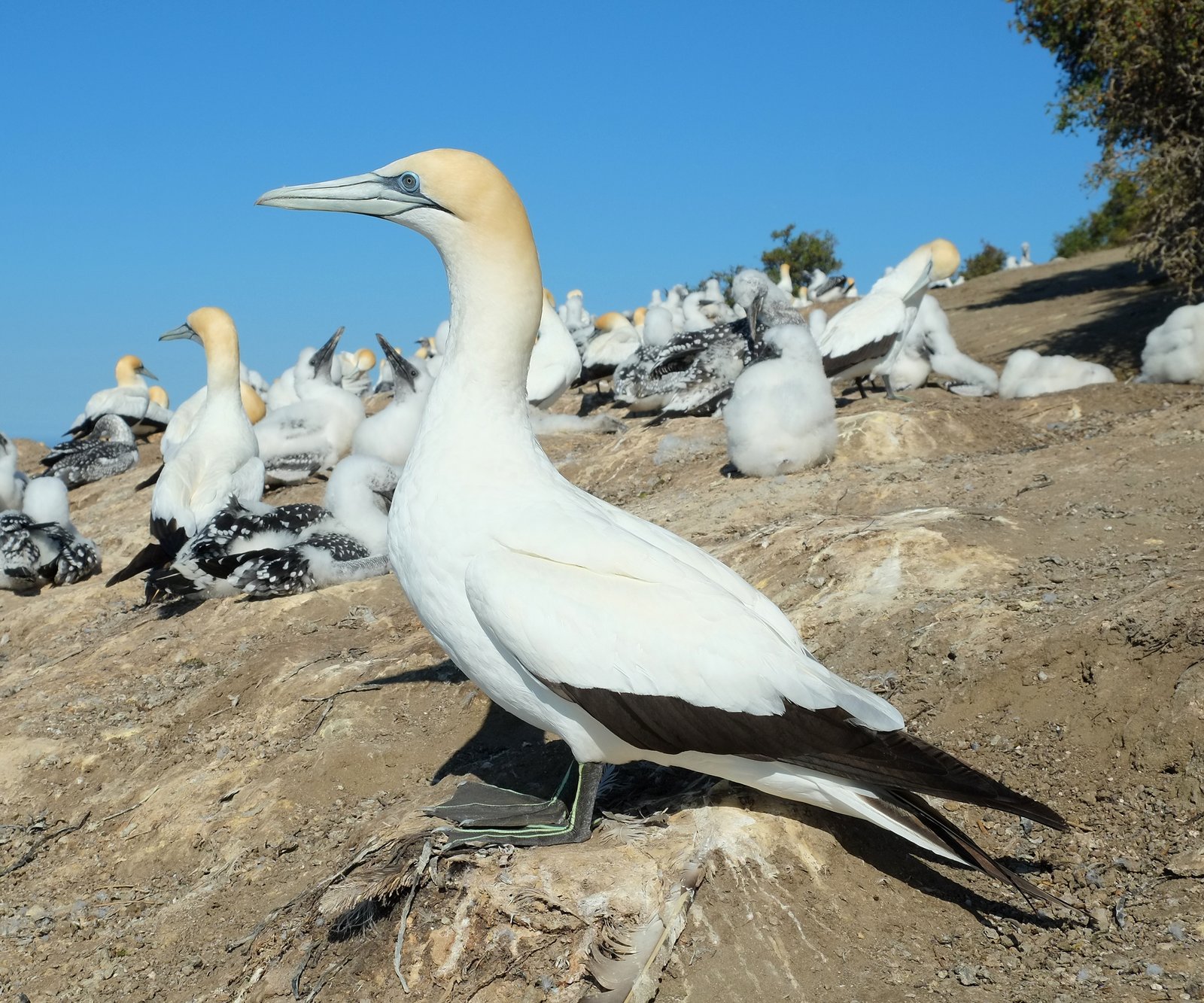
84–91 cm long, wingspan 170–180 cm; slightly smaller than Cape Gannet. White with an ochre-yellow head and neck, black primaries and secondaries, and a tail with black central and white outer feathers. The black throat stripe is short, about a third the length of Cape Gannet's. The bill is blue-grey with black grooves, the eye pale blue with a blue eye-ring. Juveniles are dark brown speckled with white and cannot be told from young Cape Gannets.
Confusion species
Cape Gannet (Morus capensis) has an all-black tail and a long throat stripe running far down the neck. Northern Gannet (Morus bassanus) has white secondaries and an all-white tail. Hybrids between Australasian and Cape Gannets occur and show intermediate features, so judge throat stripe and tail together.
Habitat
Cool coastal waters over the continental shelf. In the region it breeds among Cape Gannets on flat, bare guano islands.
Where the bird is most at home, classified by the vegetation units of southern Africa.


Range and movements
Within the region a rare but regular visitor to Cape Gannet colonies: Malgas in Saldanha Bay, Bird Island at Lambert's Bay and Bird Island in Algoa Bay in South Africa, and Possession and Ichaboe in Namibia. Ringed birds move between colonies; in 2023–2024 four were present at once on Bird Island at Lambert's Bay. The species breeds in south-eastern Australia, Tasmania and New Zealand.
How and when to look
From the hide on Bird Island at Lambert's Bay, scan the breeding birds for one with a short throat stripe; in a flying or stretching bird the white outer tail feathers are clearly visible. Individuals are often found at the same spot year after year.
Conservation status
Not globally threatened; the population in Australia and New Zealand is increasing and founding new colonies. The growing number of birds in southern Africa is linked to that increase and to changes in the ocean.
Scientific name
Morus serrator | (Gray, 1843)
Gray described the species in 1843 as Pelecanus serrator; because it was later moved to another genus, the author and year stand in brackets. The genus Morus was introduced in 1816 by Vieillot. Morus comes from the Greek moros, 'foolish' — the same root behind the English 'booby' for related gannets and boobies, for the birds' unwary, awkward-looking bearing on land at their breeding colonies. serrator is Latin for 'sawyer' — for the finely serrated edges of the bill. The specimen the first description was based on came from Tasmania, Australia.