All species › Storks › Storks › Marabou Stork
Marabou Stork | Leptoptilos crumenifer
Afrikaanse maraboe | Marabú Africano
The Marabou Stork is a huge, hunch-shouldered stork with a bare, flesh-coloured head, an enormous wedge-shaped bill and a hanging throat pouch. It lives mainly as a scavenger and stands among the vultures at carcasses, but also takes fish, frogs, rats and young birds. With the wingspan of a large vulture it is among the largest flying birds of the region.

Voice
Largely silent. Loud bill-clattering at the nest and in squabbles, plus low grunts, growls and a squealing sound from the throat pouch in display.
Recording: Josh Engel — CC BY-NC-SA 3.0 · shortened to the first 60 s, mono · xeno-canto
Identification
150 cm, wingspan 2.25 to 2.85 metres. Upperparts slate-grey, with a faint gloss in the breeding season; flight feathers and tail blackish, the wing coverts narrowly edged white. Underparts and ruff white. Head and neck are almost bare, pink to red with dark blotches and some hair-like down; a pink throat pouch hangs from the foreneck and is inflated in display, and there is a second, orange-red air sac on the nape. The bill is massive, dirty horn-coloured and straight. The legs are dark but often look white because the bird defecates on them to keep cool. Juveniles are duller and browner, with more down on the head. In flight the neck is retracted, as in a heron; the broad dark wings and white underparts give a vulture silhouette with long legs.
Confusion species
Unmistakable at close range thanks to the bare head and throat pouch. In flight it can be confused with a vulture such as White-Backed Vulture Gyps africanus, but the long bill and projecting legs are decisive. Saddle-Billed Stork Ephippiorhynchus senegalensis is black and white with a red-and-black bill and flies with outstretched neck. Great White Pelican Pelecanus onocrotalus has a white body and a yellow pouch.
Habitat
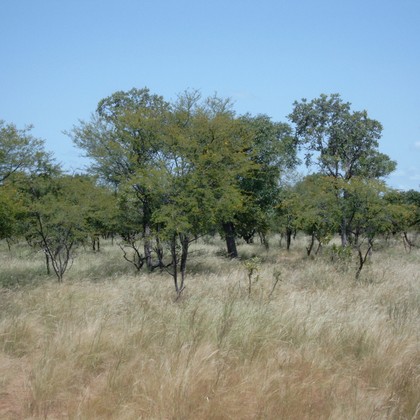
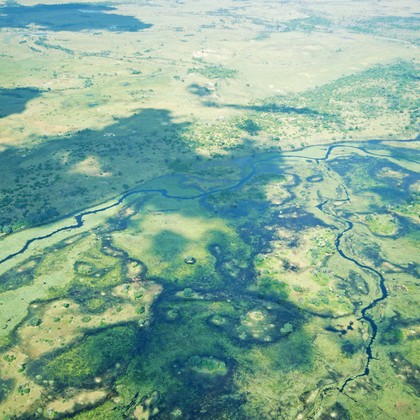
Open savanna, floodplains, riverbanks and pans, and nowadays also rubbish dumps, abattoirs and fishing villages. It stands around carcasses of large wild animals, follows bush fires to catch fleeing animals and gathers at drying pools to snatch stranded fish. Breeds colonially in tall trees, sometimes on cliffs, in the dry season.
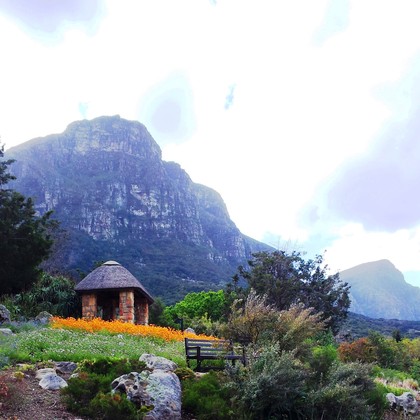
Where the bird is most at home, classified by the vegetation units of southern Africa.
Range and movements
Widespread in the north of the region: Botswana (especially the Okavango, the Chobe and the Makgadikgadi), the Caprivi and Etosha in northern Namibia, Zimbabwe, Zambia, Malawi, Mozambique and Angola. In South Africa mainly in the Kruger National Park and the lowveld of Limpopo and Mpumalanga, with a breeding colony in Eswatini; further south and west a rare vagrant. Beyond the region in Africa south of the Sahara, from Senegal and the Gambia to Sudan and Ethiopia.
- Resident
- Summer visitor (c. Oct–Mar)
- Winter visitor (c. Apr–Sep)
- Passage (Mar–Apr, Oct–Nov)
- dark = core range, pale = thinly spread
How and when to look
The Kruger National Park and the national parks of Botswana and Zambia: check a fresh lion kill or a seething mass of vultures, and the large rubbish dumps outside towns in the north. On warm afternoons Marabous soar high on thermals, often with vultures; look for the retracted head and far-projecting legs.
Conservation status
Not threatened; numbers have grown in parts of East Africa thanks to urban refuse. In the south of the region the species is less numerous and is nationally listed as Near Threatened in South Africa. Poisoning of carcasses, a major problem for vultures, also affects the Marabou.
Scientific name
Leptoptilos crumenifer | (Lesson, 1831)
Lesson described the species in 1831 as Ciconia crumenifera; because it was later moved to another genus, the author and year stand in brackets. The genus Leptoptilos was introduced in 1831 by Lesson. Leptoptilos comes from the Greek leptos, 'thin, fine', and ptilon, 'feather' — for the sparse, downy feathering of the head and neck. crumenifer comes from the Latin crumena, 'purse', and -fer, 'bearing' — for the large, pendulous throat pouch. The specimen the first description was based on came from Senegal.