All species › Cuckoos › Cuckoos › Levaillant's Cuckoo
Levaillant's Cuckoo | Clamator levaillantii
Levaillants koekoek | Críalo Listado
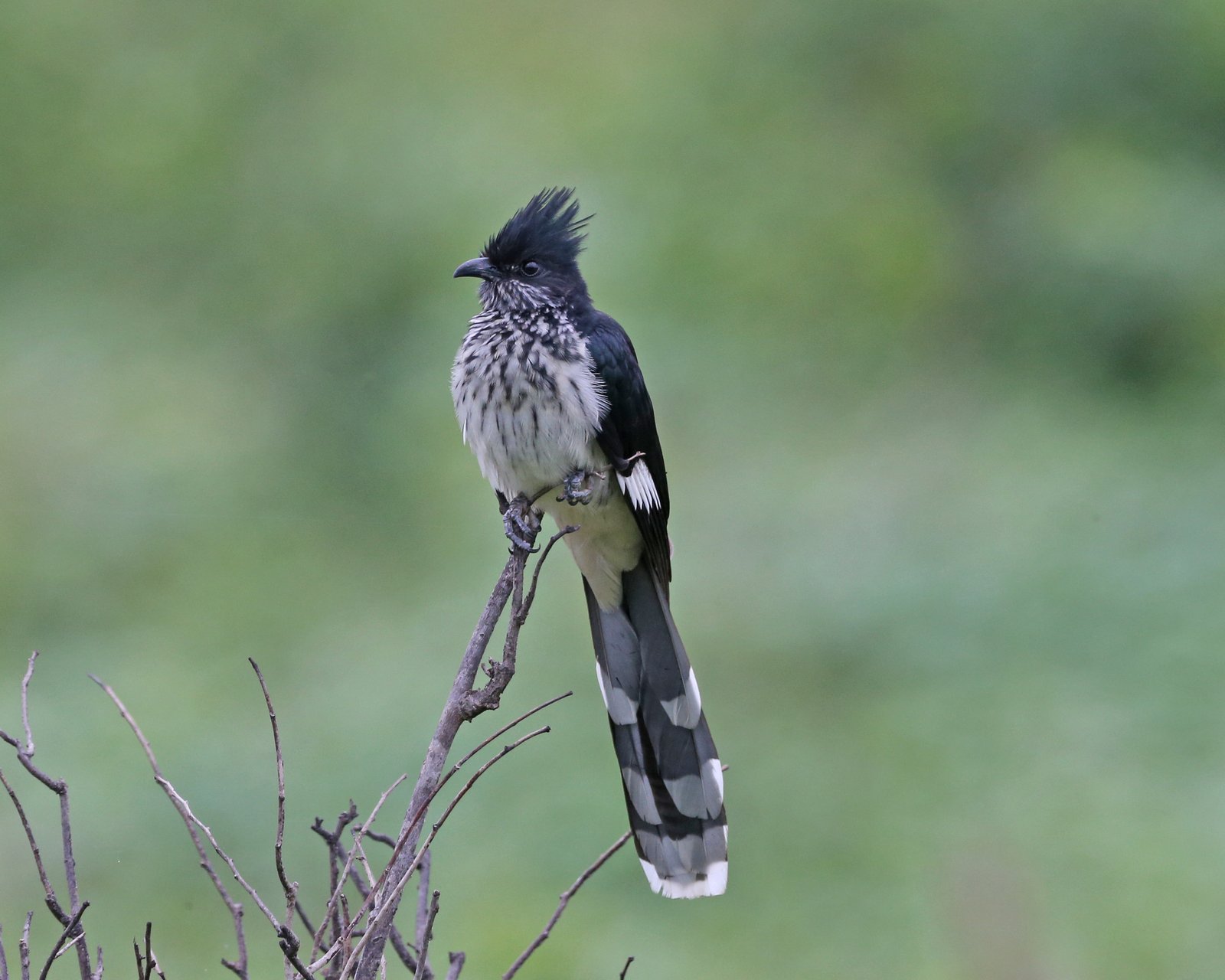
Levaillant's Cuckoo is a large, black-and-white crested cuckoo with a black-streaked throat and breast. It parasitises babblers almost exclusively, and the young cuckoo grows up in the midst of a noisy babbler group. Its persistent, rattling calls are part of summer in the bushveld of the north and east.
Voice
A loud, clear, repeated kleeuw-kleeuw-kleeuw, often followed by a long, high rattling series, kee-kee-kee-kee-kee-kee, that grows louder and faster and then stops abruptly. Calls a lot, even in the midday heat, from a high branch or in flight.
Recording: Zsombor Károlyi — CC BY-NC-SA 4.0 · converted to mono · xeno-canto
Identification
36–40 cm, with a long, graduated tail. The upperparts are glossy black with a prominent black crest; at the base of the primaries lies a white patch, which shows as a white bar in flight, and the tail feathers have broad white tips. The underparts are white with dense black streaks on throat and upper breast. The bill is black and slightly curved. A rare all-black morph shows only the white wing patch. Juveniles are browner above, with a shorter crest and a buff-tinged, also streaked throat.
Confusion species
Jacobin Cuckoo Clamator jacobinus is smaller and has a pure white, unstreaked throat and breast. The dark morphs of the two species are barely separable in the field; then use size and call. Great Spotted Cuckoo Clamator glandarius has a grey crest and white spots on a grey-brown back.
Habitat
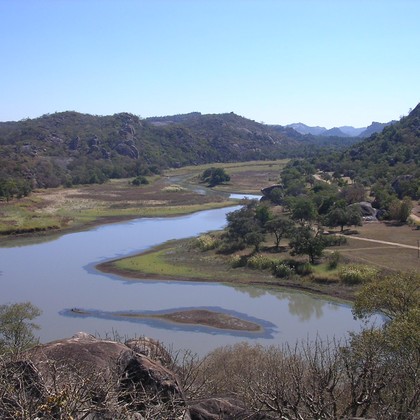
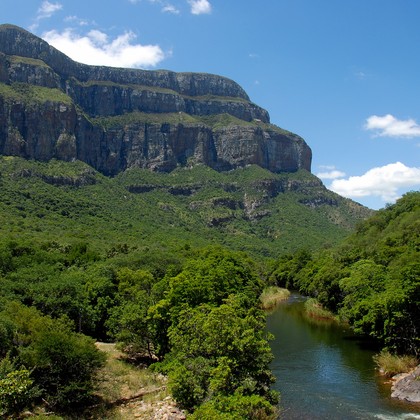
Moist mixed broadleaf woodland, miombo, dense riverine forest and rank woodland edges with plenty of scrub, also overgrown gardens and plantations with dense undergrowth; wherever Arrow-Marked Babblers Turdoides jardineii occur. It eats mainly hairy caterpillars, also grasshoppers and other large insects.
Where the bird is most at home, classified by the vegetation units of southern Africa.

Range and movements
In the north and east of the region: Angola, Zambia, Malawi, Mozambique and Zimbabwe, northern Botswana and Namibia (Okavango, Chobe, Zambezi Region), and in South Africa mainly in Limpopo, Mpumalanga and KwaZulu-Natal, with smaller numbers in Gauteng, North West and Eswatini. After breeding it moves north. Beyond the region it is widespread in much of sub-Saharan Africa, from Senegal to Ethiopia.
- Summer visitor (c. Oct–Mar)
- Passage (Mar–Apr, Oct–Nov)
- dark = core range, pale = thinly spread
How and when to look
November to February in the bushveld, for instance in Kruger National Park or the riverine forests of northern Botswana. Follow the chatter of a babbler group: where there are babblers, Levaillant's Cuckoo is often not far away, and a calling bird often sits in the open on a dead branch. In late summer young cuckoos can be seen being fed by babblers.
Conservation status
Not threatened and widespread over a large range. Its occurrence in the region is tied to that of babblers; where dense scrub and riverine forest are cleared, both host and parasite disappear.
Scientific name
Clamator levaillantii | (Swainson, 1829)
Swainson described the species in 1829 as Coccyzus levaillantii; because it was later moved to another genus, the author and year stand in brackets. The genus Clamator was introduced in 1829 by Kaup. Clamator is Latin for 'shouter', from clamare 'to shout'. levaillantii honours the French explorer and naturalist François Levaillant (1753–1824), who travelled in southern Africa in the 1780s. The specimen the first description was based on came from Unknown (not given in the sources).