All species › Cuckoos › Cuckoos › Jacobin Cuckoo
Jacobin Cuckoo | Clamator jacobinus
Jacobijnkoekoek | Críalo Blanquinegro
The Jacobin Cuckoo is a medium-sized, black-and-white crested cuckoo and in much of the region one of the first heralds of summer. It parasitises mainly bulbuls and so turns up even in gardens and parks. Besides the usual pied morph, an all-black morph occurs in the south and east.

Colour forms

Voice
A loud, clear, metallic kleeuw or klee-klee-kleeuw, repeated several times, and a fast, high rattling kee-kee-kee-kee during chases. Calls mainly in the first weeks after arrival, often in flight.
Recording: Uku Paal — CC BY-NC-SA 4.0 · converted to mono · xeno-canto
Identification
31–34 cm, with a long, graduated tail. The pale morph is glossy black above with a black, pointed crest, a narrow white patch at the base of the primaries and white tips to the tail feathers; the underparts are white to pale greyish and unstreaked. The dark morph is wholly black apart from the white wing patch. Intermediate birds with grey, faintly streaked underparts also occur. The bill is black. Juveniles are duller brownish-black above with a short crest and buff-tinged underparts. It flies fast and straight, the white wing patch showing well.
Confusion species
Levaillant's Cuckoo Clamator levaillantii is larger and has a black-streaked throat and breast. The dark morph may be confused with Black Cuckoo Cuculus clamosus, which lacks a crest and white wing patch, and with Black Cuckooshrike Campephaga flava, which is smaller, crestless and in the male has a yellow gape. Great Spotted Cuckoo Clamator glandarius has a grey crest and a white-spotted back.
Habitat
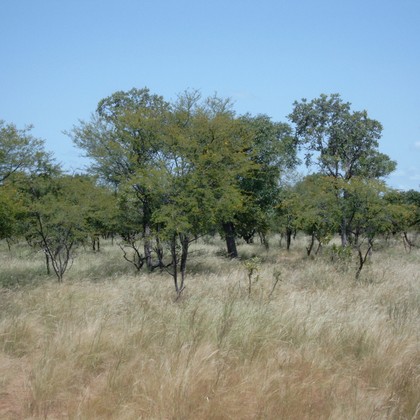
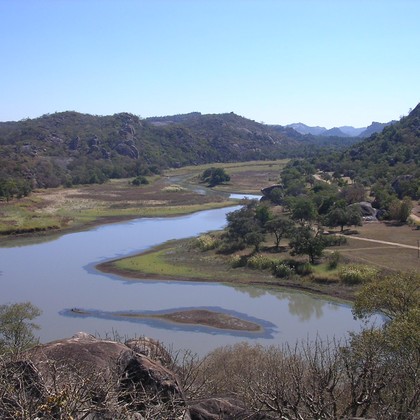
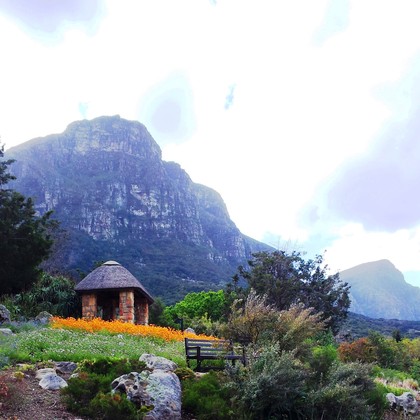
Acacia savanna, mixed woodland, riverine scrub, coastal forest edges, fynbos with tall shrubs and the edges of Karoo scrub, down to gardens, parks and orchards: wherever bulbuls breed, especially Common Bulbul Pycnonotus barbatus, Cape Bulbul Pycnonotus capensis and African Red-Eyed Bulbul Pycnonotus nigricans. It eats mainly hairy caterpillars and other insects.
Where the bird is most at home, classified by the vegetation units of southern Africa.
Range and movements
A summer visitor to almost the whole region: from Angola, Zambia, Malawi and Mozambique through Zimbabwe, Botswana and Namibia to all of South Africa, Eswatini and Lesotho, but scarce in the driest parts of the Namib and western Karoo. The dark morph is seen mainly in the eastern and southern coastal districts of South Africa. Beyond the region it is widespread in sub-Saharan Africa and in southern Asia, from Iran to Myanmar and Sri Lanka.
- Summer visitor (c. Oct–Mar)
- Passage (Mar–Apr, Oct–Nov)
- dark = core range, pale = thinly spread
How and when to look
From mid-October: in many parts of the region the first calling Jacobin Cuckoos are the sign that the summer visitors are back. In gardens and bushveld, watch for bulbuls alarming excitedly: a cuckoo is often nearby. Later in summer young cuckoos can be seen being fed by a bulbul.
Conservation status
Not threatened and widespread over a very large range in Africa and Asia. In the region it is common and benefits from the abundant bulbuls in gardens and planted greenery; there is no evidence of declines.
Scientific name
Clamator jacobinus | (Boddaert, 1783)
Boddaert described the species in 1783 as Cuculus Jacobinus; because it was later moved to another genus, the author and year stand in brackets. The genus Clamator was introduced in 1829 by Kaup. Clamator is Latin for 'shouter', from clamare 'to shout'. jacobinus refers to the Jacobins, the French Dominican friars, whose black-and-white habit resembles the black-and-white plumage. The specimen the first description was based on came from Coromandel Coast, India.