All species › Cuckoos › Cuckoos › Great Spotted Cuckoo
Great Spotted Cuckoo | Clamator glandarius
Kuifkoekoek | Críalo Europeo
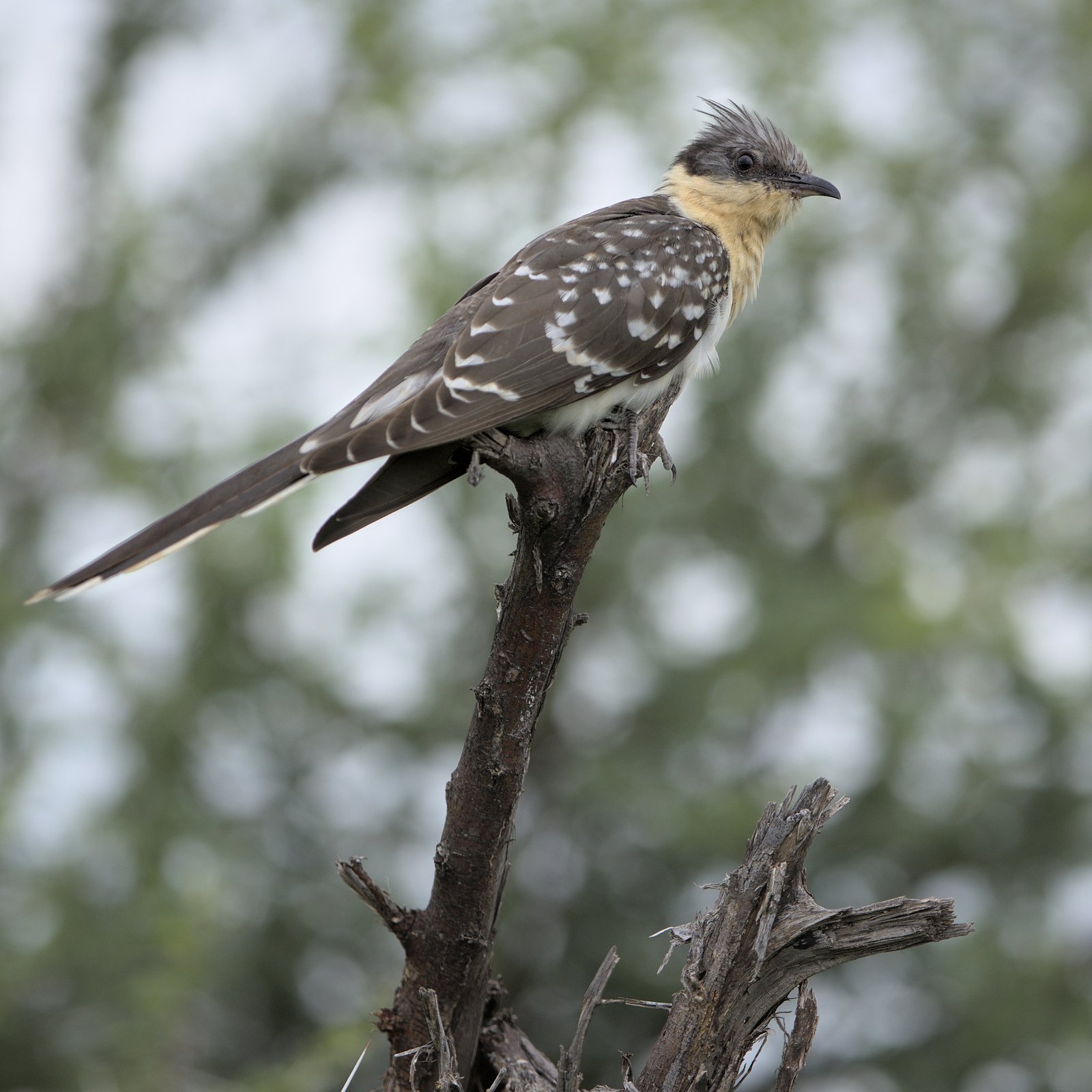
The Great Spotted Cuckoo is the largest cuckoo of the region: a long, slender bird with a grey crest, a dark back covered in white spots and a pale, creamy throat. It lays its eggs mainly in the nests of crows and starlings, whose young often grow up alongside the young cuckoos. In summer, noisy groups chasing one another are a familiar sight in the drier bushveld.
Voice
A loud, rasping, rapidly repeated kiu-kiu-kiu-kiu or kyeer-kyeer-kyeer, often in flight during chases, and a harsh rattling krrrruk. Calls mainly early in the breeding season, when groups of three to five birds noisily pursue one another.
Recording: Walter Wallner — CC BY-NC-SA 4.0 · converted to mono · xeno-canto
Identification
35–40 cm, with a long, graduated tail. Adults have a silver-grey crown with a soft backward-pointing crest, dark grey-brown back and wings with large white teardrop spots, and a dark tail with white tips to the feathers. Throat and breast are creamy yellow, the rest of the underparts white. The bill is dark and slightly curved, and there is a red to orange eye-ring. Juveniles have a black crown without an obvious crest, striking chestnut primaries and a warmer, buffy throat. It flies straight and fast on deep beats, like a small falcon.
Confusion species
Jacobin Cuckoo Clamator jacobinus and Levaillant's Cuckoo Clamator levaillantii are also crested but black and white, with a white wing patch and no white spots on the back. Juvenile Great Spotted Cuckoos with their rufous primaries and dark cap can suggest a small raptor in flight, but the long white-tipped tail and the white spots on the back are diagnostic.
Habitat
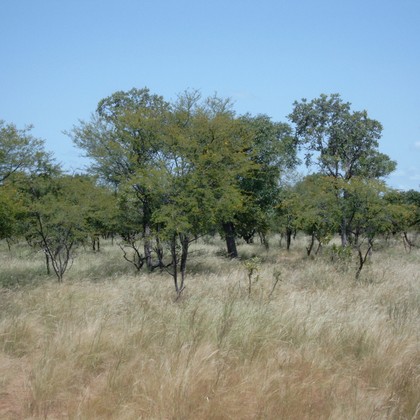
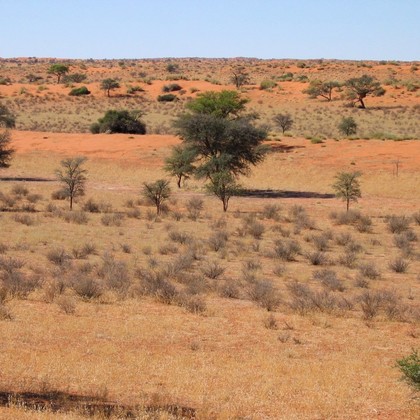
Open and semi-open acacia savanna, thornveld, Kalahari thornveld and mopane woodland, also drier farmland with scattered trees and village edges, wherever crows and starlings breed. It eats mainly hairy caterpillars, also grasshoppers and other large insects, often taken on or just above the ground.
Where the bird is most at home, classified by the vegetation units of southern Africa.

Range and movements
Widespread in the north and centre of the region: Namibia, Botswana, Zimbabwe, Zambia, Malawi, southern Angola and Mozambique, and in South Africa mainly in the north and east, the Kalahari thornveld and the Free State; scarce in Lesotho and the south-western Cape. Birds in the region belong to an African breeding population that moves north after the summer. Beyond the region the species also breeds in southern Europe, the Middle East and North Africa, with wintering birds in the Sahel and East Africa.
- Summer visitor (c. Oct–Mar)
- Passage (Mar–Apr, Oct–Nov)
- dark = core range, pale = thinly spread
How and when to look
September to December, when the birds have just returned and their crow and starling hosts begin to breed. Watch in the bushveld for crows or glossy starlings fiercely chasing a long-tailed bird: often it is a Great Spotted Cuckoo searching for a nest. Later in summer, conspicuous juveniles with rufous wings can be seen still being fed by their foster parents.
Conservation status
Not threatened and widespread over a large range in Africa, Europe and Asia. In southern Africa it may benefit from the increase of Pied Crow Corvus albus along roads and on farmland. There is no evidence of major declines in the region.
Scientific name
Clamator glandarius | (Linnaeus, 1758)
Linnaeus described the species in 1758 as Cuculus glandarius; because it was later moved to another genus, the author and year stand in brackets. The genus Clamator was introduced in 1829 by Kaup. Clamator is Latin for 'shouter', from clamare 'to shout'. glandarius is Latin for 'of acorns', the same epithet borne by the jay. The specimen the first description was based on came from Gibraltar.