All species › Swifts › Swifts › Horus Swift
Horus Swift | Apus horus
Horusgierzwaluw | Vencejo Horus
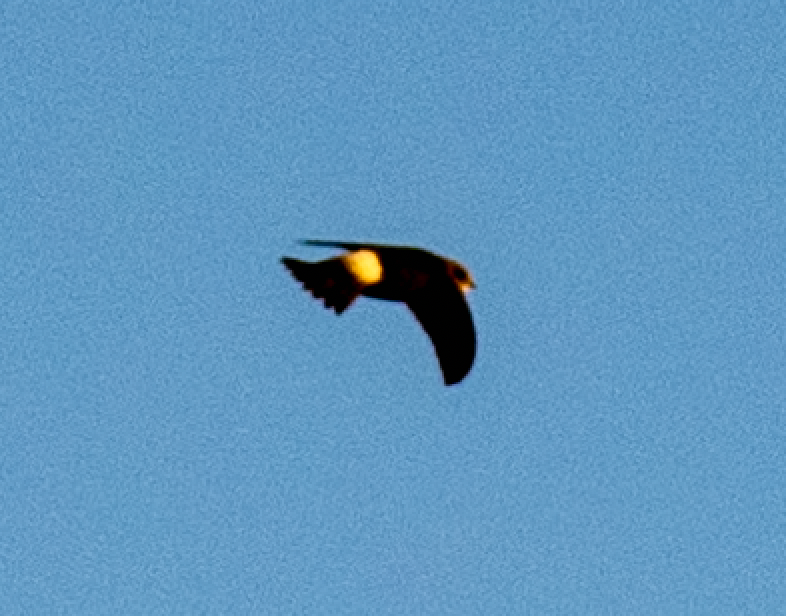
The Horus Swift is a stocky black swift with a broad white rump and a shallowly forked tail, the only swift in the region that breeds in burrows in sandy banks. It is therefore local and often tied to rivers with steep sandbanks.
Voice
A high, buzzing scream, sreeeee, and a twittering around the breeding bank, more in chorus than White-Rumped Swift but less high than Little Swift.
Recording: Bram Piot — CC BY-NC-SA 4.0 · shortened to the first 60 s, mono · xeno-canto
Identification
About 15 cm, more robust than White-Rumped Swift. Blackish brown with a large, bright white throat patch and a broad white rump band that wraps around the sides onto the flanks. The tail is moderately forked and often spread, but lacks the long spike of White-Rumped Swift. The wings are slightly broader than in that species. In the north-west of the region dark birds occur with an indistinct or no white rump. The sexes are alike.
Confusion species
White-Rumped Swift (Apus caffer) is slimmer, with a narrow white U on the rump and a long, usually closed spike tail. Little Swift (Apus affinis) has an equally broad white rump but a square tail, and breeds under eaves and bridges. Dark Horus Swifts resemble African Black Swift (Apus barbatus) or Bradfield's Swift (Apus bradfieldi) but are smaller and have a larger white throat.
Habitat
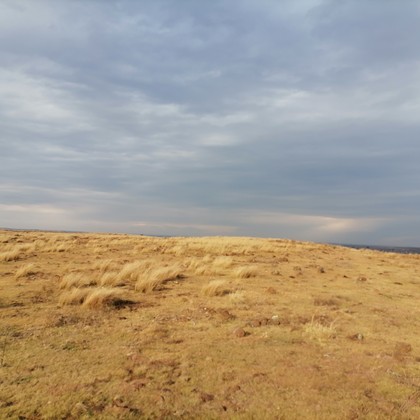
Rivers with steep sandy or loamy banks, sand and gravel pits and road cuttings, and the surrounding open grassland and woodland where it forages. It breeds colonially in existing burrows of Sand Martins, Brown-Throated Martins and bee-eaters, lined with feathers and grass.
Where the bird is most at home, classified by the vegetation units of southern Africa.

Range and movements
Local over much of the region: in South Africa mainly in the eastern provinces, the interior of the Eastern Cape, the Free State and along the Orange River, and further in Lesotho, Eswatini, Zimbabwe, Botswana, Zambia, Malawi, Mozambique and Angola. Largely a summer visitor in the south; in the north some birds are present all year. Beyond the region scattered through East Africa to Ethiopia and Sudan, and very locally in West and Central Africa.
- Resident
- Summer visitor (c. Oct–Mar)
- Winter visitor (c. Apr–Sep)
- Passage (Mar–Apr, Oct–Nov)
- dark = core range, pale = thinly spread
How and when to look
In summer, search at steep sandbanks along rivers, especially where Sand Martins or bee-eaters breed: the birds fly at speed straight into a hole. Sand pits and fresh road cuttings are also worth checking. Look for a broad white rump combined with a forked tail.
Conservation status
Not threatened, but local and dependent on suitable banks. River regulation, sand mining and the collapse of banks can eliminate colonies locally, while new sand pits sometimes provide new breeding sites.
Scientific name
Apus horus | (Heuglin, 1869)
Heuglin described the species in 1869 as Cypselus affinis var. Cypselus Horus; because it was later moved to another genus, the author and year stand in brackets. The genus Apus was introduced in 1777 by Scopoli. Apus is Latin for a swift, from Greek a- 'without' and pous 'foot', the ancients taking it for a kind of swallow without feet. horus refers to Horus, the falcon-headed Egyptian sky god — fitting for a species described from north-eastern Africa. The specimen the first description was based on came from north-eastern Africa (not specified).